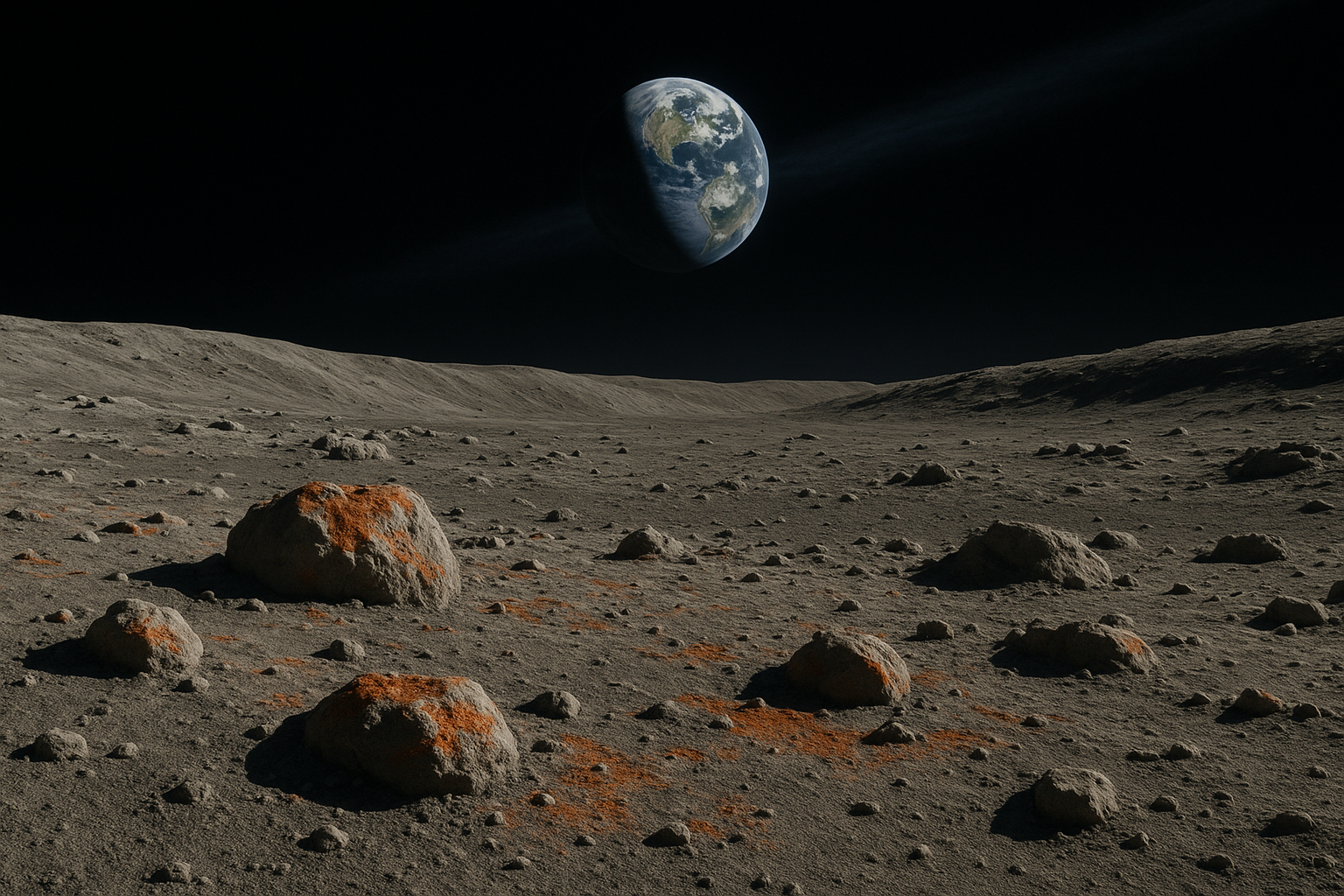
Rust on an airless, water-scarce world sounds impossible, yet that’s exactly what scientists are finding on the Moon. The surprising culprit isn’t lunar moisture, but oxygen that escapes from Earth’s upper atmosphere and rides a stream of particles known as the Earth Wind all the way to the lunar surface.
The mystery began in 2020 when India’s Chandrayaan-1 orbiter detected hematite near the Moon’s poles. Hematite is a reddish form of iron oxide (Fe2O3) typically linked to rust on Earth, where it forms in the presence of oxygen and water. Finding it on a dry, nearly airless Moon left researchers puzzled.
A study published on September 2, 2025, in Geophysical Research Letters offers experimental evidence that points back to our own planet. For roughly five days each month, when Earth sits between the Sun and the Moon, our planet shields the Moon from the solar wind. During this window, ions of oxygen, hydrogen, and nitrogen can escape Earth’s upper atmosphere and stream down the planet’s elongated magnetic tail toward the Moon. These particles settle into the lunar soil and spark chemical reactions.
Laboratory experiments led by Ziliang Jin at the Macau University of Science and Technology show that Earth-sourced oxygen ions promote the formation of hematite on lunar-like materials, while hydrogen can partially reverse that oxidation. The balance of these particles during the monthly Earth Wind window appears to favor rust formation in certain regions, especially near the poles where hematite was spotted.
Why it matters:
– It reveals a deeper Earth–Moon connection. The Moon isn’t just a passive partner; it preserves a long-term record of Earth’s atmospheric escape.
– It reframes how scientists think about lunar surface chemistry and the role of our planet’s magnetotail in shaping it.
– It guides future exploration. Upcoming missions aimed at returning polar samples containing hematite could confirm whether the oxygen’s isotopic fingerprint traces back to Earth.
If verified, this Earth-driven rusting would reshape our understanding of the Earth–Moon system, turning the Moon into a geological archive of our planet’s atmospheric history—and offering a new lens on how planetary bodies interact across space.