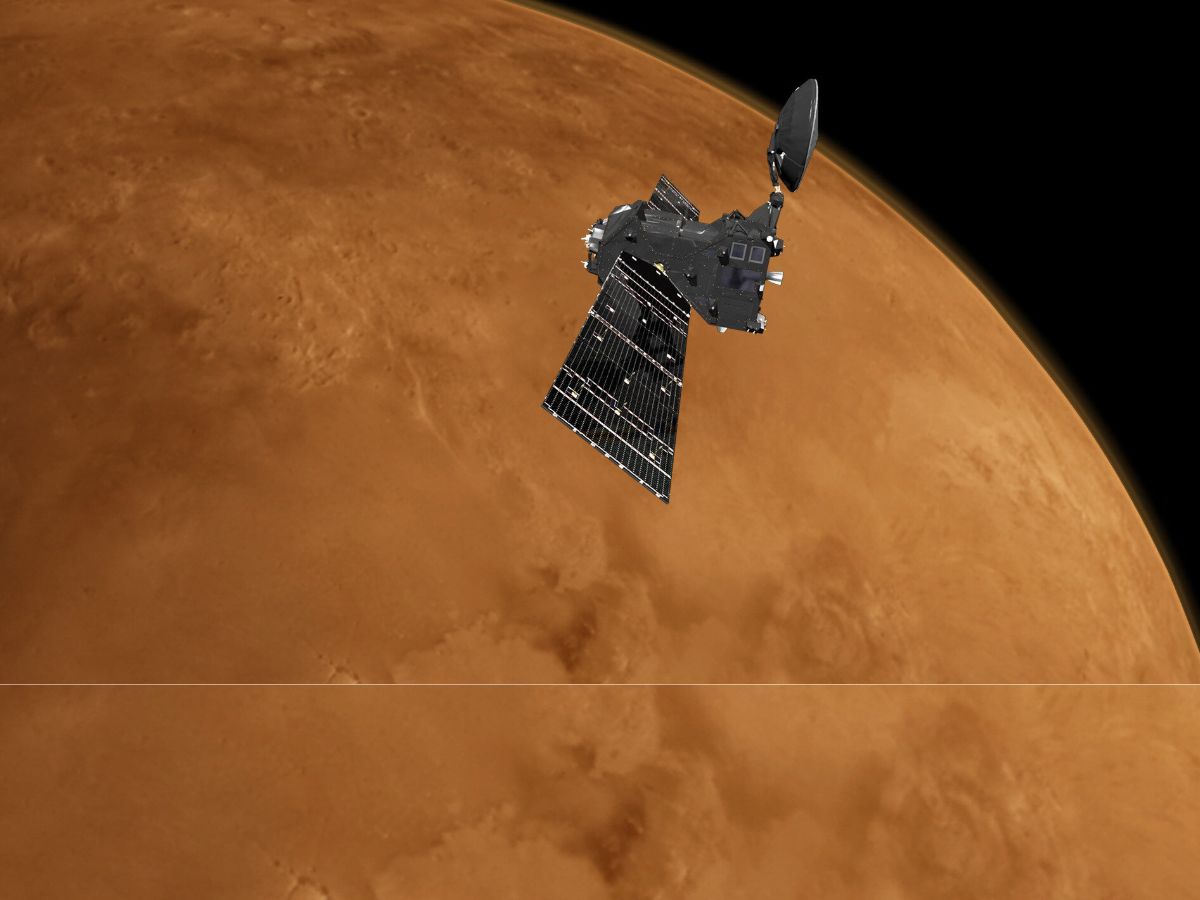
A solar storm happens when the Sun suddenly unleashes a powerful burst of energy and charged particles into space. These outbursts can arrive as solar flares, coronal mass ejections (CMEs), and streams of high-energy particles that race across the solar system. In May 2024, the Sun delivered its strongest solar storm in more than two decades, lighting up Earth’s skies with dramatic auroras. But the real scientific spectacle was happening millions of miles away at Mars.
Unlike Earth, Mars doesn’t have a strong global magnetic field to shield its atmosphere. That difference makes the Red Planet far more exposed when space weather turns intense. During the May 2024 event, incoming solar particles slammed into the Martian atmosphere and directly heated it, energizing the upper layers in a way that’s difficult to observe during calmer solar conditions.
Scientists were in the perfect position to watch it unfold because two missions were already orbiting Mars: Mars Express and the ExoMars Trace Gas Orbiter. As the storm arrived, charged particles collided with atoms in the Martian atmosphere and knocked electrons loose. This electron-stripping process, known as ionization, rapidly increased the number of electrically charged particles in Mars’ ionosphere, the region of the atmosphere shaped by solar radiation and particle impacts.
To measure what was happening in near real time, researchers used a technique called radio occultation. Mars Express transmitted radio signals that were received by the ExoMars Trace Gas Orbiter, allowing scientists to detect changes in the atmosphere by analyzing how the signals were altered as they passed through different layers. Remarkably, this observation was carried out only about ten minutes after the solar flare reached Mars, capturing immediate atmospheric effects from a major space weather event.
The findings were also supported by observations from NASA’s MAVEN mission, which is dedicated to studying Mars’ upper atmosphere and how it interacts with the Sun. Together, these measurements provide a clearer picture of how extreme solar storms can supercharge the Martian ionosphere and heat the atmosphere when there’s little magnetic protection.
Understanding how Mars reacts to intense solar activity isn’t just an academic win. It’s essential for planning future Mars missions, especially for spacecraft operations and eventual human exploration. Better knowledge of solar storm impacts helps improve space weather prediction, refine mission safety strategies, and anticipate how the Martian environment can rapidly change when the Sun becomes unusually active.


