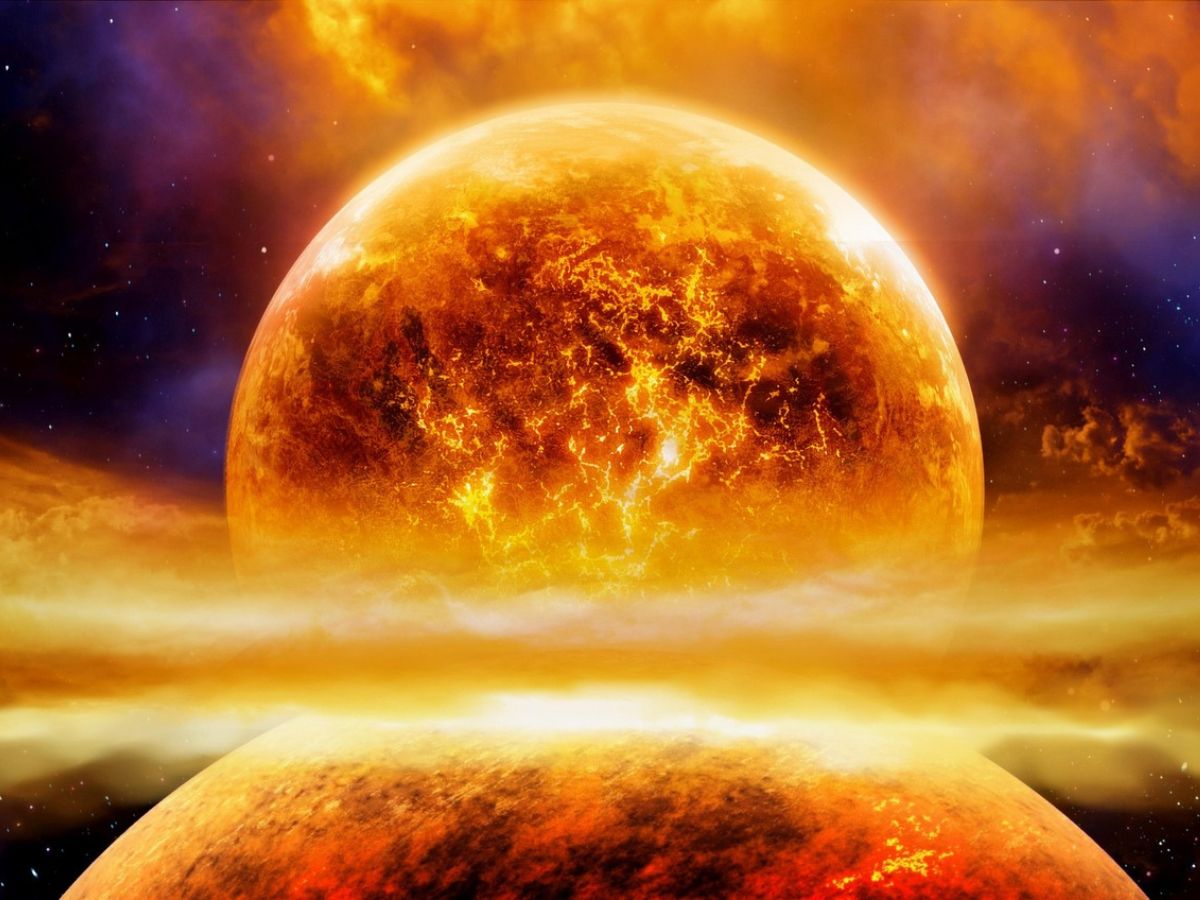
The Moon wasn’t always Earth’s faithful companion. Around 4.45 billion years ago, a Mars-sized protoplanet known as Theia is believed to have slammed into the young Earth. The colossal impact hurled vast amounts of debris into space, which eventually coalesced over millions of years to form the Moon—a scenario widely known as the giant impact hypothesis.
While the Moon’s origin story has become increasingly clear, Theia’s past has remained far more mysterious. For years, scientists proposed competing ideas about where this rogue world came from. Some speculated it might have formed far from the Sun, or even outside our solar system, before crossing paths with Earth. Others suspected a more local origin. Now, new research offers a compelling clue.
A recent study published in Science points to a birthplace much closer to home. By carefully comparing the chemical fingerprints of lunar rocks with those of Earth’s crust and mantle, researchers found striking similarities. In particular, they analyzed iron isotopes—subtle variations of the same element preserved in meteorites, Moon samples, and terrestrial rocks. These isotopic patterns act like a cosmic signature, revealing where in the early solar system a body likely formed. The results suggest Theia’s composition aligns with material from the inner solar system, closer to the Sun and, crucially, not far from Earth.
If Theia indeed formed nearby, it helps explain why the Earth and Moon share so many chemical traits. It also strengthens the idea that both worlds were built from similar ingredients orbiting the young Sun in the same neighborhood. That tighter connection offers a more elegant solution to long-standing puzzles about the Moon’s makeup and the aftermath of the giant impact.
Still, the story is far from complete. Pinning down Theia’s exact origin is notoriously difficult. Planetary formation is a chaotic process, and much of the evidence has been reshaped by billions of years of geological activity on Earth and the Moon. The available samples, while invaluable, represent just a fraction of the material that could help answer lingering questions. Further studies—combining fresh lunar samples, meteorite analyses, and advanced computer simulations of early planetary dynamics—will be essential to refine the picture.
For now, the latest findings tilt the scales toward a simple but powerful idea: Theia was likely born in the inner solar system, formed from the same primordial disk of dust and rock that gave rise to Earth. That proximity would make the giant impact not just a dramatic chapter in our planet’s past, but a natural outcome of worlds growing up side by side in a crowded, turbulent early solar system.
Key takeaways:
– The Moon likely formed after a massive collision between early Earth and a Mars-sized body called Theia about 4.45 billion years ago.
– New isotopic evidence from iron in lunar, terrestrial, and meteorite samples suggests Theia formed in the inner solar system, close to the Sun and near Earth.
– The findings support the giant impact hypothesis and help explain the close chemical kinship between Earth and the Moon.
– Theia’s exact birthplace and path remain uncertain, and more research is needed to uncover the full story of our lunar neighbor’s violent beginnings.


