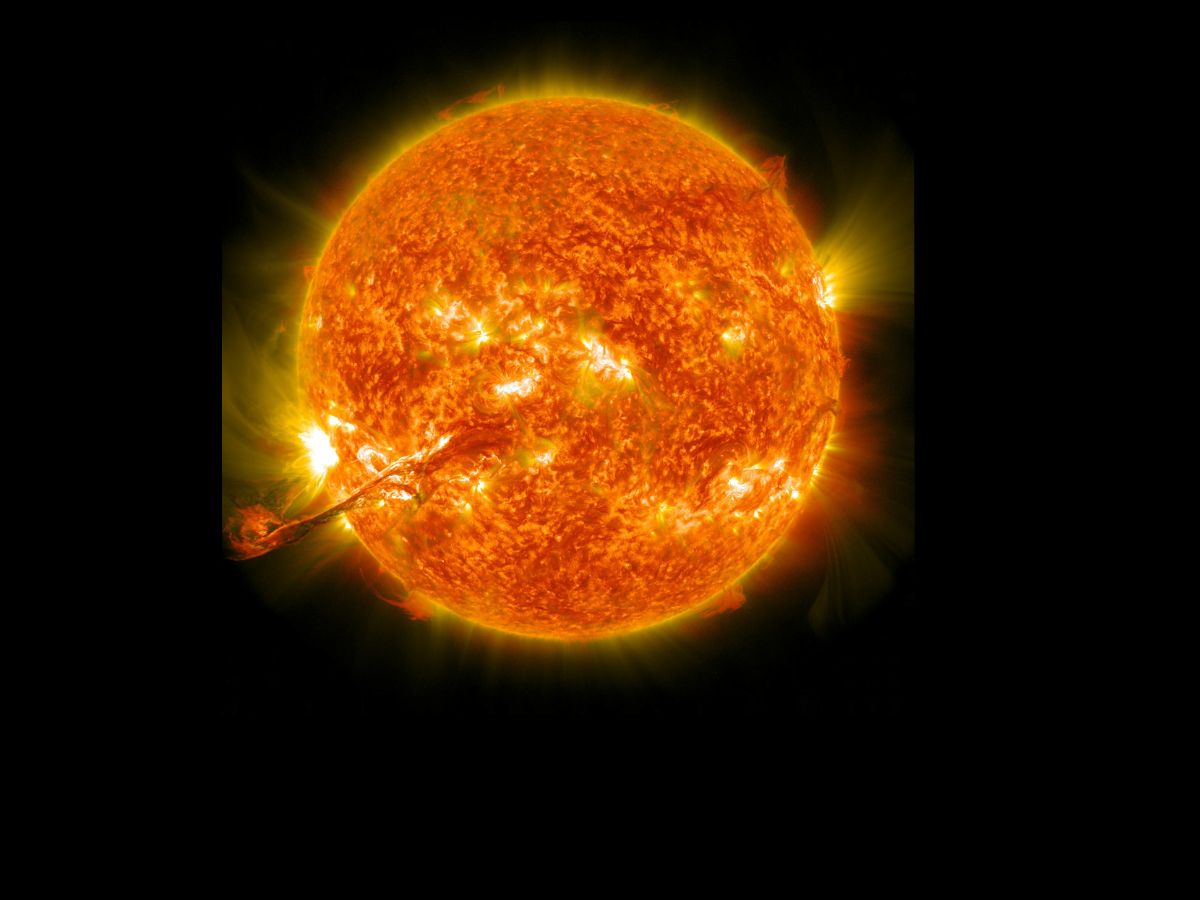
The Sun follows a repeating rhythm known as the solar cycle, a pattern that rises and falls about every 11 years. During the solar maximum, the Sun is at its busiest, marked by frequent sunspots and powerful solar flares. During the solar minimum, that visible activity fades, magnetic fields weaken, and the Sun appears calmer from the outside.
For a long time, many researchers assumed that when the Sun reached these quiet solar minimum phases, its interior stayed essentially the same—just a less active version of normal. New findings suggest that idea doesn’t hold up.
By using the Birmingham Solar-Oscillation Network (BiSON), scientists were able to monitor the Sun continuously, collecting precise measurements of solar vibrations. BiSON’s round-the-clock observations provided a rare long-term view of how the Sun behaves, not just on the surface, but deep within its structure.
What made this research especially valuable is its time span. The team analyzed 40 years of data, covering four separate solar minimum periods between solar cycles 21 and 25. With such a long record, they could compare one minimum to another and see whether “quiet” Suns are truly identical internally—or if each minimum has its own signature.
To look inside the Sun, scientists relied on helioseismology, a method that studies vibrations created by sound waves trapped within the Sun. These waves cause subtle motions on the Sun’s surface that can be measured from Earth. By analyzing those vibrations, researchers can infer internal conditions such as temperature, pressure, and density—essentially turning the Sun’s surface oscillations into a map of what’s happening underneath.
One key clue came from a feature known as the helium ionization glitch. At extreme temperatures inside the Sun, helium atoms become ionized, and that transition creates tiny disruptions in the sound waves traveling through the solar interior. Tracking changes in this “glitch” helps scientists detect structural shifts that would otherwise be invisible.
Among the four solar minima examined, one stood out sharply: the 2008–2009 solar minimum between solar cycles 23 and 24. This period is already known for being unusually deep and long, with exceptionally low solar activity. But the new research shows something even more surprising—its internal conditions were noticeably different from the other minima in the dataset. In other words, the Sun wasn’t just quieter on the outside; it also appeared to be behaving differently on the inside.
This discovery matters well beyond curiosity about how the Sun works. Understanding hidden structural changes during solar minimum could improve how scientists interpret stellar magnetic activity, refine predictions of upcoming solar cycles, and strengthen space weather forecasting. That’s important because space weather driven by solar behavior can affect Earth’s satellites, communications, navigation systems, and even power grids.
The takeaway is simple but powerful: even when the Sun looks calm, its interior may be shifting in ways we’re only beginning to detect—and those subtle changes could help us better anticipate what the Sun will do next.