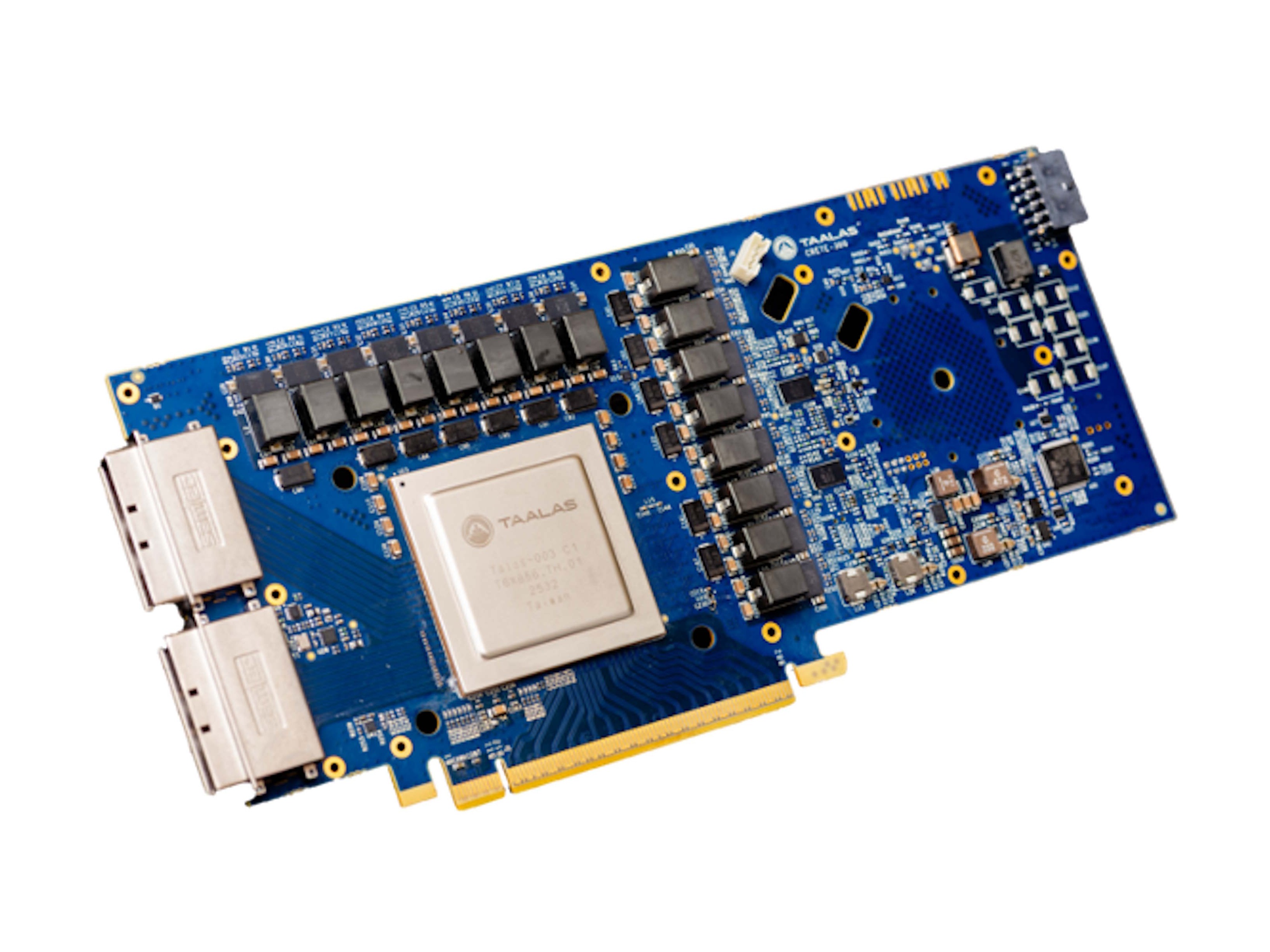
A new kind of AI chip is arriving, and it’s built around a simple idea: if you design hardware to do one job exceptionally well, it can outperform “do-everything” processors by a huge margin. That approach isn’t new—crypto mining went through the same evolution when specialized ASIC miners replaced general-purpose CPUs and GPUs. Now, a similar shift is starting to show up in local AI acceleration.
The latest example is the Talaas HC1, a highly specialized processor created to accelerate one specific AI model rather than serving as a broad, general-purpose AI engine. Instead of trying to run every neural network under the sun, the HC1 is engineered around Llama 3.1 8B, a relatively compact large language model that’s popular for local inference and on-device AI use cases. While the chip is purpose-built, Talaas says it still allows some degree of fine-tuning, giving it a bit more flexibility than a completely locked, single-function accelerator.
What makes the HC1 attention-grabbing are the performance claims. Talaas reports the HC1 can reach 16,960 tokens per second on Llama 3.1 8B. For comparison, the company cites 353 tokens per second for an Nvidia B200 under the same model-focused scenario. Talaas also positions the HC1 against other dedicated AI hardware, claiming it delivers about 10 times the performance of the Cerebras WSE-3 while using less power, and at a cost that could be roughly 20 times lower.
If those numbers hold up in real-world deployments, the HC1 highlights a growing trend in AI hardware: maximum efficiency comes from shrinking the target. By removing architectural overhead meant to support many different data types, edge cases, and varied workloads, specialized accelerators can dedicate more silicon to exactly what a single model needs. That can translate into faster inference, better throughput, and lower energy use—key advantages for businesses trying to run AI locally without massive power bills or expensive data center hardware.
For now, there’s one big missing piece: the company hasn’t announced pricing or availability yet. Still, the Talaas HC1 is a strong signal of where parts of the AI market may be heading next—toward model-specific chips designed to deliver extreme local AI performance at far lower cost and power than traditional GPU-based solutions.