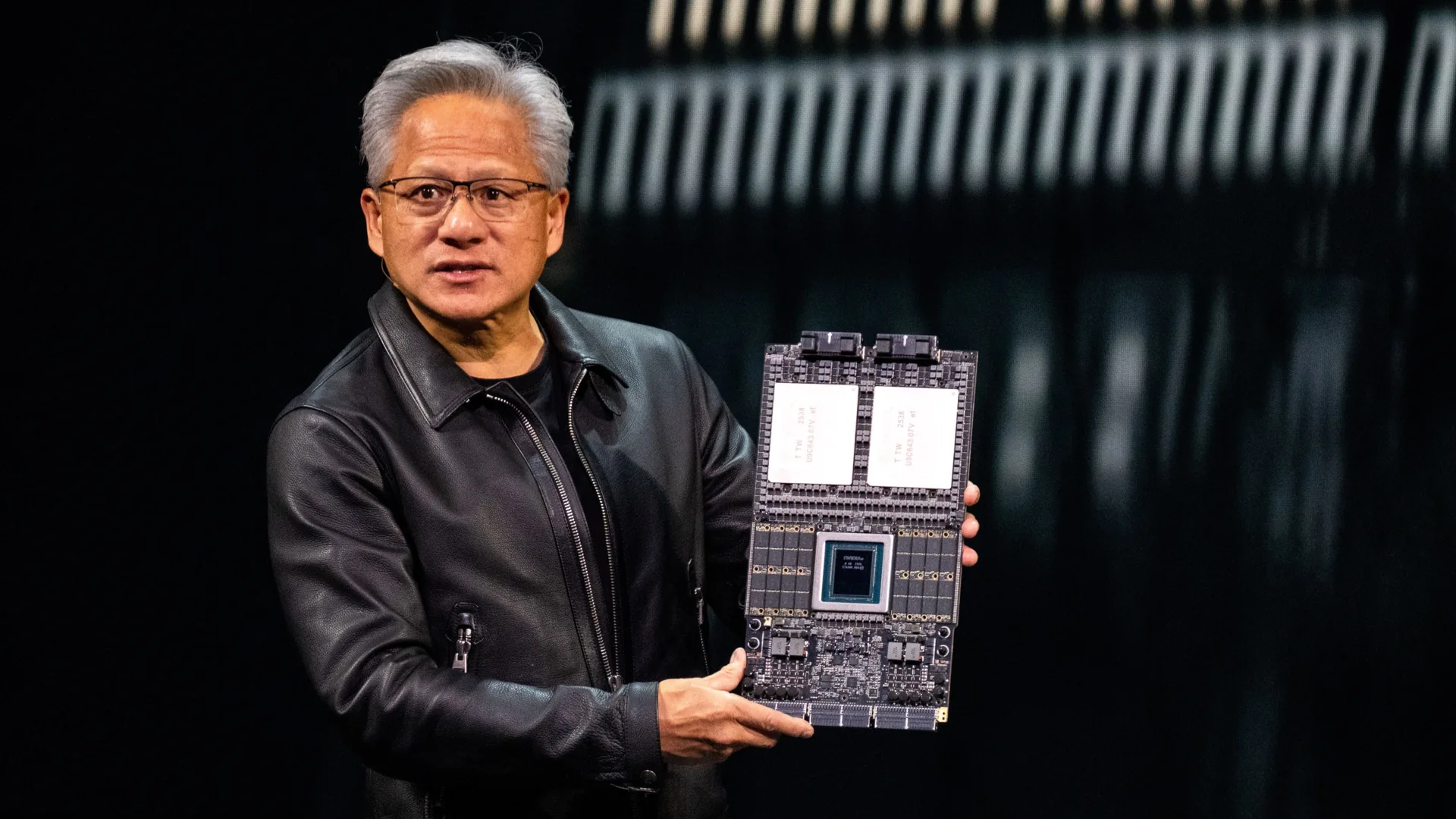
NVIDIA’s next big AI move may revolve around Groq’s LPU hardware, and the company is finally starting to tease what that could look like. During NVIDIA’s Q4 FY2026 earnings call, CEO Jensen Huang was asked directly about Groq and its low-latency “decoder” strengths. Rather than laying out the full roadmap right away, he suggested that NVIDIA will share more at GTC—and hinted that Groq will be used to expand NVIDIA’s overall platform in a way that echoes one of its most important past deals.
According to Huang, NVIDIA plans to “extend” its architecture with Groq as an accelerator, comparing the approach to how NVIDIA integrated Mellanox years ago. That comparison matters. Mellanox helped NVIDIA solve critical data center networking challenges and became foundational to high-performance scaling strategies. If Groq is being positioned in a similar role, it signals that NVIDIA views ultra-low-latency inference as the next major bottleneck to solve at the platform level, not just with faster GPUs.
Why latency matters so much right now comes down to how AI is being used. Training remains crucial, and NVIDIA has been dominant there with platforms like Hopper and Blackwell. But the inference phase—where models respond to users and applications in real time—has taken center stage as AI shifts into agentic workflows. In systems where multiple AI agents collaborate, reason, and act in sequences, response time becomes a defining feature. Even small delays can stack up quickly, turning latency into a serious limiter for compute providers and enterprises building real-time AI products.
Inference is often described in two major stages: prefill and decode. Prefill processes the initial prompt and context; decode is where the system generates tokens step by step, which is especially important for interactive and multi-agent scenarios. In agentic AI, decode performance can make the difference between an assistant that feels instant and one that feels sluggish. The expectation in the industry is that AI applications are moving toward “swarms” of agents that depend on one another, making fast decoding even more valuable.
NVIDIA appears to be addressing these stages with a split strategy. The company’s newer architectures already emphasize prefill acceleration with specialized engines and high-throughput compute features. Decoding, however, is where Groq’s LPU approach could come in. LPUs are optimized for extremely low-latency execution and use large amounts of on-die SRAM, enabling massive internal bandwidth—often described in the range of tens of terabytes per second. SRAM-heavy designs have been gaining traction across the AI hardware landscape because they can reduce memory bottlenecks that slow down token-by-token generation.
So how could NVIDIA actually deploy Groq LPUs within its data center offerings? One leading idea is rack-scale integration. In this scenario, NVIDIA could build hybrid compute systems that combine GPUs and LPUs in the same rack-level platform, with LPUs handling decode-heavy workloads while GPUs tackle prefill and other compute-intensive phases. Industry chatter has even suggested NVIDIA might reveal a dedicated LPU-focused rack configuration at GTC, potentially packing a very large number of LPU units into a single deployment footprint.
In a hybrid rack design, the interconnect becomes key. LPU-to-LPU communication would need to be fast and predictable, while GPU-to-LPU links would need to handle heavy data movement, including potential offload of key-value (KV) cache data that can grow large in real-world inference. If NVIDIA treats Groq integration like it treated Mellanox—making it a core part of the platform rather than a standalone add-on—then the company will likely focus on tightly engineered system-level performance, not just raw chip specs.
Another possibility being discussed is deeper integration, such as combining LPU-like functionality more directly with future GPUs using advanced packaging methods. But near-term, rack-scale hybrid systems appear more practical, faster to deploy, and easier to scale across data centers that are already built around NVIDIA infrastructure.
Stepping back, the strategic message is clear: NVIDIA wants to cement its leadership not only in training, but also in latency-sensitive inference—especially as AI shifts from single-model chat to agentic systems that must respond instantly and coordinate complex tasks. Huang also noted on the earnings call that compute growth and revenue growth are now tracking closely, suggesting real demand is being pulled by the application layer evolving rapidly.
All signs point to NVIDIA using GTC to explain how Groq LPUs fit into its future AI stack—and whether the company can set a new standard for low-latency inference performance at scale.