BYD is moving fast to make ultra-rapid EV charging easier to use in the real world, not just impressive on a spec sheet. After unveiling its new megawatt charging system built around a 1000V electric vehicle architecture—paired with high-performance motors and the promise of adding hundreds of miles of range in minutes—the company is now preparing a major rollout of upgraded charging piles designed for everyday convenience.
The scale alone is attention-grabbing. BYD plans to build 4,000 megawatt-capable charging units itself and has also secured partnerships for another 15,000. If deployed as intended, this would become one of the largest megawatt-level EV charging infrastructures anywhere, signaling a serious push to make 1 MW charging feel mainstream rather than experimental.
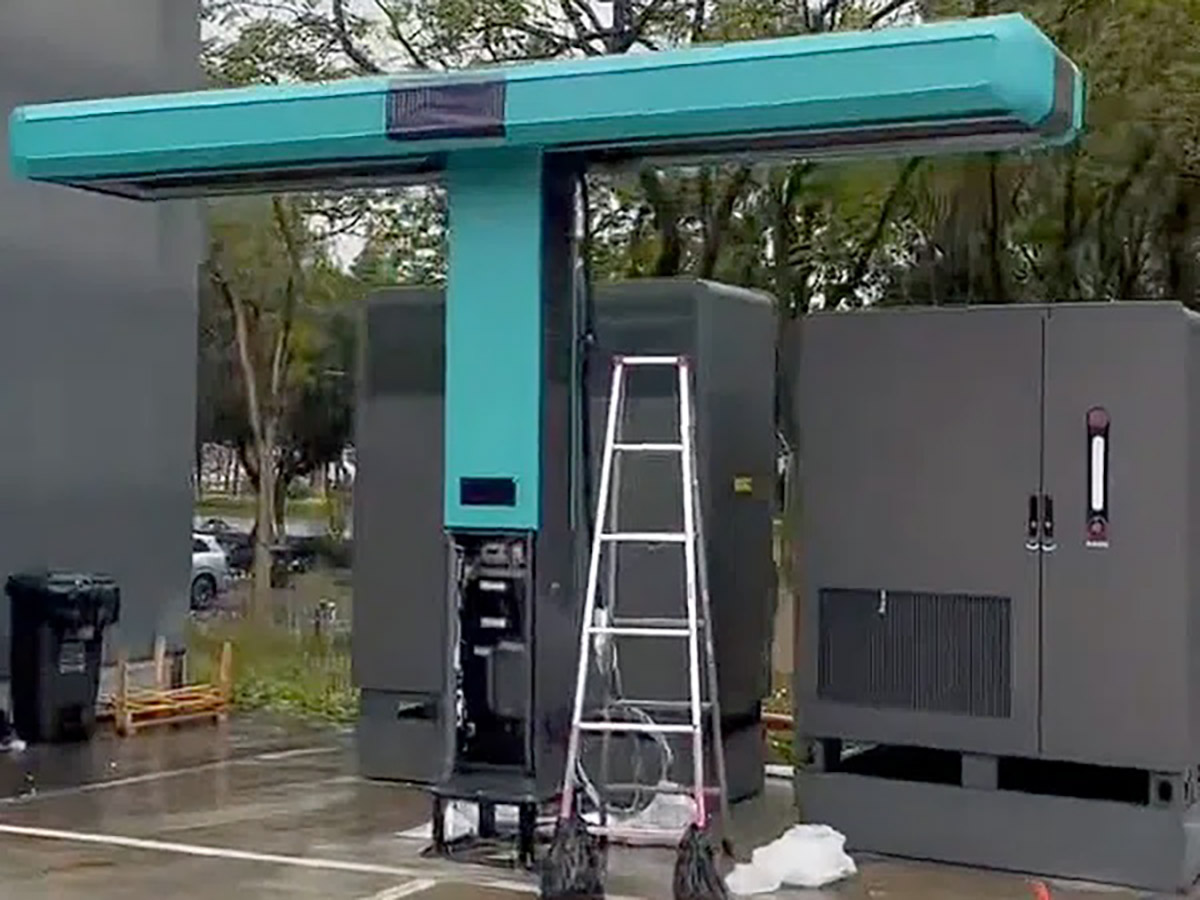
What makes BYD’s latest charging hardware especially interesting is the physical design. Instead of a fixed stall layout where drivers may need to back in, pull forward, or awkwardly stretch a cable depending on where the charge port sits, BYD’s new piles use a T-shaped structure with two heavy charging cables suspended from an overhead pulley system. By hanging the cables, the design reduces the burden of handling thick, high-power charging lines, which are typically stiff and cumbersome. The cable length is also tuned to stay off the ground—helping keep connectors cleaner—while still reaching charge ports located in different positions on different vehicles.
Performance is where the numbers turn heads. BYD says the system can deliver peak output up to 1360 kW. The two charging guns can also work in parallel, enabling charging speeds that go beyond what most mass-market EV drivers have experienced. In practical terms, BYD is positioning this as the kind of setup that can add more than a mile of driving range per second and deliver around 200 miles of additional range in roughly five minutes, assuming the vehicle can fully take advantage of the power.
BYD is also addressing a key challenge that comes with megawatt EV charging: grid demand. Because it’s a major battery manufacturer as well as an EV brand, BYD is pairing these liquid-cooled charging piles with an energy storage and release system that includes supercapacitors. The goal is to store cheaper electricity during off-peak hours and release it during peak charging demand, helping reduce strain on the grid while potentially improving charging consistency when lots of vehicles plug in at once.
The broader megawatt charging race is heating up across the industry. Other major players are pursuing their own high-power charging plans, including truck-focused megawatt networks with peaks in the 1.2 MW range. But for everyday passenger EV charging, much of today’s widely deployed infrastructure still tops out far lower, and only a limited set of vehicles can take full advantage of the newest high-voltage architectures. BYD’s strategy appears to be tackling both sides of the equation at once: vehicles designed for extreme charging speeds, plus charging stations built to make those speeds easy to access no matter where the charge port is located.
If BYD follows through with tens of thousands of deployments, megawatt charging could quickly shift from a headline feature to a practical advantage—turning the “charging takes too long” complaint into something that feels increasingly outdated for compatible EVs.