Resident Evil Requiem arrives tomorrow, and PC gamers are already eager to see how it performs on everything from budget builds to today’s fastest gaming PCs. While the official recommended requirements are surprisingly modest, citing GPUs like the GeForce RTX 2060 or Radeon RX 6600 paired with older CPUs such as the Intel Core i7-8700 or AMD Ryzen 5 5500, many players are running far newer hardware. That has naturally sparked one big question: how high can the frame rate go with a top-tier CPU and GPU combination?
Fresh benchmark results from PC Games Hardware give an early look at how modern processors stack up in Resident Evil Requiem, especially for players chasing the highest possible FPS. The testing compares a range of current and previous generation chips from both AMD and Intel, including what are widely considered their flagship gaming options: the AMD Ryzen 7 9850X3D and the Intel Core i9-14900KS.
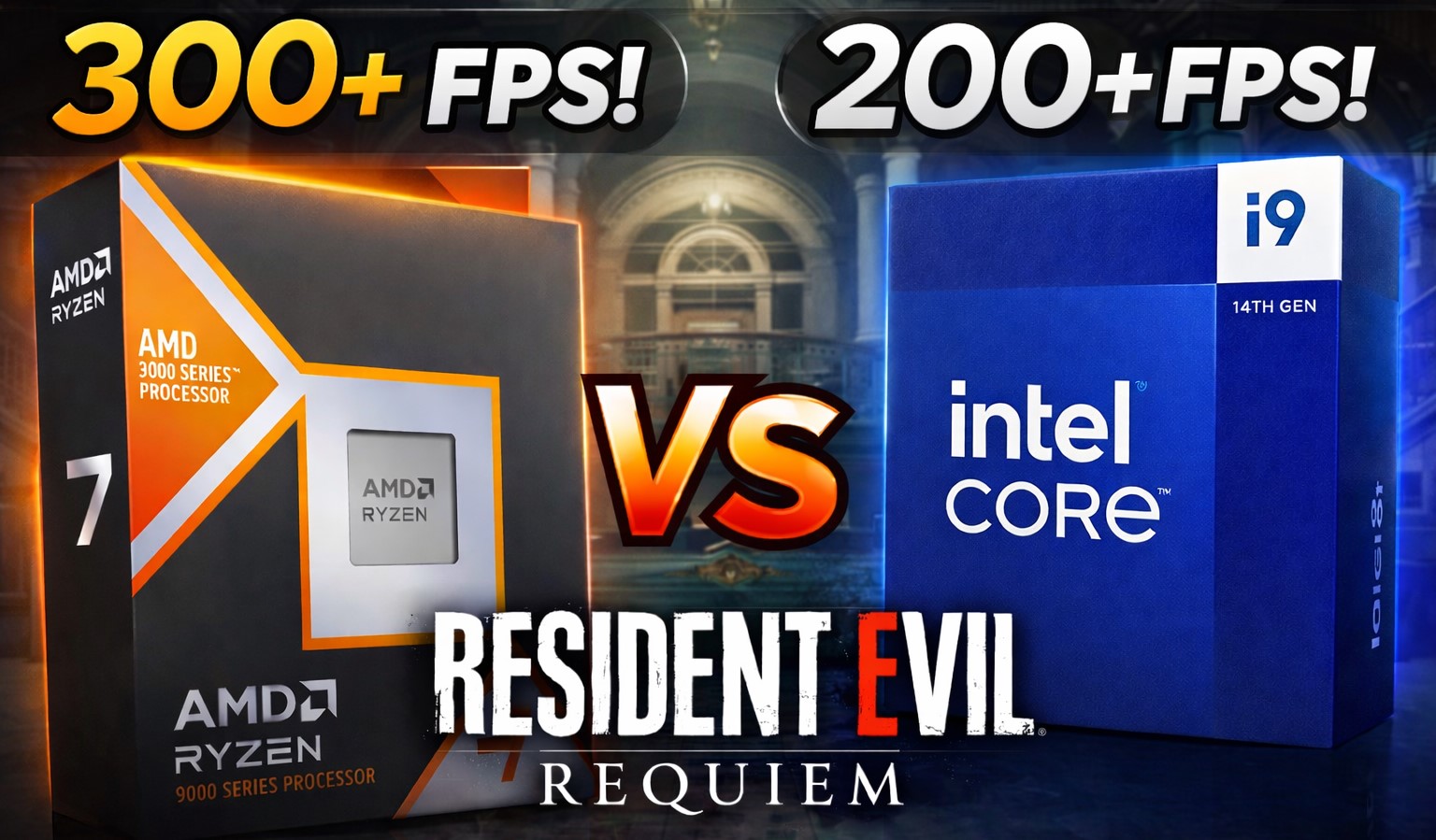
In a 1080p benchmark designed to highlight CPU performance (using a GeForce RTX 5090 and DDR5 memory running at 5600 MT/s), the Ryzen 7 9850X3D takes the top spot for average frame rate. According to the results, it can push Resident Evil Requiem beyond 300 FPS and finishes more than 100 FPS ahead of the Core i9-14900KS. That’s a massive lead in raw averages, showing just how dominant AMD’s X3D cache-focused CPUs can be in scenarios where the game is heavily CPU-limited.
However, average FPS isn’t the whole story, especially for gamers who care more about smoothness than peak numbers. When looking at 1% low FPS (a key metric that reflects dips and stutter during heavier moments), Intel narrows the gap. Even though the Core i9-14900KS trails significantly in average frame rate, it holds up better in percentile performance than the headline FPS difference might suggest.
It’s also worth noting that memory settings can influence CPU results. With DDR5 at 5600 MT/s, AMD’s lead is clear, but higher memory overclocks can sometimes help Intel processors claw back some performance in certain games. Whether that would meaningfully reduce the gap here isn’t confirmed from these results, but it’s a factor enthusiasts will consider when tuning their systems.
Across the broader charts, Ryzen X3D chips remain at the front of the pack, particularly the Ryzen 7 9850X3D, Ryzen 9 9950X3D, and Ryzen 7 7800X3D. And while ray tracing results tend to reduce the performance separation between AMD and Intel CPUs, the Ryzen 7000X3D and 9000X3D family still comes out on top overall in these early tests.
For anyone planning a new build specifically for high-FPS gaming in Resident Evil Requiem, these numbers reinforce a familiar trend: AMD’s X3D processors continue to deliver exceptional average frame rates, while Intel remains competitive in the smoother “lows” that can impact real-world feel during gameplay.