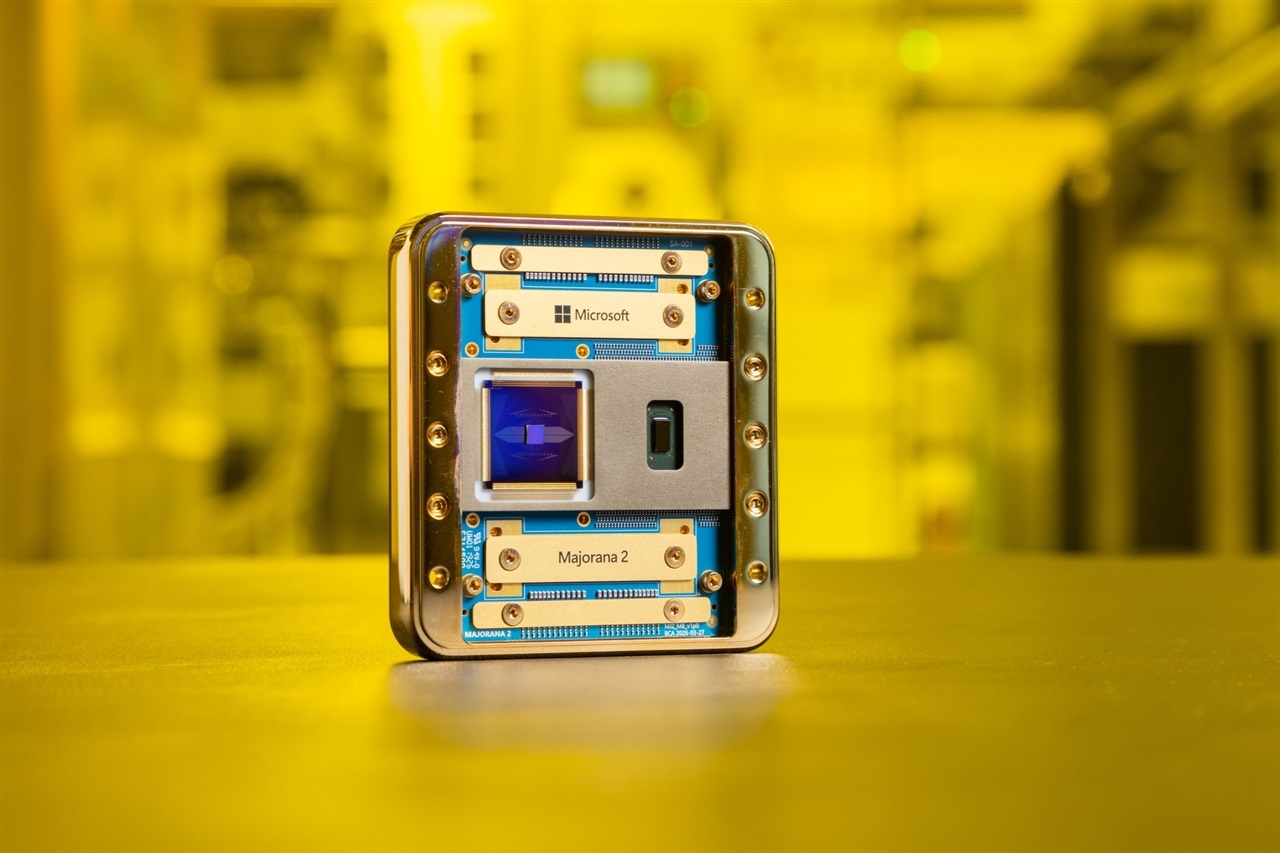
Microsoft Majorana 2 Quantum Chip Signals a Bigger Push Into Topological Quantum Computing
Microsoft has introduced Majorana 2, its newest quantum computing chip, marking the next step in the company’s long-term effort to build more reliable and scalable quantum machines. Revealed on June 2, 2026, Majorana 2 follows the earlier Majorana 1 chip, which was announced on February 19, 2025.
The new chip continues Microsoft’s focus on a distinctive quantum computing strategy built around Majorana-based technology. While many companies in the quantum race are working with superconducting qubits, trapped ions, or photonic systems, Microsoft has spent years pursuing topological qubits, a design that could theoretically make quantum computers more stable and less vulnerable to errors.
That stability is one of the biggest challenges in quantum computing. Today’s quantum systems are extremely sensitive to noise, temperature changes, and environmental interference. Even tiny disruptions can cause qubits to lose their information, limiting how long calculations can run and how useful current machines can be. Microsoft’s approach aims to solve this problem at the hardware level by creating qubits that are naturally more protected from errors.
Majorana 2 is important because it shows Microsoft is not backing away from that ambitious path. Instead, the company appears to be doubling down on its belief that topological quantum computing could eventually unlock practical quantum systems capable of solving problems beyond the reach of classical supercomputers.
The Majorana name refers to Majorana particles, unusual theoretical particles that have fascinated physicists for decades. In quantum computing, Microsoft’s research centers on creating and controlling Majorana-based states in special materials. If successful, these states could form the foundation of topological qubits, which may require fewer error-correction resources than other quantum designs.
That possibility is what makes Majorana 2 so interesting to researchers, investors, and the broader technology industry. A more fault-tolerant qubit could dramatically accelerate the development of useful quantum computers. Such machines may one day help with advanced chemistry simulations, drug discovery, materials science, optimization problems, cryptography research, and artificial intelligence workloads.
However, Microsoft’s quantum roadmap also comes with scientific debate. The company’s Majorana-based strategy is considered one of the more challenging approaches in the field. Demonstrating that Majorana states can be reliably created, measured, and used for computation remains a difficult task. Because of that, Majorana 2 is likely to attract both excitement and careful scrutiny from the quantum research community.
The launch also arrives at a time when competition in quantum computing is intensifying. Major technology companies, startups, universities, and government-backed labs are all racing to improve qubit quality, reduce error rates, and scale systems beyond experimental demonstrations. Each new chip announcement is closely watched because it may indicate which hardware approach is moving closer to real-world usefulness.
For Microsoft, Majorana 2 is more than just another chip release. It is a signal that the company sees topological quantum computing as a core part of its future. Rather than chasing short-term milestones alone, Microsoft is working toward a longer-term architecture that could make large-scale quantum computing more practical if the underlying science continues to progress.
The biggest question now is how Majorana 2 performs and what it proves experimentally. If the chip delivers stronger evidence that Microsoft’s design can scale, it could strengthen confidence in the company’s quantum strategy. If challenges remain, the chip will still provide valuable data for one of the most closely watched efforts in quantum hardware development.
Quantum computing is still in an early stage, and no company has yet delivered a broadly useful, fault-tolerant quantum computer. But announcements like Majorana 2 show how quickly the field is evolving. Microsoft’s latest chip adds another important chapter to the race, combining bold engineering goals with some of the most complex physics in modern computing.
Majorana 2 may not make quantum computers mainstream overnight, but it highlights the direction Microsoft wants to take: fewer errors, more stable qubits, and a pathway toward machines that could eventually transform science, industry, and computing itself.


