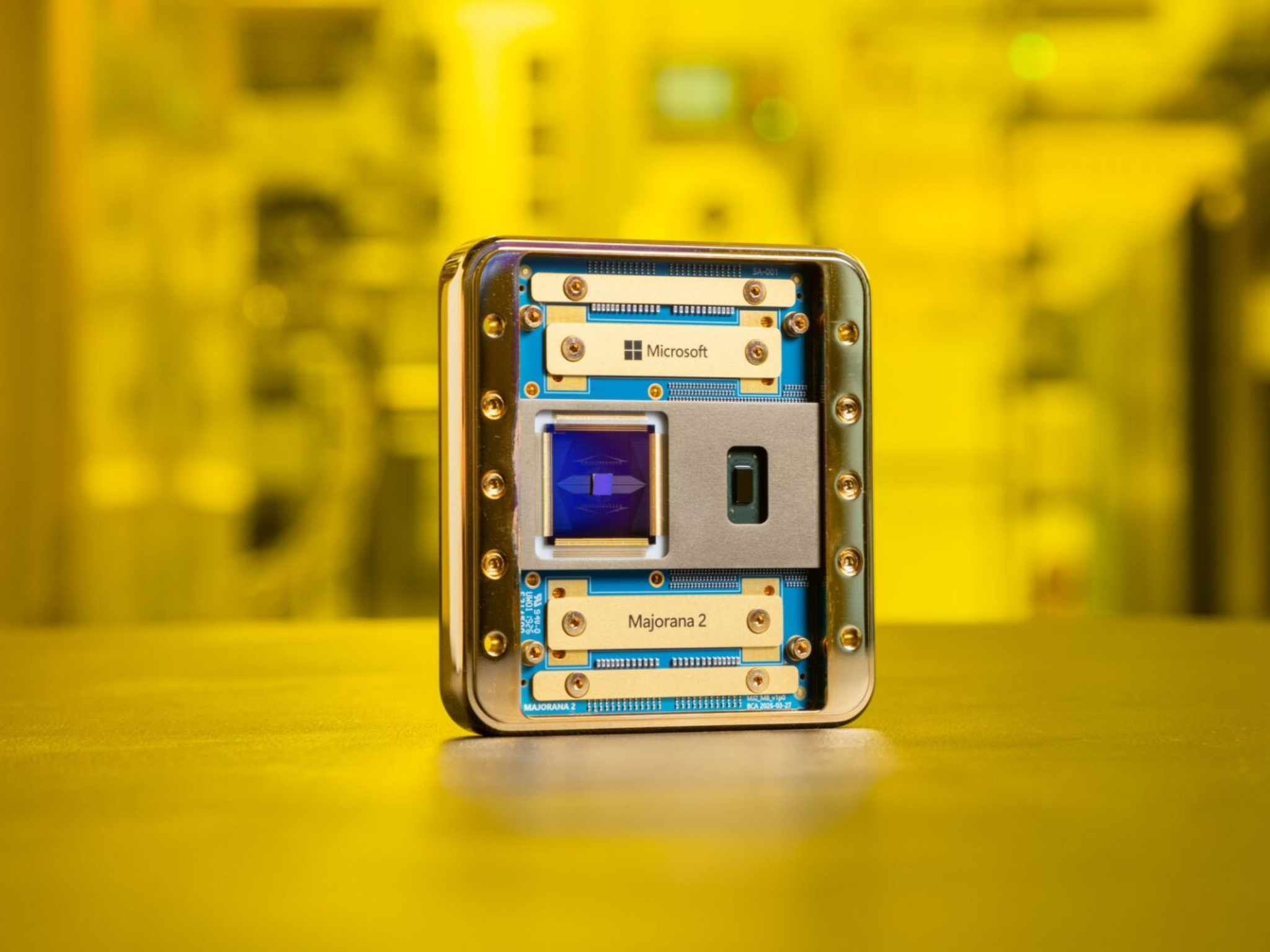
Microsoft Majorana 2 Quantum Chip Could Bring Useful Quantum Computing Closer by 2029
Microsoft has introduced Majorana 2, a new version of its topological quantum computing chip, and the company believes it could mark a major step toward building a commercially useful quantum computer by 2029.
The biggest claim behind Majorana 2 is reliability. Microsoft says the chip’s qubits can hold their quantum state far longer than many conventional quantum systems. According to the company, Majorana 2 delivers an average qubit lifetime of around 20 seconds, with some cases reaching up to a full minute. That is a significant jump in a field where qubit stability is often measured in microseconds.
This matters because qubits are the foundation of quantum computing. A traditional computer bit can represent either 0 or 1. A qubit, however, can exist in multiple states at once, giving quantum computers the potential to process certain types of problems far more efficiently than classical machines. The issue is that qubits are extremely sensitive. Heat, vibration, electrical noise, and other environmental interference can cause them to lose their quantum state almost instantly.
Microsoft’s approach focuses on topological qubits, which are designed to be more resistant to errors. If Majorana 2 performs as claimed, it could help overcome one of the biggest barriers standing between today’s experimental quantum hardware and future machines capable of solving real-world problems.
The company says Majorana 2 is not just more stable, but also fast and compact. Its qubits are said to operate at microsecond speeds while remaining small enough to support large-scale quantum systems in the future. That combination of durability, speed, and scalability is crucial if quantum computers are ever going to move beyond laboratory demonstrations.
However, this does not mean everyday devices are about to change overnight. Majorana 2 will not make smartphones, laptops, or gaming PCs faster in the near future. Instead, it is part of a much longer journey toward quantum computers that could tackle problems too complex for even the most powerful supercomputers available today.
If successful, Microsoft’s quantum computing roadmap could eventually impact industries such as medicine, clean energy, materials science, logistics, agriculture, and climate research. Practical quantum computers may help researchers discover new drugs, design better batteries, create advanced materials, improve supply chains, and model complex chemical or biological systems with greater accuracy.
The announcement also comes at a time when Microsoft’s topological quantum computing work remains under close scientific attention. In the past, some researchers questioned earlier claims related to Microsoft’s Majorana-based approach, arguing that more evidence was needed to support the existence and control of the Majorana particles central to the design. With Majorana 2, Microsoft is aiming to show that its long-term bet on topological quantum computing is moving forward.
Alongside the new chip, Microsoft also announced the broader availability of Microsoft Discovery, an AI-powered research platform designed to support scientific work. The platform is intended to help researchers analyze data, automate measurements, improve fabrication processes, detect hidden faults, and speed up discovery across advanced research fields.
Majorana 2 is not a consumer product, and it is not a finished quantum computer. But it could be an important building block. If Microsoft’s reliability claims hold up under wider testing and validation, the chip may bring the tech industry a step closer to the long-promised era of useful quantum computing by the end of the decade.