Imagine a packed Subway on a Tuesday lunch rush. A tray of avocados has been out for six hours, and there’s only a short window left before they turn brown, get thrown away, and become another quiet line item in food waste. In most stores, the manager would need to notice the clock, tell the team to upsell avocado sandwiches, and hope the message sticks while everyone is swamped.
Now swap that stress for automation. A small device running in the background tracks timing and conditions, and the moment the system sees the avocados have less than two hours of shelf life left, it updates the in-store digital menu instantly. “Avocado Specials — Today Only” takes over the screen. Other items get temporarily hidden or marked unavailable to focus demand where it matters. No manager reminders. No last-minute scrambling. Less waste.
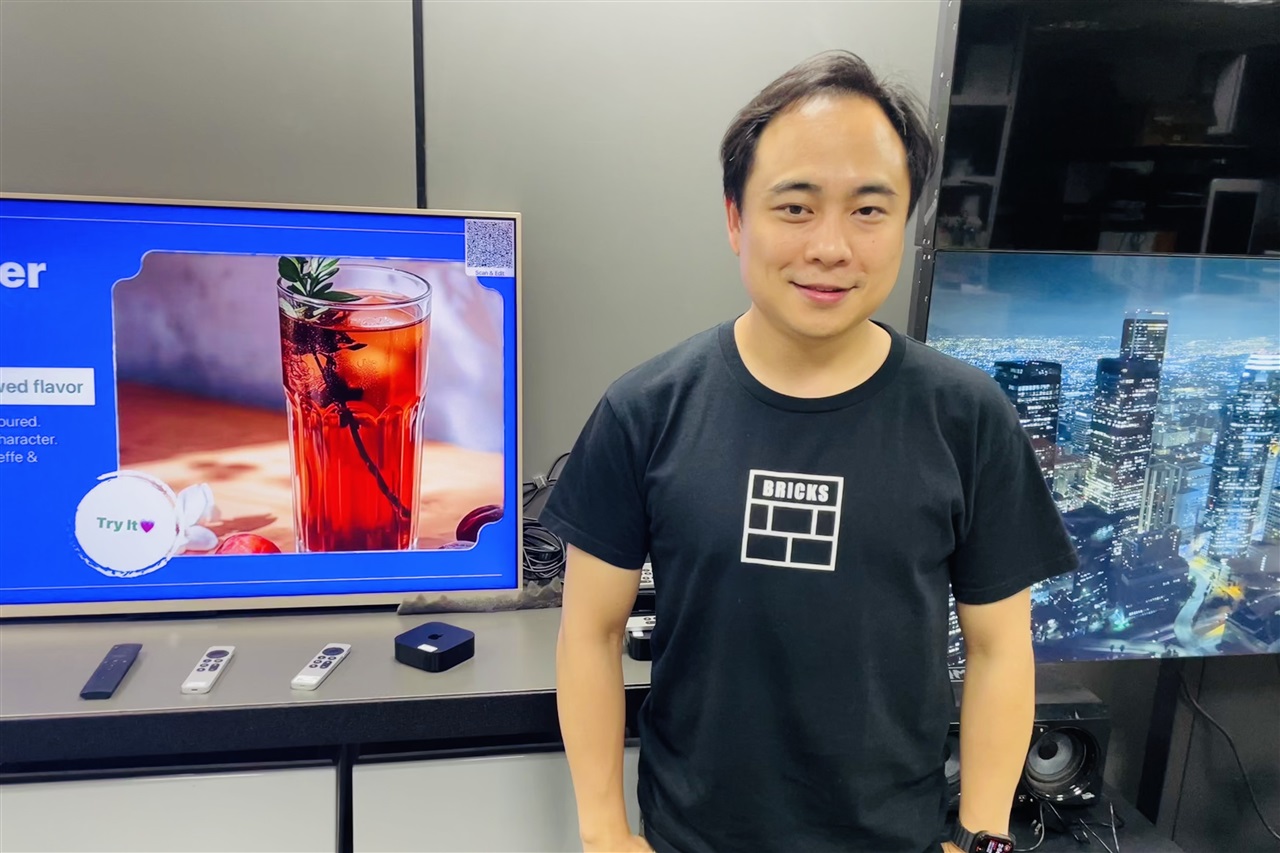
That avocado scenario is a simple example of what BRICKS, a Taipei-based startup, is built to do. And according to its founder, Pepper Yen, it’s only scratching the surface.
BRICKS is often mistaken for a company that makes digital signage software or smart menu boards. Pepper pushes back on that framing right away. In his view, BRICKS isn’t an app company at all. It’s building an operating system.
That difference is important. Apps handle single tasks. An operating system becomes the foundation that many different solutions can run on, across industries and devices. BRICKS is aiming to provide that foundation for a world where AI agents are the primary “users” of software, making decisions and carrying them out in real environments. Instead of a person tapping buttons, an AI agent determines what should happen next, then needs a dependable layer that can execute those actions safely on actual hardware.
That’s where BRICKS’ Agentic OS comes in. It’s designed to connect on-device AI inference with hardware controls and real-world actions. The same engine that can change a menu promotion based on food freshness can also handle tasks like lowering a security shutter, tuning air conditioning, or triggering customer notifications, all without waiting for a human to issue a command.
The timing is not accidental. Chipmakers are rapidly pushing edge AI hardware forward, shipping processors with neural engines that can run compact language models directly on the device. The promise is fast, private AI that doesn’t need to send everything to the cloud.
But there’s a major obstacle between powerful chips and usable products: software.
Open-source AI models evolve at a speed that chip vendor toolkits can’t always match. A model released this week might take months before it’s fully supported through official hardware acceleration paths. For companies trying to build solutions on edge devices, that gap is painful: the silicon is ready, but the software path to running the latest models smoothly often isn’t.
BRICKS positions itself as the bridge between the two. Pepper describes the mission in practical terms: make it possible for the newest models to run on partner hardware quickly, without developers having to wrestle with low-level NPU complexity. By abstracting driver details and providing a stable runtime, BRICKS aims to shorten the time it takes for hardware makers and solution providers to ship new AI capabilities, cutting cycles that can otherwise drag on for months.
Interestingly, BRICKS didn’t begin as a deep infrastructure company. It started in late 2019 as a wedding entertainment platform called MyBigDay, built around interactive games for receptions. Guests could play through LINE while the experience synced to a big display at the venue. With a team of five, the business reached more than NT$3 million in monthly revenue.
Then the pandemic hit. Taiwan’s weddings were cancelled, and revenue dropped to zero overnight.
The company was forced into a hard reset. When Pepper and the team looked at what they truly owned, they realized the core wasn’t weddings or games. It was screen control technology. They rebuilt around that strength and started meeting potential customers across sectors. Food and beverage stood out immediately, especially restaurant groups dealing with labor shortages and constantly changing menus. BRICKS launched a sub-brand for the restaurant market and has since expanded to serve more than 300 restaurant brands across Taiwan.
A second shift happened as generative AI became impossible to ignore. BRICKS’ technical edge wasn’t just commercial traction or customer relationships. The company’s CTO is known for contributions to key open-source tools that help run language models efficiently on edge hardware. That combination, real-world deployments plus deep talent in model optimization, helped BRICKS see a bigger opportunity: not just controlling screens, but building the execution layer that lets AI move from “thinking” to “doing” in physical environments.
Breaking into hardware ecosystems is notoriously difficult, especially where OEM relationships are built over decades. BRICKS found an opening through an innovation competition in Taiwan that gave it access to advanced edge AI chips and development resources. The company used that access to build live demos that helped open doors to hardware partners and system integrators.
That early momentum led to broader partnerships. BRICKS now works across multiple chip ecosystems and provides a reference software foundation for certain device manufacturers, essentially giving them a baseline stack that already includes a working AI runtime. When a platform becomes part of the default software that ships with hardware, distribution scales naturally with device volume, and developers can build on top without reinventing the basics.
BRICKS’ business model has matured alongside that shift. It began with project-based work, then moved into subscription software for restaurant and food service use cases, and is now expanding further into royalty licensing as hardware partnerships deepen. In Taiwan, a major point-of-sale hardware manufacturer contributes significant revenue through a white-label arrangement that runs BRICKS technology under the hood. Internationally, the platform has also been used in cloud-based deployments where stores can launch quickly using off-the-shelf consumer devices, making rollout simpler for multi-country operations.
The company is also developing a larger collaboration with a major global digital signage content management provider, working on next-generation OS capabilities. If that partnership grows, it could place BRICKS’ technology in reach of a massive installed base of commercial displays worldwide, without requiring the company to build an enormous direct sales organization market by market.
To move faster, BRICKS is raising a $3 million seed round. The team is currently small, around 10 people split between Taiwan and the US, operating remotely. The biggest cost is talent: engineers who are comfortable working across AI model optimization, NPU drivers, and execution reliability. That intersection is rare, and it’s expensive.
Pepper argues that raising this kind of capital is better matched to Silicon Valley than to Taiwan’s venture environment. Infrastructure and platform businesses often take longer to show their full compounding value, and they need investors comfortable with that time horizon. He also points to fundraising mechanics that can better fit early-stage deep tech, allowing the company to build without forcing a premature price-setting round. As part of that push, Pepper plans to spend several months in the Bay Area focusing on investor conversations and enterprise partnerships.
Even Pepper’s name reflects the way he approaches focus and momentum. Many assume “Pepper” is a wordplay nickname tied to his surname. The real origin is more personal: he spent early childhood in the US and became so attached to Dr. Pepper that he stopped responding to his given name. Call him normally, nothing. Say “Dr. Pepper,” and he’d come running. The nickname stuck when he returned to Taiwan.
It’s a small story, but it fits the broader theme. When something genuinely captures his attention, he moves toward it decisively.
Right now, that focus is the Agentic OS: an operating system designed for AI agents operating in the physical world, where decisions need to translate into real actions across devices, screens, and hardware endpoints. If BRICKS succeeds, the “avocado special” won’t just be a clever menu trick. It will be a glimpse of how stores, restaurants, and other real-world businesses can run with less waste, less friction, and far more automation powered by on-device AI.