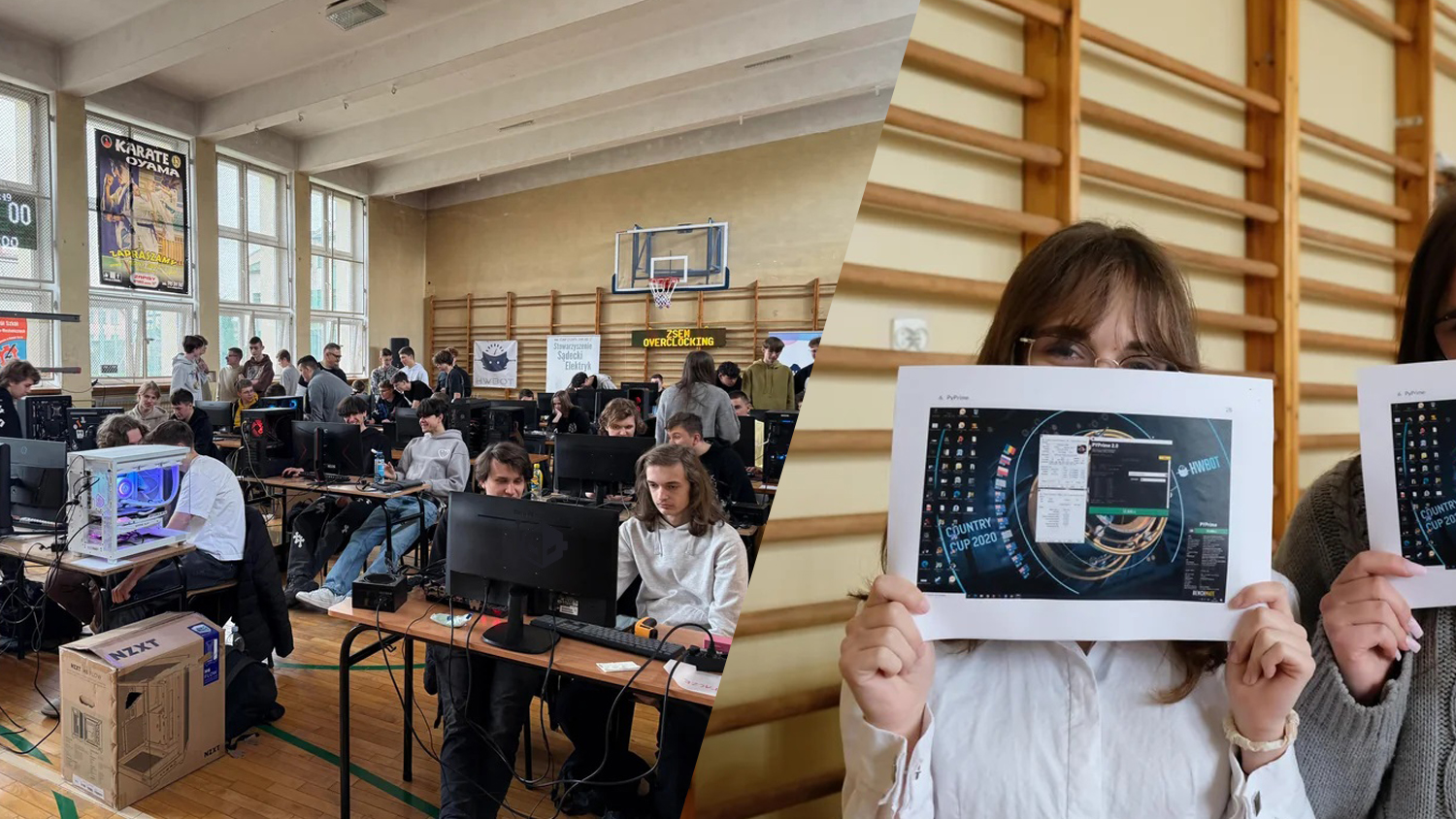
A Polish high school is turning PC hardware lessons into something far more hands-on than any textbook: real overclocking tournaments where students learn how CPUs and GPUs behave under pressure, how BIOS tuning works, and what it takes to squeeze extra performance out of a system safely.
The idea is simple, but incredibly effective. Reading about hardware can help students pass exams, yet actually building, testing, and tweaking a working PC is what makes the knowledge stick. In this school’s case, the teacher doesn’t just explain the basics of components and performance—he encourages students to push their systems further through careful tuning, benchmarking, and real-world experimentation.
Photos shared on Reddit by user u/2C_Wizard show the event set up on what looks like a school sports court, with more than two dozen students gathered around a wide variety of machines. There are laptops, open-bench builds, older “retro” systems, and modern mid-range and higher-end PCs. Instead of a typical classroom lab exercise, students focus on maximizing performance by manually overclocking processors and graphics cards, adjusting BIOS settings, and running benchmarks to measure gains.
According to the post, the school has already held two editions of the tournament, and it’s become a recurring event. The competitions involve plenty of trial and error—sometimes even mistakes that become learning moments. In the first edition, one student reportedly managed to break two power supplies, which is a harsh but memorable lesson in power delivery, stability testing, and hardware limits.
What makes the tournament even more exciting is that it isn’t just a small internal contest. The school also runs a livestream during the event, and sponsors contribute real prizes that PC builders would actually want. Past rewards included an AMD Ryzen 5 7600X, an NVIDIA GeForce RTX 4060, a 360mm all-in-one liquid cooler, and a 650W Gold-rated power supply. That kind of prize pool turns a school project into a serious challenge—and gives students an extra reason to show up prepared and eager to learn.
More schools hosting competitions like this could be a major win for practical tech education. Overclocking teaches far more than “making a PC faster.” It pushes students to understand thermals, cooling solutions, voltage behavior, system stability, component quality, and the risks of improper tuning. Most importantly, it builds confidence with real hardware—something that can translate directly into career skills for IT, engineering, and the broader PC building community.
The biggest credit goes to the teacher who not only supports the idea, but participates and motivates students to explore hardware in a way that feels challenging, social, and genuinely fun.