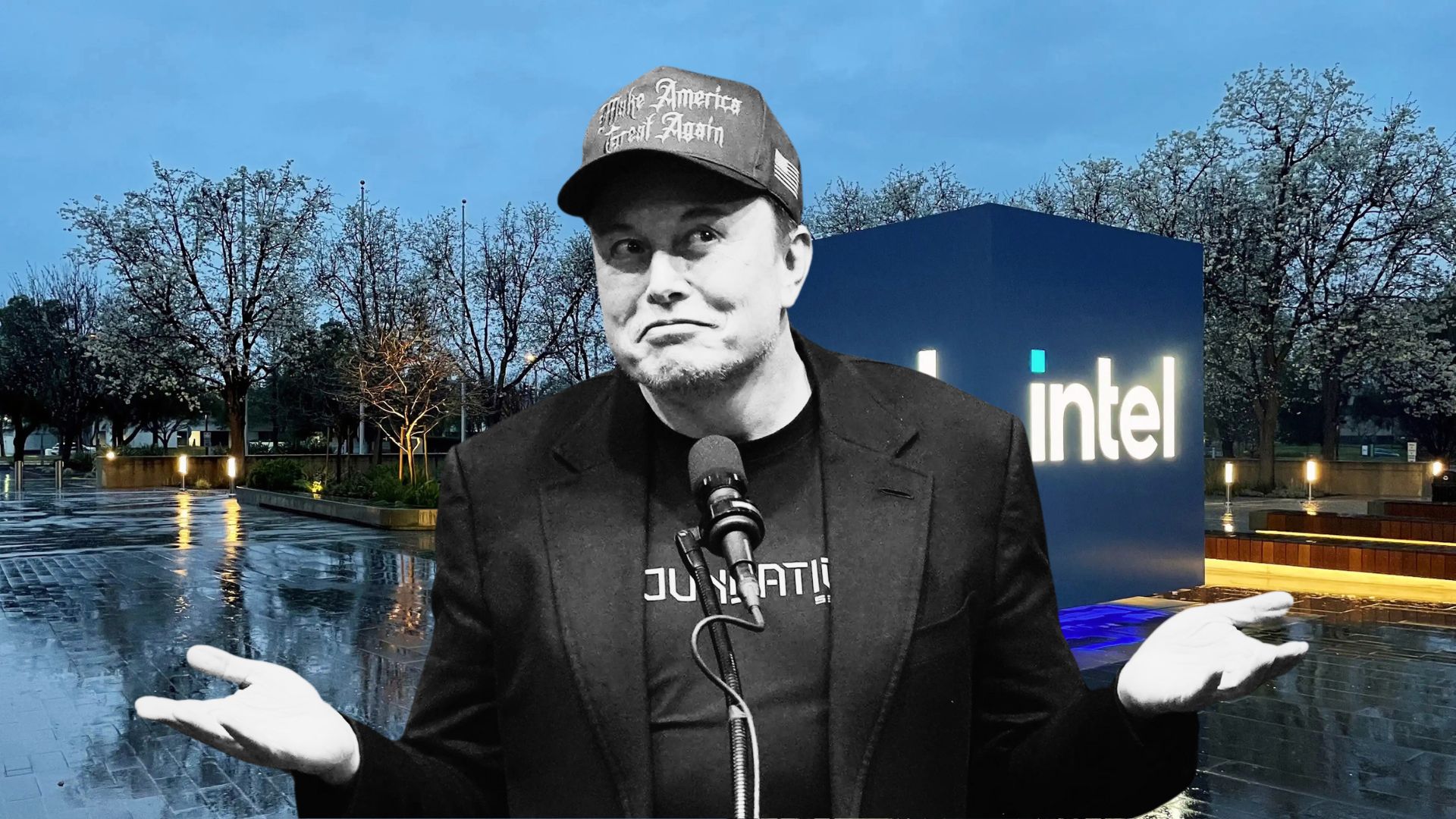
Tesla is widening its chip-sourcing strategy, and after lining up manufacturing with TSMC and Samsung, the company is now exploring Intel’s foundry services. If talks progress, Tesla could become the first external customer to tap Intel’s 18A process for its upcoming AI6 custom silicon.
Intel’s contract manufacturing business has struggled to win major third-party volume, even as its 18A node emerges as a competitive, leading-edge option. The potential tie-up gained momentum after Elon Musk said Tesla needs “gigantic” chip production across multiple partners, adding that even the best-case output from current suppliers won’t cover future demand. Bringing Intel into the mix would make Tesla the rare automaker sourcing cutting-edge semiconductors from all three of the world’s top advanced foundries.
A deal would likely center on Intel’s 18A technology, which aligns with Tesla’s search for 2nm-class partners for next-generation AI chips. Intel’s Arizona-based Fab 52 is ramping 18A production, positioning it as a direct alternative to TSMC’s N2 and Samsung’s SF2. For Tesla, which places a premium on U.S. manufacturing, access to a domestic, state-of-the-art fab could be a strategic advantage in scaling AI compute for vehicles and infrastructure.
This wouldn’t be the first time the two companies crossed paths. Intel was previously rumored to provide advanced packaging for Tesla’s Dojo supercomputer, but that possibility faded after the program shut down. A new collaboration focused on front-end wafer production would be a much larger and more visible step—especially for Intel, which is seeking marquee customers to validate its foundry roadmap.
Nothing is signed yet, and specific terms haven’t been disclosed. But if Tesla proceeds with Intel, it would signal a major shift in the semiconductor landscape: a high-profile, AI-focused customer spreading risk across three leading foundries to secure capacity at the most advanced nodes. That approach could help Tesla meet surging compute needs while giving Intel’s foundry business the market spotlight it’s been chasing.