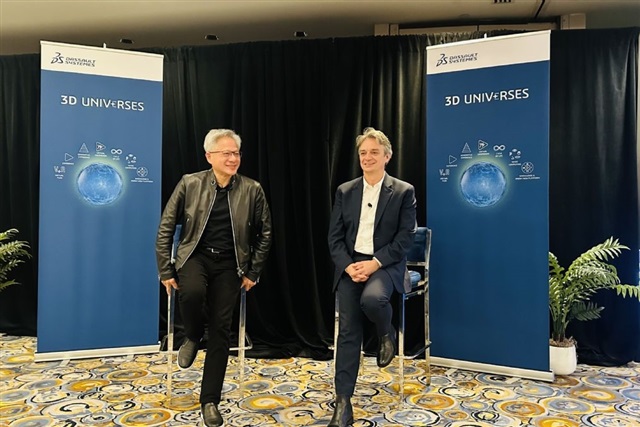
Nvidia CEO Jensen Huang believes the next decade will be a defining era for robotics, with humanoid robots poised to move from impressive demos to real, large-scale deployment in industrial settings. According to Huang, the biggest breakthrough won’t come from hardware alone, but from the systems that allow robots to learn, practice, and operate safely before they ever step onto a factory floor.
At the center of this vision is the idea of “digital twins” — highly detailed virtual replicas of real-world environments such as factories, warehouses, and production lines. In practical terms, a digital twin lets companies simulate how humanoid robots will move, perceive objects, collaborate with humans, and complete tasks in a controlled virtual world. That means fewer surprises, fewer costly mistakes, and faster rollouts when robots are finally introduced into real operations.
Huang’s point is simple but powerful: once robotics training and testing can be done at scale in realistic simulations, the pace of development can accelerate dramatically. Instead of relying on slow, expensive trial-and-error in physical spaces, engineers can run countless training cycles in virtual environments, refine performance, and then transfer those learnings to robots in the real world. This approach could make humanoid robots far more practical for manufacturers looking to improve productivity, address labor shortages, and keep operations running efficiently.
Factories are an especially appealing target for humanoid robots because they are structured environments with repeatable processes — ideal conditions for automation. But they’re also complex, crowded, and safety-critical. That’s where simulation becomes essential. A realistic virtual factory can help validate everything from a robot’s navigation and balance to its ability to handle tools, parts, and unexpected obstacles. It can also help organizations plan robot workflows, estimate return on investment, and identify bottlenecks long before deployment.
Huang’s broader outlook suggests robotics is entering a “compounding” phase, where improvements in AI, simulation, and computing reinforce each other. As AI gets better at understanding the physical world, robots become more capable. As simulation becomes more lifelike, training becomes faster and more reliable. And as computing power continues to scale, companies can test more scenarios, train more models, and deploy more robots across more industries.
If this trend holds, the next ten years could bring a surge in practical humanoid robotics — not just in labs, but in real factories where companies need flexible automation that can adapt to changing production demands. Digital twins and deep integration between virtual training and real-world deployment may be the key that unlocks that transformation, turning humanoid robots into an everyday part of industrial work.