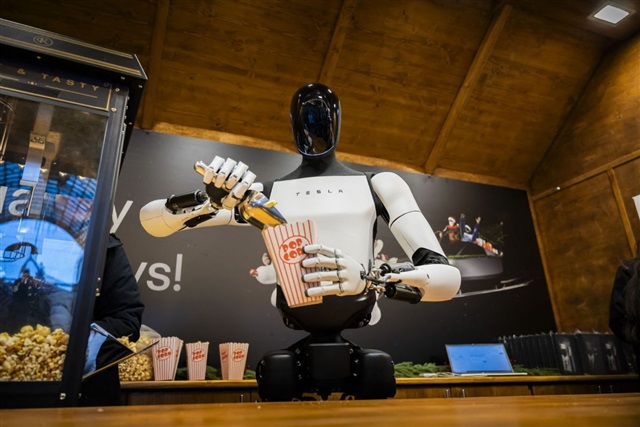
Tesla is making a bold manufacturing shift that says a lot about where the company believes its next major growth story lies. By scaling back production lines for the Model S and Model X, Tesla is freeing up valuable factory space to accelerate work on Optimus, its humanoid robot. On the surface, it’s a simple capacity move. In reality, it signals that Tesla is treating humanoid robotics as a serious, near-term business priority—one important enough to reshape how its factories are used.
The decision also highlights a bigger transformation happening across the robotics industry. Humanoid robots are quickly becoming the next competitive battleground, and the fight is shaping up less around a single product and more around ecosystems. At the center of that shift is a growing rivalry between Tesla’s tightly controlled, vertically integrated strategy and a broad, platform-style approach associated with Nvidia and its expanding AI and robotics ecosystem.
Tesla’s approach to Optimus has always leaned toward building as much as possible in-house—hardware, software, manufacturing processes, and the data pipelines used to train AI systems. That “closed” model can create a powerful advantage if everything works: tight integration, faster iteration, and a clear path to scaling production without relying heavily on outside partners. It also fits how Tesla has historically built its EV business, where controlling the stack has been key to its identity.
But there’s another strategy competing for the future of robotics: a more open, ecosystem-driven model where many companies build robots, components, and software on top of shared platforms. This is where Nvidia’s influence comes in. Instead of focusing on one robot, the platform approach aims to become the underlying foundation for many robots across industries—enabling manufacturers, developers, and researchers to standardize on tools, chips, simulation, and AI frameworks. If that model dominates, the winners may be the companies whose platforms are adopted most widely, not just those producing a single flagship humanoid.
Tesla’s production reallocation underscores a critical point: factory space and manufacturing capacity are becoming strategic resources in the race to bring humanoid robots into real-world use. Robots aren’t just software. They require scale, supply chains, reliability testing, and repeatable assembly—exactly the areas where Tesla believes it has an edge. Reducing attention on lower-volume, premium vehicle lines like Model S and Model X to make room for Optimus suggests Tesla is prioritizing scaling a future robotics line over maintaining every part of its current car lineup at full strength.
For consumers and investors watching the robotics market, this is a key moment. The industry is shifting from experimental prototypes toward a high-stakes push to deploy humanoid robots in factories, warehouses, and eventually broader everyday environments. The biggest question may not be “Which humanoid robot is best?” but “Which ecosystem will developers and businesses bet on?” Tesla is betting on a tightly integrated, Tesla-controlled system. The Nvidia-led world is betting that robotics will look more like the broader tech industry, where platforms and partnerships create faster adoption.
As this rivalry intensifies, the outcome could define how humanoid robots are built, trained, and deployed for years—whether the future belongs to a single-company model built end-to-end, or a shared ecosystem that powers thousands of different machines. Tesla’s factory shift is a clear sign it wants Optimus at the center of that future, and it’s willing to rearrange its existing priorities to get there.


