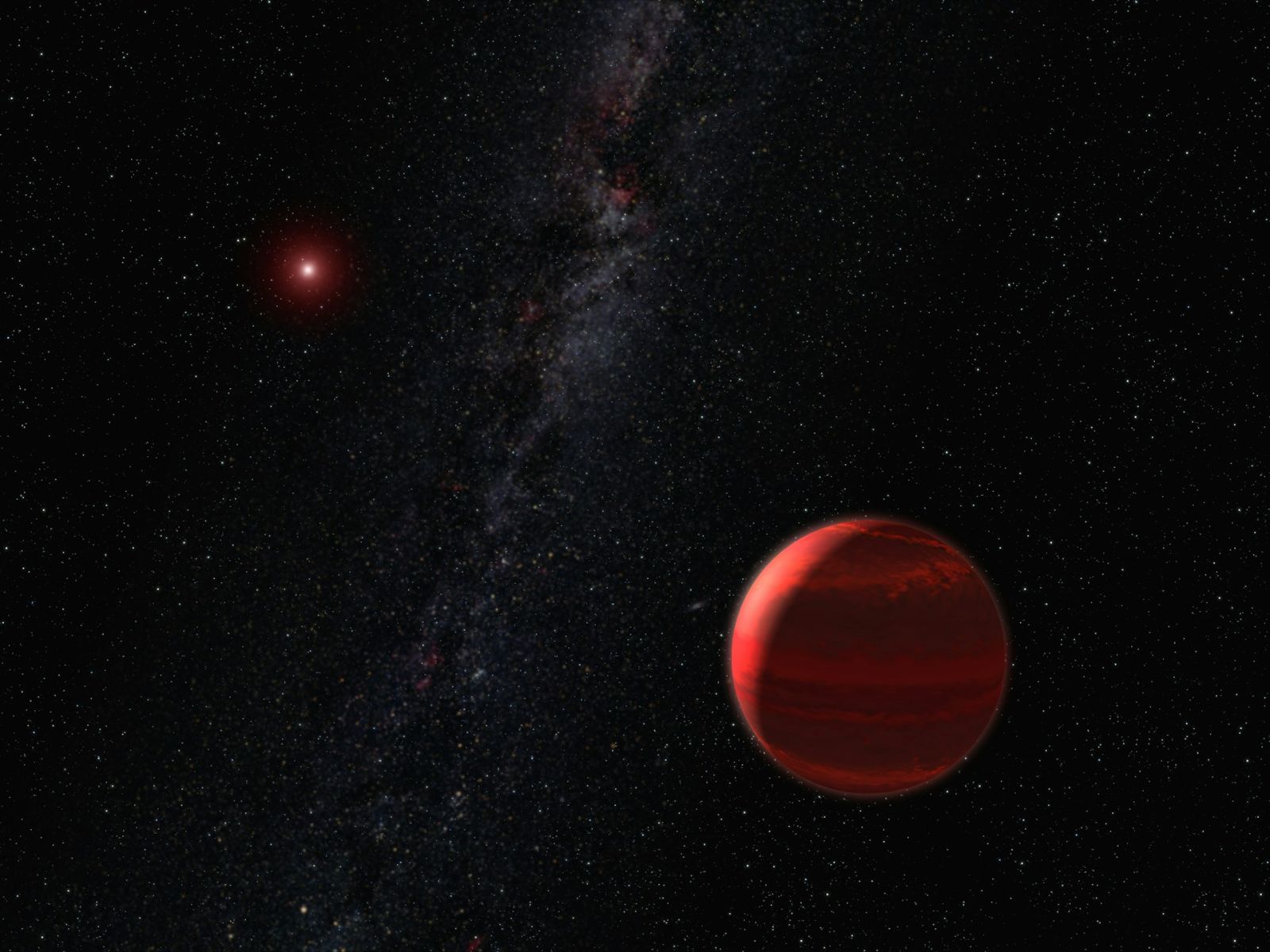
Astronomers have identified a nearby “exo-Jupiter” that could be wrapped in clouds, offering a promising new target for understanding how giant planets evolve beyond our solar system. The planet, called Epsilon Indi Ab, sits roughly 12 light-years from Earth and is already drawing attention as next-generation telescopes prepare to take exoplanet research to a whole new level.
Scientists study exoplanets to search for clues about how planetary atmospheres work—and, ultimately, to spot potential signs that could point to habitable environments elsewhere in the universe. In this case, a research team led by Elisabeth Matthews at the Max Planck Institute for Astronomy took a closer look at Epsilon Indi Ab using the James Webb Space Telescope. By analyzing data from Webb’s mid-infrared instrument (MIRI), the team was able to uncover fresh details that weren’t possible to confirm before.
Epsilon Indi Ab was first confirmed in 2018, but the new observations are helping astronomers better understand what kind of world it really is. The planet appears to have a diameter similar to Jupiter’s, yet it’s far more massive—estimated at about 7.6 times Jupiter’s mass. That combination makes it an especially interesting object to study, because it suggests a very different internal and atmospheric structure compared with the gas giants closer to home.
Even more surprising is its temperature. Epsilon Indi Ab is relatively cool for a giant exoplanet, with estimates ranging between 200 and 300 K (about −70 to +26 °C). Based on multiple studies and the characteristics revealed through infrared observations, researchers now believe clouds are likely present in its atmosphere.
Clouds on giant planets aren’t unusual in principle—Jupiter itself is famous for its cloud bands, with ammonia clouds high in its atmosphere. But Epsilon Indi Ab may be different. The evidence points toward thick clouds possibly made of water ice rather than ammonia, and they may not be limited to a single uniform layer. Instead, these clouds could be spread across different regions of the planet, hinting at complex atmospheric behavior.
Despite how exciting the discovery is, confirming clouds on an exoplanet remains extremely challenging. These worlds are faint, distant, and difficult to measure in detail, especially when scientists are trying to interpret subtle atmospheric signals. That’s why researchers are looking ahead to upcoming observatories, including NASA’s Nancy Grace Roman Space Telescope, which could make it easier to detect and map cloud structures on exoplanets with greater precision.
As new space telescopes come online, planets like Epsilon Indi Ab could help astronomers refine their methods for reading atmospheric chemistry and weather patterns far beyond our solar system. And while this particular world is a gas giant rather than an Earth-like planet, improving our ability to analyze exoplanet atmospheres is an important step toward the long-term goal: identifying planets that could potentially support life somewhere out there in the cosmos.