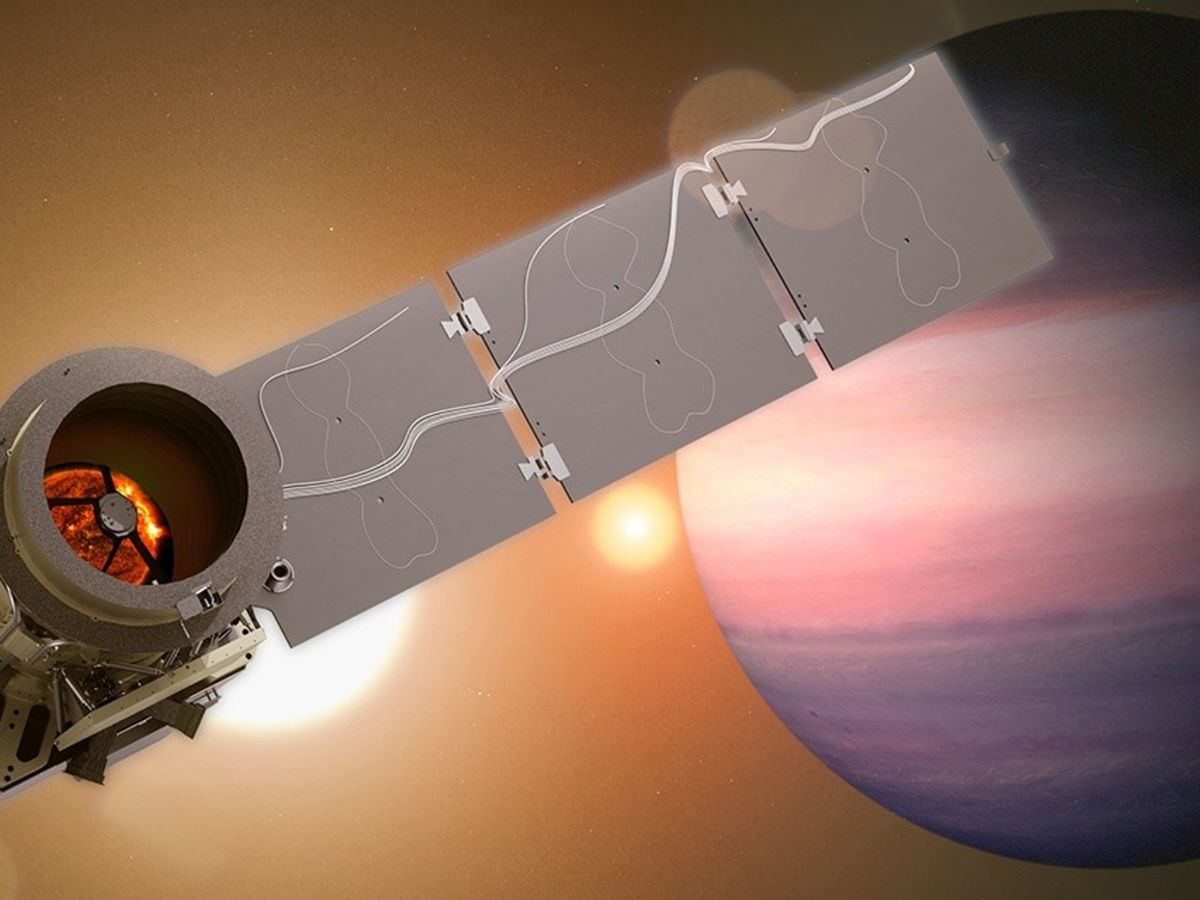
NASA’s newest exoplanet mission, Pandora, lifted off on January 11 with a clear goal: help astronomers figure out whether the chemical “fingerprints” seen in exoplanet observations truly come from a planet’s atmosphere or are being distorted by the planet’s own star.
Over the past several years, planet-hunting missions such as NASA’s Transiting Exoplanet Survey Satellite (TESS) have helped push the known exoplanet count beyond 6,000. With so many worlds discovered, the search has shifted from simply finding planets to understanding what they’re like. One of the biggest challenges is that scientists sometimes detect molecules that seem to be present in an exoplanet’s atmosphere—but there’s a lingering question. Are those signals actually produced by the planet, or are they coming from the host star’s activity and getting mixed into the data?
Pandora is designed to solve that long-standing problem by carefully separating starlight from planetary signals. The satellite carries a 17-inch, all-aluminum telescope that collects visible and near-infrared light, a combination that’s especially useful for teasing out subtle changes in light that occur when a planet passes in front of its star.
Instead of relying on a single quick look, Pandora will take a repeat-observation approach. For each planet-star system it studies, the mission plans to observe the target 10 different times. Each observing session is expected to last up to 24 hours, allowing Pandora to capture the star’s light before the transit begins and continue watching as the planet moves across the star’s face. That extended timeline is critical because it helps scientists track how the star itself behaves, making it easier to identify what part of the signal is truly caused by starlight filtering through the exoplanet’s atmosphere.
By comparing these long, repeated observations, Pandora aims to determine which spectral clues belong to the planet and which are influenced—or even created—by the host star. That kind of clarity is essential for atmospheric studies, especially when researchers are trying to interpret the presence of specific molecules.
Pandora is also notable because it’s the first mission focused on detailed, repeated measurements of starlight filtered through exoplanet atmospheres in a way that directly accounts for stellar variability. During its first year in orbit, it’s expected to study at least 20 exoplanets and their host stars. The results should strengthen how scientists interpret exoplanet data gathered in the past and improve how they analyze observations from current and future space telescopes, including NASA’s Kepler archive and the James Webb Space Telescope.
The satellite reached space aboard a SpaceX Falcon 9 rocket. It didn’t travel alone either: two additional missions launched alongside it. BlackCAT (Black Hole Coded Aperture Telescope) will explore short-lived events in the high-energy universe, while SPARCS (Star-Planet Activity Research CubeSat) will examine the activity of low-mass stars—research that also complements the broader effort to understand how stars affect the planets orbiting them.
With Pandora now in orbit, scientists are one step closer to turning atmospheric hints into reliable evidence—helping transform exoplanet discoveries into deeper insights about what these distant worlds are truly made of.


