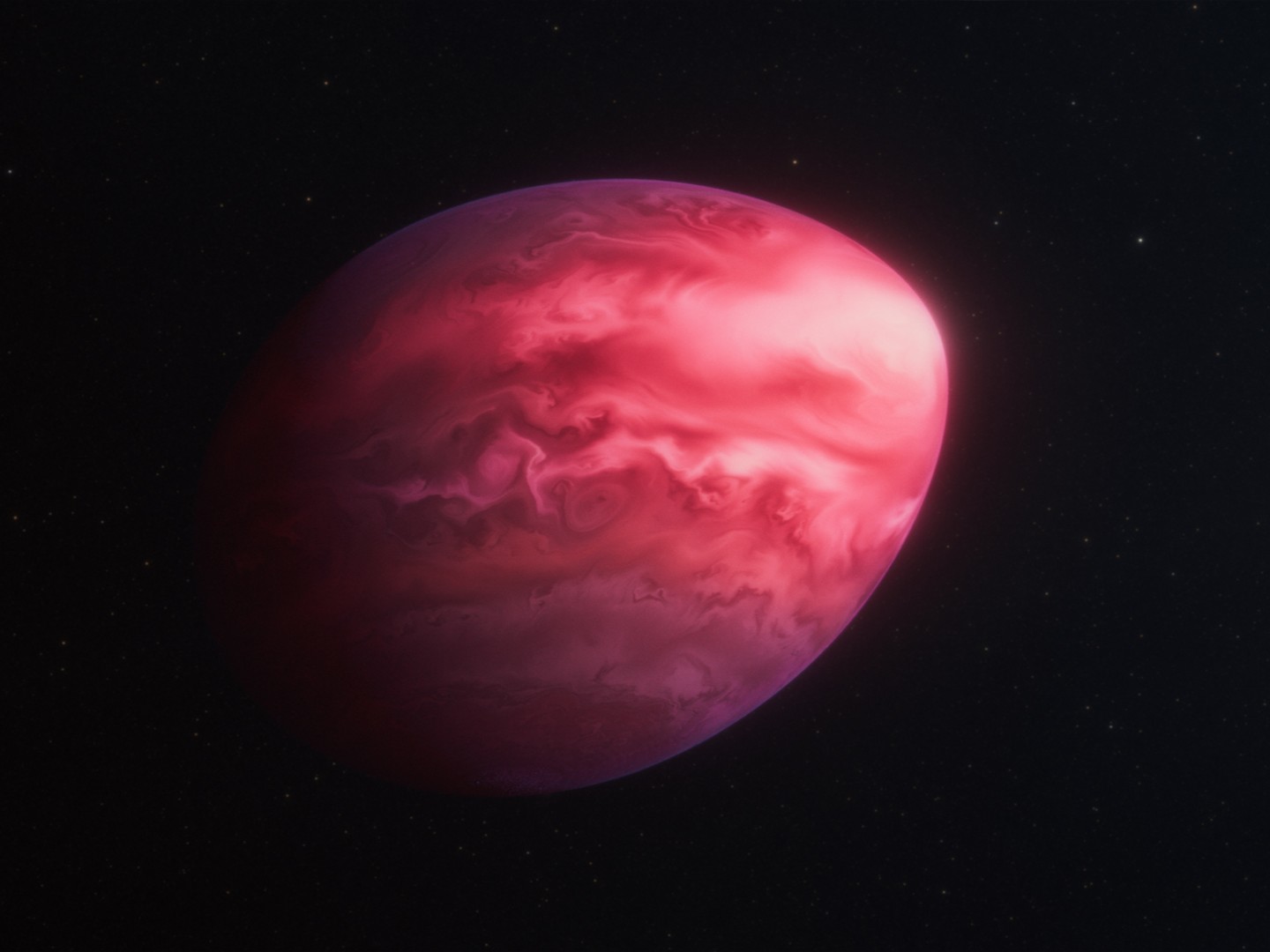
NASA’s James Webb Space Telescope has taken a closer look at a truly unusual world: an exoplanet known as PSR J2322-2650b. While thousands of planets have been discovered beyond our solar system, this one stands apart in multiple ways—from where it lives to what its atmosphere is made of.
PSR J2322-2650b doesn’t orbit a normal star like the Sun. Instead, it circles a pulsar, which is a rapidly spinning neutron star left behind after a massive star explodes. Planets around pulsars are already rare, but this planet is even more of an outlier because it’s the only known exoplanet comparable to a “hot Jupiter-like” world that orbits a pulsar.
One of the strangest details is its shape. Scientists describe PSR J2322-2650b as lemon-shaped, distorted by the extreme gravitational pull of its pulsar. That intense tug-of-war doesn’t just warp the planet—it also hints at how extreme the environment is.
The planet’s orbit is unbelievably tight. PSR J2322-2650b sits only about one million miles from its pulsar. For comparison, Earth is roughly 100 million miles from the Sun. At that close range, radiation from the pulsar blasts the planet continuously, lighting it up and heating it to searing temperatures estimated to range from about 1,200 to 3,700 degrees Fahrenheit.
Yet the biggest mystery isn’t the planet’s orbit or its distorted shape. It’s the atmosphere.
Webb’s observations indicate that the atmosphere is dominated mostly by helium and molecular carbon. That molecular carbon signature is what has astronomers scratching their heads. At the planet’s extremely high temperatures, scientists would typically expect carbon to bond with other atoms rather than remain detectable as molecular carbon. And among roughly 150 planetary atmospheres studied so far—both in our solar system and beyond—PSR J2322-2650b is the only one with detectable molecular carbon.
That unique chemical fingerprint raises a bigger question: how did this planet form at all? Based on what scientists currently understand about planet formation, PSR J2322-2650b doesn’t fit the usual models. Its location, its relationship with a pulsar, and its unusual atmospheric chemistry appear to rule out every known formation mechanism, at least for now.
The findings were reported in a study published in Astrophysical Journal Letters, adding PSR J2322-2650b to the growing list of space discoveries that challenge what astronomers thought they knew—and reminding us that the universe still has plenty of surprises left.