Astronomers have spotted a newly discovered exoplanet circling a young star, offering a rare look at what planets can be like early in their lives and how they change over time. The planet, known as TOI-5734 b, orbits the star TOI-5734, located around 106 light-years from Earth. What makes this find especially compelling is that it appears to sit in a transitional zone where planets may be actively evolving from one type into another.
TOI-5734 b is bigger than Earth but smaller than Neptune, placing it in the popular “sub-Neptune” category that scientists often see in other star systems but not in our own. Measurements indicate the planet has a radius about 2.1 times Earth’s and a mass around 9.1 Earth masses. Its density is slightly lower than Earth’s, hinting that the planet likely carries a significant atmosphere or envelope rather than being purely rocky from surface to core.
The planet is also extremely close to its host star. It completes a full orbit in just 6.18 days at a distance of about 0.06 AU, much closer than Mercury is to the Sun. That tight orbit makes it blisteringly hot, with an estimated temperature near 688 K. Because of its size and intense heat, scientists classify it as a hot sub-Neptune.
The host star, TOI-5734, is a young K-type dwarf, smaller and cooler than the Sun. It has about 0.72 times the Sun’s mass and roughly 0.64 times the Sun’s radius. The star’s youth is important: younger stars tend to be more active, and that activity can strongly influence the atmospheres of nearby planets.
One of the most intriguing details is where TOI-5734 b falls in what researchers call the “radius valley.” This is a noticeable gap in planet sizes—roughly between 1.5 and 2.0 Earth radii—where relatively few planets are found. Many scientists think this valley exists because planets in this range are being stripped of their atmospheres, shrinking over time. TOI-5734 b sits near the upper edge of that valley, suggesting it could be caught in the act of transformation.
Researchers suspect the planet may be losing its atmosphere through a process called photoevaporation, where high-energy radiation from the star heats and drives atmospheric gases away into space. Based on current estimates, TOI-5734 b could lose much of its original, primordial envelope in about 300 million years. If that happens, it may end up looking more like a rocky super-Earth than the puffier sub-Neptune we see today. That makes this world a valuable natural laboratory for studying how close-in planets can evolve dramatically as their stars age.
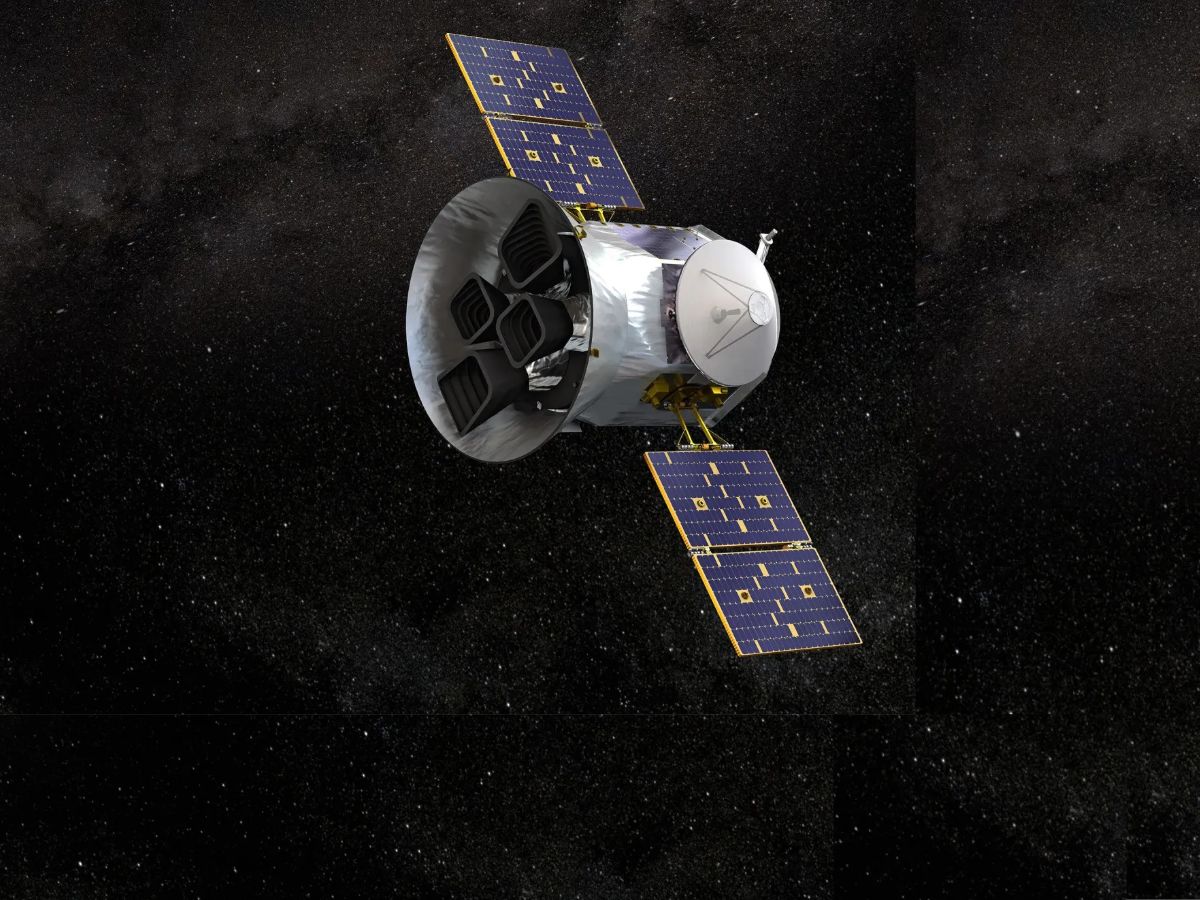
This discovery was made possible by combining two powerful observing approaches. NASA’s Transiting Exoplanet Survey Satellite (TESS) first identified the planet by detecting small, periodic dips in the star’s brightness—signatures that occur when a planet passes in front of its star from our perspective. Those transit observations, first recorded in 2022, helped scientists estimate the planet’s size. To confirm the planet and measure its mass, astronomers used HARPS-N, a highly precise instrument that detects tiny star “wobbles” caused by a planet’s gravitational pull. Together, the transit and follow-up measurements allow researchers to calculate the planet’s mass, radius, and density—key properties for understanding what it’s made of and how it might change over time.
TOI-5734 b stands out not just as another exoplanet discovery, but as a snapshot of planetary evolution in progress. As more worlds like this are found and studied, astronomers get closer to answering some of the biggest questions in planetary science: why some planets hold onto thick atmospheres, why others become stripped-down rocky worlds, and how the early life of a star can reshape the destiny of planets that form around it.