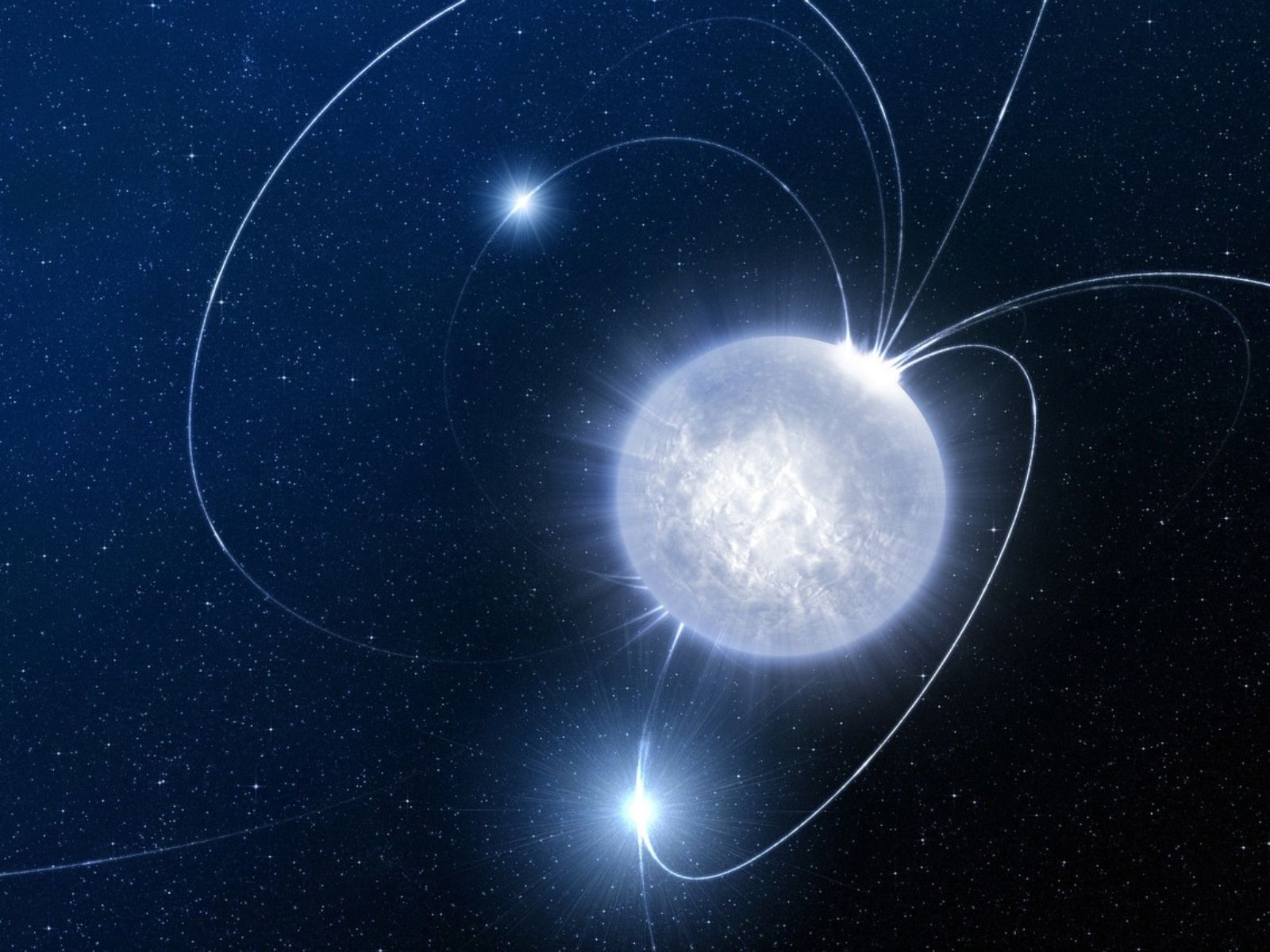
Astronomers may have spotted a rare and exciting object hiding in one of the most extreme neighborhoods of the Milky Way: a pulsar candidate located near the galaxy’s center, not far from the supermassive black hole Sagittarius A*. If future observations confirm it’s real, the find could open a powerful new window into how our galaxy works—and how the universe behaves in the presence of intense gravity and magnetic forces.
Even after decades of studying the Milky Way, the Galactic Center remains difficult to explore. Dense clouds of gas and dust obscure visibility, and the region is packed with energetic phenomena. In 2022, scientists achieved a major milestone by capturing the first image of Sagittarius A*, the supermassive black hole at the heart of our galaxy. Now, researchers think a highly magnetized, rapidly spinning neutron star could be nearby—exactly the type of discovery that would help explain why the Galactic Center is still full of unanswered questions.
Pulsars are a special kind of neutron star formed after massive stars explode. They’re incredibly compact—often containing about twice the Sun’s mass squeezed into a sphere roughly 19 kilometers (about 12 miles) across. What makes pulsars so useful to astronomers is their rotation. Many spin at extraordinary speeds and sweep beams of electromagnetic radiation into space from their magnetic poles. When those beams cross Earth, scientists detect rhythmic pulses, like a cosmic lighthouse.
Some pulsars rotate so quickly they seem almost unreal. One well-known example is PSR J1748-2446ad, located about 18,000 light-years away, which spins 716 times per second and is considered the fastest pulsar discovered so far. These extreme rotations and strong magnetic fields make pulsars perfect natural laboratories for studying physics under conditions impossible to recreate on Earth.
In a search conducted between 2021 and 2023, researchers from the Breakthrough Listen program used the Green Bank Telescope to scan the Galactic Center. During that work, they identified a pulsar candidate that appears to rotate around 122 times per second. While that is slower than the fastest pulsars known, it is still remarkably rapid—and potentially very important given its suspected location near Sagittarius A*.
The bigger surprise, however, was how few pulsars turned up during the survey. Based on the team’s sensitivity, they expected to detect significantly more. Instead, only one candidate stood out, now referred to as the Breakthrough Listen Pulsar (BLPSR), and it remains under active investigation. That gap between expectations and results raises intriguing possibilities: perhaps the Galactic Center’s pulsar population differs from the rest of the Milky Way, or the environment near the black hole makes pulsars harder to detect than scientists predicted.
For now, the discovery is not considered confirmed. Researchers need additional observations to verify the signal and determine whether it truly comes from a pulsar near the Milky Way’s central black hole. Future work using next-generation radio astronomy facilities—such as the planned next-generation Very Large Array and the Square Kilometre Array—is expected to play a key role in confirming the source and learning more about it.
If BLPSR is validated, it could become an invaluable tool for astronomers. A pulsar near Sagittarius A* would help scientists probe the extreme gravitational environment at the heart of the Milky Way, refine models of how matter behaves near supermassive black holes, and improve our understanding of how galaxies evolve across the universe. In short, one fast-spinning neutron star could help illuminate one of the darkest, most mysterious regions of our cosmic home.