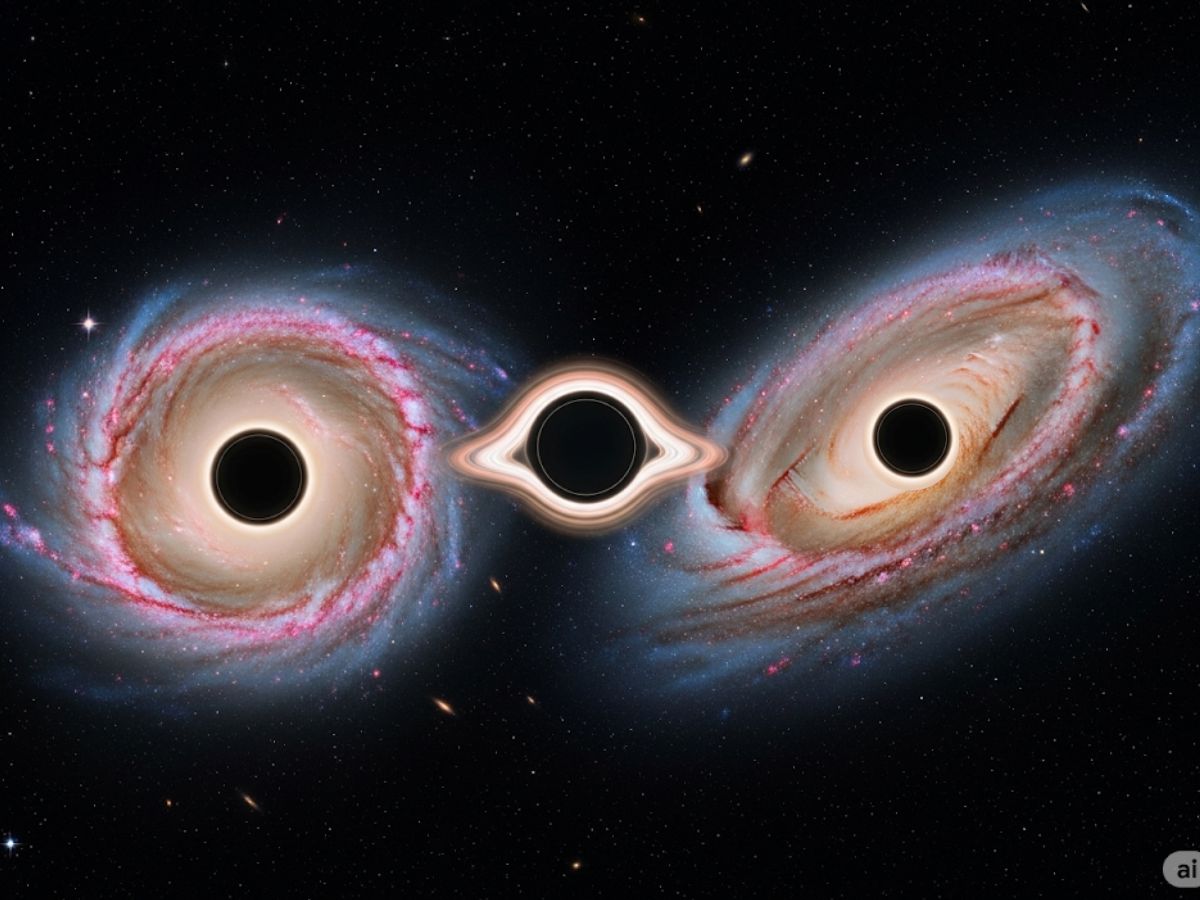
Astronomers using NASA’s James Webb Space Telescope have stumbled upon a fascinating cosmic phenomenon: a supermassive black hole nestled between two colliding galaxies, rather than at the core of either. This unusual discovery offers compelling support for the direct collapse theory, which suggests that supermassive black holes can rapidly form from collapsing gas clouds.
The object, intriguingly dubbed the “Infinity Galaxy,” emerged from a head-on clash between two galaxies. The standout revelation here is a supermassive black hole thriving in the gas between them. This finding strongly backs the heavy seed theory, proposing that a massive gas cloud can directly form a giant black hole. Such a process could shed light on how colossal black holes in the early universe grew so immensely and so swiftly.
“We think we’re witnessing the birth of a supermassive black hole – something that has never been seen before,” noted Pieter van Dokkum from Yale University, who led the study.
The team conducted further observations using the Webb telescope and confirmed a fascinating detail: the black hole’s velocity matches that of the surrounding gas cloud. This implies that it’s not a runaway black hole ejected from another galaxy, but one that formed from within the collapsing gas.
Adding to the wonder of this discovery, both galactic cores involved in the collision house their own active supermassive black holes. This makes the Infinity Galaxy a rare system featuring three supermassive black holes. While the team cannot absolutely confirm the presence of a direct collapse black hole, the new evidence bolsters their theory and discounts other explanations.