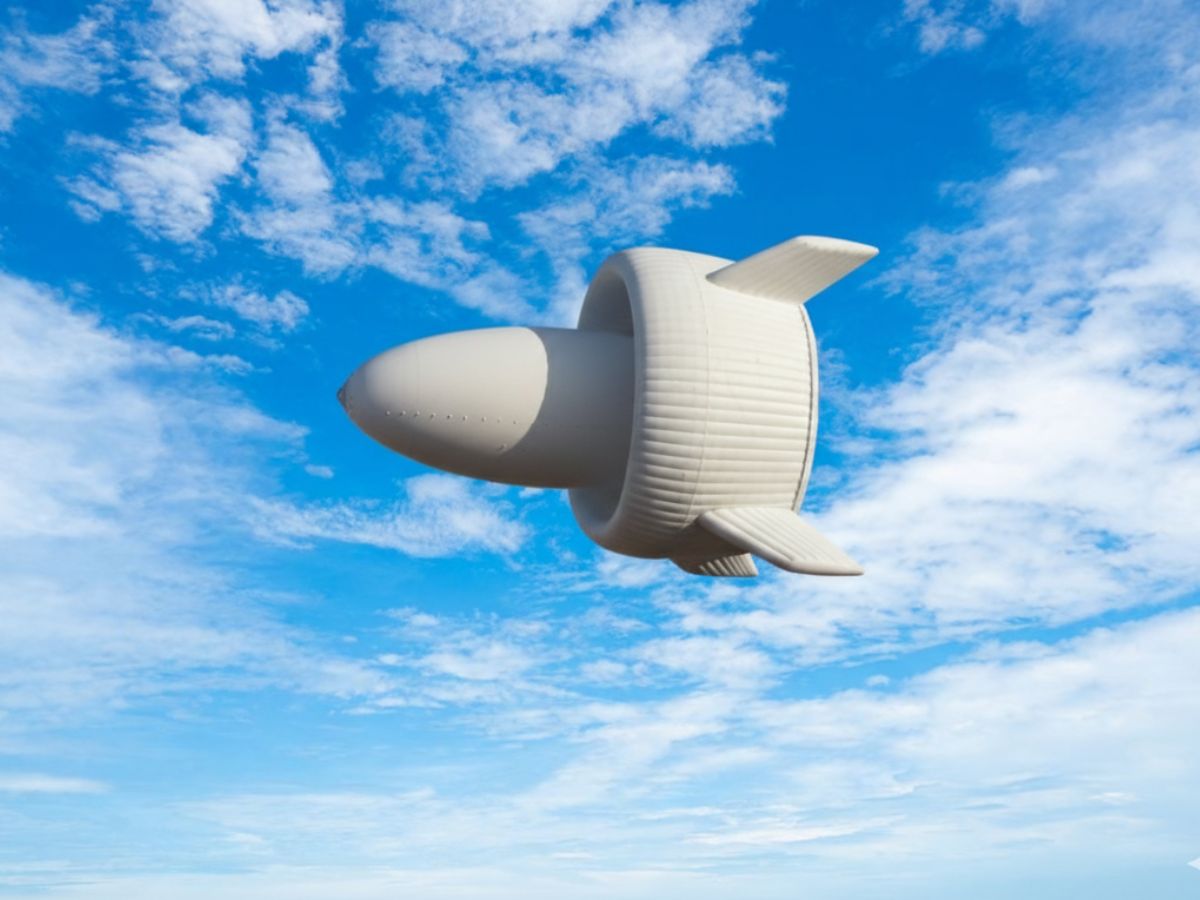
China has taken a bold step forward in high-altitude wind power with the successful maiden flight of the S1500, a colossal airborne wind turbine tested over the desert near Hami in Xinjiang. The flight marks a major milestone for the project and underscores the country’s push to harness stronger, more consistent winds found at higher altitudes.
The S1500 is the largest and most powerful airborne wind-power system built to date. Measuring approximately 60 meters long, 40 meters wide, and 40 meters high, it carries 12 turbine-generator units, each rated at 100 kW, delivering megawatt-class capability. In operation, the aircraft captures high-altitude winds and converts them into electricity, which is sent to the ground through a tethered power cable.
During the desert trial, the team completed full on-site assembly and repeatedly launched, deployed, and retrieved the system in high-wind conditions. While the developers have not yet disclosed power output figures from the test, the successful flight validates the platform’s core design and its readiness for more demanding trials.
The S1500 builds on earlier prototypes, including the S500 and S1000, and is being developed by a partnership between Beijing SAWES Energy Technology, Tsinghua University, and the Chinese Academy of Sciences. According to the team, the S1500 incorporates multiple safety features and is engineered for uninterrupted operation over a 25-year service life.
Beyond the spectacle of a turbine in the sky, the technology targets practical challenges that traditional wind farms struggle to solve. Airborne wind systems can be rapidly deployed, relocated as needed, and set up in areas where building towers is difficult or too costly. That makes them promising for powering remote communities, emergency response operations, and temporary industrial sites, while also complementing conventional renewable energy infrastructure.
With its first flight now complete, attention turns to detailed performance data—energy yield, endurance, and grid-integration results—that will determine how quickly the S1500 can move from pioneering prototype to real-world power solution. For now, the test in Hami stands as a significant achievement for airborne wind energy and a clear signal that high-altitude wind power is edging closer to mainstream use.