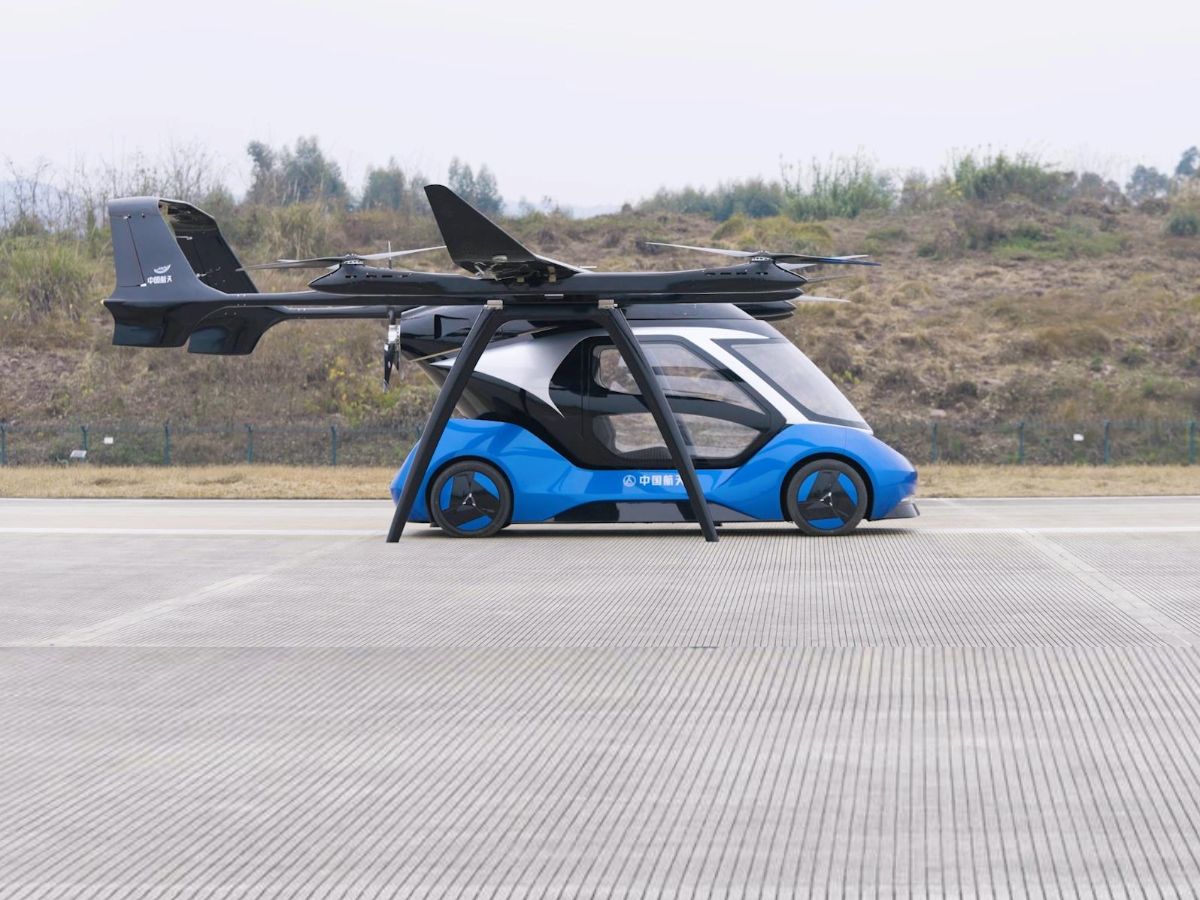
A new electric flying car-style aircraft has just taken a major step forward in China. The Ninth Academy of the China Aerospace Science and Technology Corporation (CASC) has completed the maiden flight of its domestically developed electric vertical takeoff and landing (eVTOL) aircraft, proving the core performance of a modular design built to operate both in the air and on the road.
The test flight took place on February 6 at Yongchuan Da’an Airport in Chongqing. What makes this eVTOL stand out is its split-type, detachable architecture that blends aerospace engineering with automotive-style modularity. Instead of being a single fixed vehicle, it’s designed as a system made up of three main modules: the wings (airborne module), the passenger cabin, and a road-going chassis.
At the center of the concept is a self-developed automatic alignment and coupling system. This mechanism allows the modules to connect and separate under programmed control, so the vehicle can transition between air travel and road travel by attaching or detaching sections as needed. In practical terms, that could mean using the same cabin for different missions, then pairing it with the appropriate flight module or chassis depending on where it needs to go.
In the air, the aircraft is designed to carry two passengers. CASC says the airborne module can reach speeds of up to 150 km/h while flying at altitudes below 3,000 meters, positioning it for low-altitude mobility scenarios where fast point-to-point travel matters.
On the ground, the system relies on a fully electric intelligent by-wire chassis, with an operational range of more than 300 kilometers. By-wire technology replaces traditional mechanical linkages with electronic controls, a common direction for next-generation EV platforms and autonomous-ready vehicles. CASC also notes the project draws on industrial capabilities from leading automakers and integrates tiltrotor control along with intelligent driving systems, aiming to create a flexible platform that can adapt to different travel demands.
CASC says development followed strict airworthiness standards, signaling a focus on long-term certification and real-world deployment rather than a one-off demonstration. The modular approach is also meant to support customization, with the potential for different cabin layouts and multiple chassis types that can be swapped depending on the task.
Looking ahead, the company expects this multifunctional low-altitude mobility equipment to be used across a range of sectors. Target use cases include personalized transportation, logistics and delivery operations, and emergency response—areas where combining road access with vertical takeoff and landing capability could reduce travel time and expand reach, especially in congested cities or hard-to-access locations.
With the maiden flight now completed, the project adds momentum to the broader push for practical eVTOL aircraft and “flying car” concepts—this time with a clear focus on modular design, automated coupling, and a dual-mode strategy that treats air and road travel as parts of one integrated system.