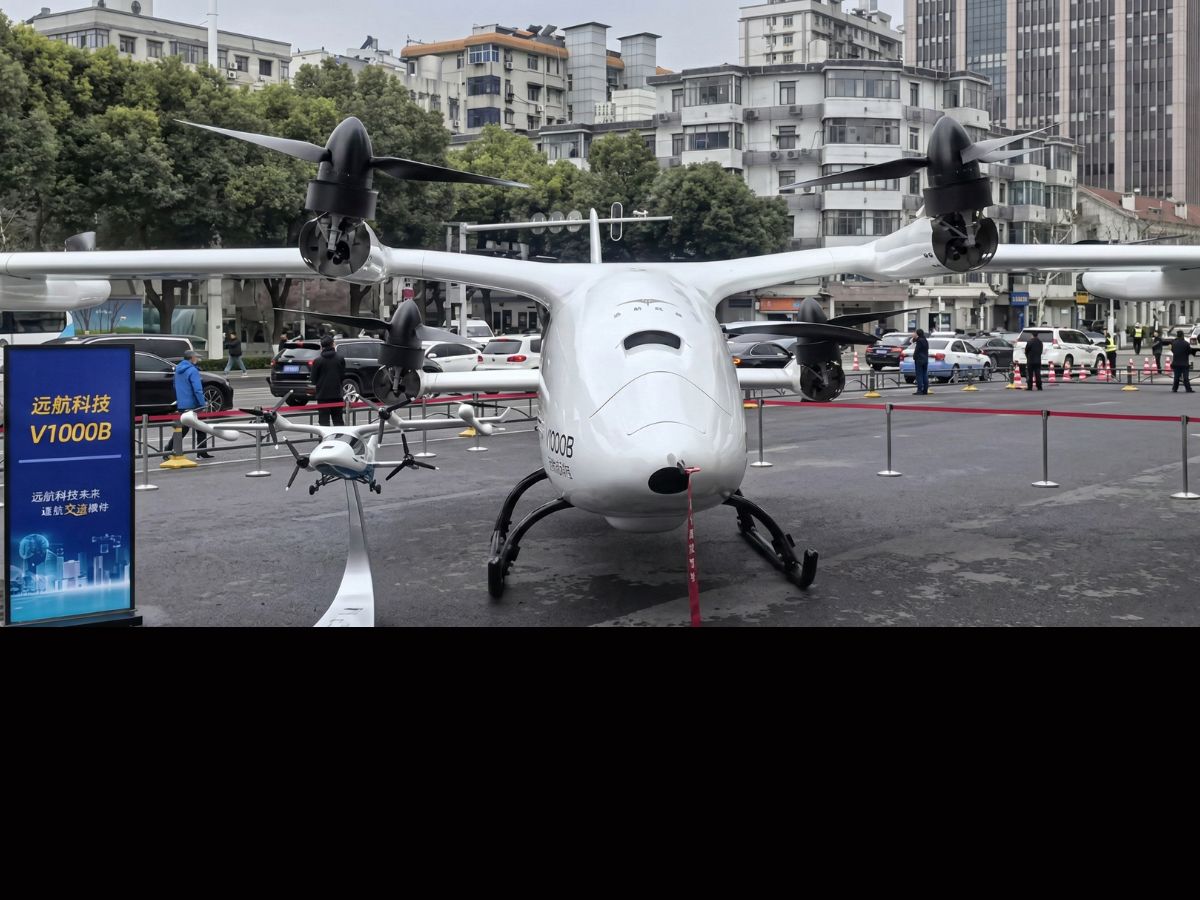
Four domestically developed electric vertical takeoff and landing aircraft (eVTOLs) made a high-profile appearance in Wuhan, putting China’s fast-growing “low-altitude economy” in the spotlight and underscoring how quickly flying-car-style transportation is moving from concept to commercial rollout.
The showcase took place on February 24 outside the Hongshan Auditorium in Wuhan, Hubei province, during the first provincial meeting after the Spring Festival. The timing and setting weren’t accidental: the display signaled that urban air mobility is becoming a near-term industrial priority, with manufacturers, suppliers, and regulators aligning around a path to scaled production.
What’s especially notable is how the eVTOL industry is benefiting from the same supply chains that power the new energy vehicle boom. That connection is helping speed up development, lower costs, and push prototypes closer to certification-ready aircraft. Many industry leaders are now treating 2026 as a decisive year, when mass production ramps up and commercial passenger operations begin to look less like pilot programs and more like real transportation services.
The four aircraft highlighted both Hubei’s aviation manufacturing base and the range of use cases emerging in the market. Hubei reported 27.9 billion yuan in aviation revenue in 2025, and the latest eVTOL models being shown there reinforce the province’s ambition to play a central role in next-generation aviation.
One of the display standouts was the E-Hawk, a ton-class eVTOL designed for short-haul urban travel. It features fully enclosed rotors and is built to carry four passengers, positioning it as a practical air-commuting option for city-to-city or cross-town routes where speed and convenience matter most.
Range anxiety—one of the biggest concerns for electric aviation—was addressed by Wuhan Xunqi Technology’s V1000. Using a hybrid tilt-rotor configuration, the V1000 is designed to exceed 1,000 kilometers of range, a headline figure that could expand eVTOL use beyond short hops into longer regional missions. The aircraft has already received formal design acceptance from the Civil Aviation Administration of China, a meaningful step on the path toward broader certification and eventual commercial deployment.
For personal recreation and tourism-focused scenarios, Shi Yun Aviation introduced the SW-one. Instead of unconventional controls, it uses a traditional steering wheel-style interface, aiming to make piloting feel familiar and accessible. The company is positioning it for personal water sports use today, with an eye toward future tourism applications.
The display also made it clear that eVTOLs aren’t just being developed for commuting and leisure. Emergency response is becoming a major proving ground, where time savings and operating economics can justify rapid adoption. Fusheng General Aviation presented the Sparrow-X2, an airborne intensive care unit designed to carry a stretcher along with medical monitoring equipment. As a pure-electric aircraft, it targets significantly lower operating costs—estimated around 2,200 yuan per hour for emergency rescue—well below what conventional helicopters typically require.
The broader momentum behind China’s eVTOL and flying car industry is accelerating quickly. With 547 related companies nationwide and a continuing surge in aviation patent filings, the sector is attracting substantial investment as domestic developers aim to secure certifications, scale manufacturing, and claim a leading position in global advanced air mobility.
From four-seat urban air taxis to long-range hybrid designs and electric emergency medical aircraft, the Wuhan showcase offered a snapshot of an industry shifting gears—moving beyond vision and prototypes and toward production lines, real-world operations, and a new era of low-altitude transportation.


