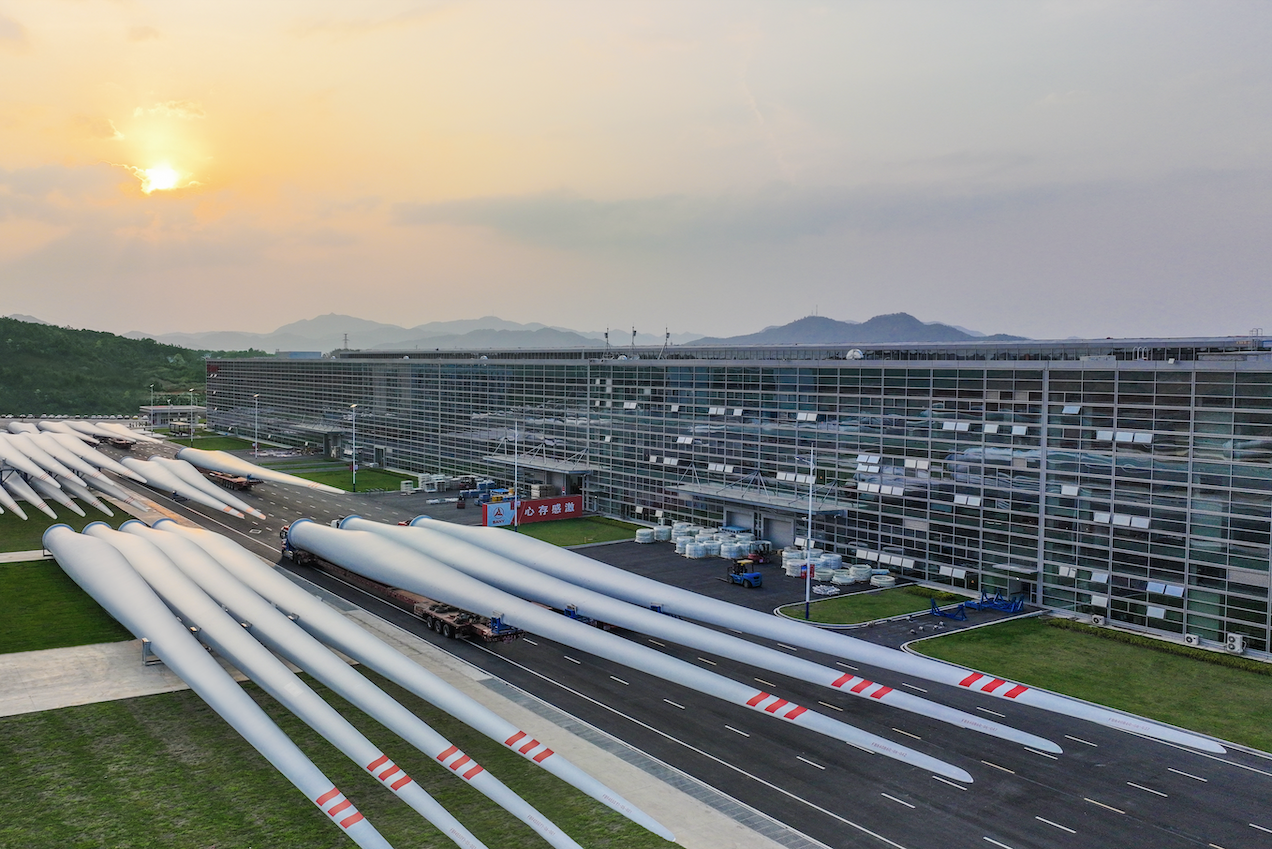
A Chinese renewable energy company has introduced a groundbreaking addition to the wind power industry with the launch of the SY1310A wind turbine blades. Measuring a massive 131 meters (430 feet), these turbine blades are recognized as the longest onshore wind turbine blades in existence. Sany Renewable Energy aims to install these blades on 15 MW wind turbines, which will be identified amongst the most potent on land.
The manufacturing giant, Sany Renewable Energy, has advanced wind turbine technology with its latest project in Bayannur, Inner Mongolia. The colossal SY1310A blades surpass even the most sizable offshore turbines, including those of current prototypes. The automated manufacturing process, ensuring a negligible prefabrication failure rate, allows the creation of each blade in under 30 hours – notably spare than the industry’s usual timeframe.
Sany Renewable Energy has embraced IoT technologies to optimize their operations. They utilize a ‘digital twin’ of their factory, enabling remote monitoring and management of production processes, ensuring maximum efficiency and minimal physical presence requirements.
The durability of these large-scale wind turbine blades is a top priority in their design. The integration of a thicker airfoil, a strengthened carbon fiber main beam, and an incorporated metal mesh for lightning protection constitute a robust structure crafted for longevity. The blades also include an inventive use of recycled polyurethane in certain parts to aid in recyclability after their operational tenure concludes.
Sany is set to undertake extensive testing, including three-point bending, buckling, flapping fatigue, component, and full-size tests, before implementing the SY1310A blades on their planned onshore wind turbines. Despite the enormous potential of these blades, the possibility of a global distribution appears limited for the time being.
Meanwhile, smaller-scale wind turbines are accessible for purchase, like the 800W Hilitand wind turbine available on Amazon.
This invention represents a remarkable stride in wind energy technology, offering significant benefits due to its scale and efficiency, although its widespread adoption may be constrained outside of China. Sharing innovative developments such as this has the potential to inspire further advancements in renewable energy technologies worldwide.