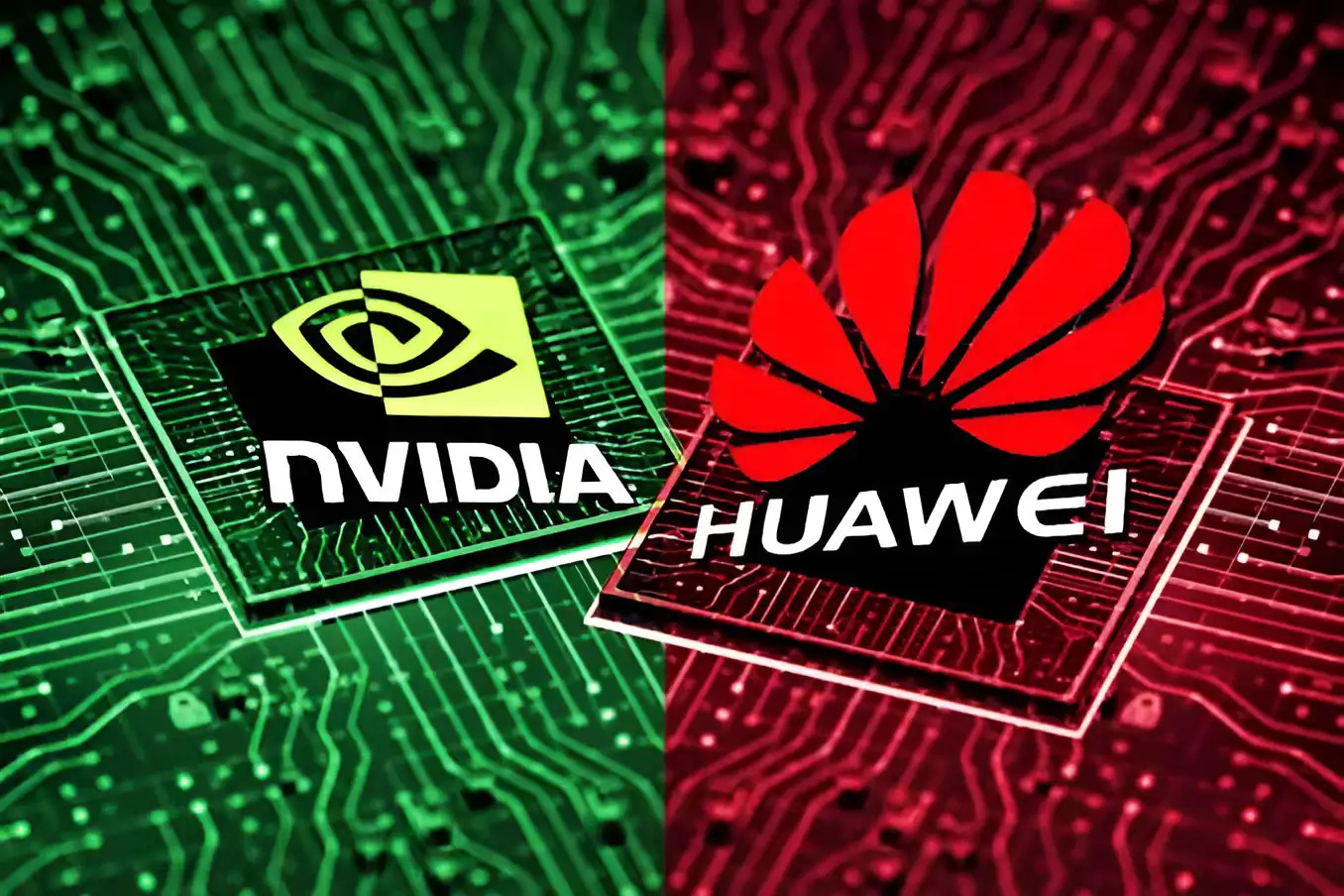
DeepSeek Reportedly Chooses Huawei AI Chips Over Nvidia for Massive Mongolia Data Center
DeepSeek is reportedly making a major move that could reshape China’s artificial intelligence hardware market. Just weeks after its CEO suggested that Nvidia’s position in China was weakening, the company is said to be placing a massive order for Huawei’s Ascend 950DT AI chips instead of relying on Nvidia’s China-focused H20 GPUs.
According to the report, DeepSeek has ordered 160,000 Huawei Ascend 950DT chips for a new 1GW AI data center in Inner Mongolia. With each chip estimated to cost around 111,000 yuan, or roughly $16,000, the total value of the order could reach about $2.56 billion.
The decision is significant because it shows how quickly China’s AI industry is shifting toward domestic alternatives. Nvidia has long dominated the global AI accelerator market, but export restrictions, rising geopolitical pressure, and China’s push for self-reliance are creating new opportunities for Huawei and other local chipmakers.
Huawei’s Ascend 950DT is based on the company’s third-generation DaVinci v3 architecture and is manufactured using SMIC’s N+3 process, an advanced 7nm-class technology. While it may not match Nvidia’s top AI hardware in raw performance, it is designed to handle both AI training and inference workloads.
DeepSeek is reportedly buying the Ascend 950DT chips mainly for inference, the stage where trained AI models generate responses, process queries, and serve users at scale. This makes sense for a company focused on deploying large AI models efficiently across massive infrastructure.
Each Ascend 950DT chip is said to include 144GB of specialized high-bandwidth memory known as HiZQ 2.0 HBM. The chip reportedly delivers 4.0TB/s of memory bandwidth and 2.0TB/s GPU-to-GPU interconnect speed. It also supports low-precision AI formats such as FP8, FP4, and Huawei’s own HiF8 format, all of which are important for improving AI inference efficiency and reducing operating costs.
Huawei also uses the Ascend 950DT in its Atlas 950 SuperPoD infrastructure. This system can link as many as 8,192 Ascend 950DT chips together, delivering up to 8 EFLOPS of peak AI computing performance. For China’s growing AI ecosystem, this type of domestic supercomputing platform could become increasingly important as access to foreign chips remains uncertain.
However, the order may not be fulfilled quickly. Huawei’s current production capacity for the Ascend 950DT is reportedly limited to only a few hundred thousand units per year. That means DeepSeek’s 160,000-chip order could take as long as a year to complete.
Even so, DeepSeek appears willing to accept the wait. The company is also reportedly choosing Huawei despite a notable performance gap compared with Nvidia’s AI chips. DeepSeek CEO Liang Wenfeng previously said that Huawei’s supernode could handle the same tasks as Nvidia’s GB300, including latency-sensitive workloads, but acknowledged that it takes around four Huawei GPUs to equal one Nvidia GPU and that Huawei remains about two years behind.
That makes the decision even more important. DeepSeek is not simply choosing the fastest available hardware. Instead, it appears to be prioritizing supply security, domestic technology, long-term scalability, and alignment with China’s broader AI strategy.
For Nvidia, this development adds to the challenges it already faces in China. The company created China-specific chips such as the H20 to comply with export rules, but Chinese AI firms are increasingly turning to domestic options. If major players like DeepSeek continue moving toward Huawei hardware, Nvidia’s share of China’s AI accelerator market could continue to shrink.
Inner Mongolia is also becoming a key location for China’s AI infrastructure expansion. Its cold, dry climate is attractive for large-scale data centers because it can reduce cooling costs. The region also has access to low-cost energy, including solar power, making it suitable for energy-hungry AI computing facilities.
Power costs in some large data center locations in Inner Mongolia are reportedly around 0.32 to 0.35 yuan per kilowatt-hour, equal to roughly $0.05 per kWh. That is a major advantage for AI companies, since electricity is one of the largest operating expenses for large-scale AI data centers.
Other Chinese technology giants are also investing heavily in the region. Large-scale projects measured in gigawatts are being discussed, with each 1GW of data center capacity estimated to cost tens of billions of dollars. This points to a future where Inner Mongolia could become one of China’s most important hubs for AI computing power.
DeepSeek’s reported Huawei chip order highlights a major trend in the global AI race: performance is no longer the only factor that matters. Availability, sovereignty, cost, energy access, and supply-chain independence are becoming just as important.
If the deal moves forward as reported, it could mark another major step in China’s effort to build a self-sufficient AI hardware ecosystem. It would also strengthen Huawei’s position as the leading domestic alternative to Nvidia in China’s rapidly expanding artificial intelligence market.