Brookhaven’s 1,000-ton sPHENIX detector clears key test, ready to probe matter from moments after the Big Bang
A new era in high-energy nuclear physics is underway at Brookhaven National Laboratory. The lab’s 1,000-ton sPHENIX detector at the Relativistic Heavy Ion Collider (RHIC) has passed a crucial “standard candle” test, confirming the precision and speed needed to study quark-gluon plasma—the superhot, primordial state of matter that filled the universe just microseconds after the Big Bang.
sPHENIX is engineered to capture, in extraordinary detail, the spray of particles created when gold ions slam into each other at nearly the speed of light. By reconstructing these collision byproducts, scientists can infer the properties of quark-gluon plasma, a short-lived soup of quarks and gluons that eventually cooled to form the protons and neutrons that make up ordinary matter.
To validate its performance, the collaboration conducted the standard candle test by recording gold-ion collisions and benchmarking measurements against well-established expectations. The results, reported in the Journal of High Energy Physics, show sPHENIX precisely tracked the number of charged particles emerging from the collisions. It also resolved how collision geometry shapes the outcome: head-on impacts produced around 10 times more particles and roughly 100 times more energy than glancing blows, a hallmark signature that confirms the detector’s accuracy.
“It’s as if you sent a new telescope up in space after you’ve spent 10 years building it, and it snaps the first picture,” said Gunther Roland, a physics professor at MIT and a member of the sPHENIX Collaboration. “It’s not necessarily a picture of something completely new, but it proves that it’s now ready to start doing new science.”
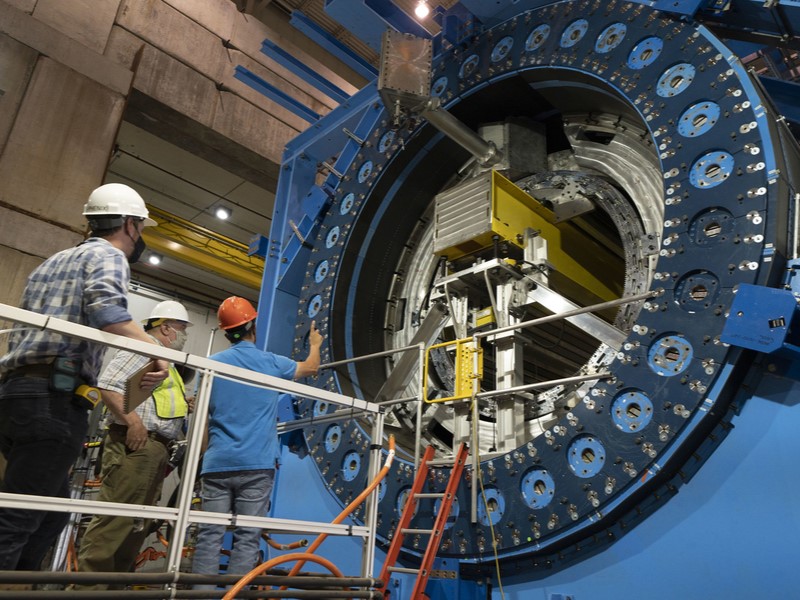
Standing as tall as a two-story house and built for speed, sPHENIX can record up to 15,000 collisions per second. That throughput is essential for capturing rare processes and accelerating discovery, giving researchers a deeper, more statistically robust look at how quark-gluon plasma behaves under extreme temperatures and densities.
Key components, including the inner hadronic calorimeter pictured during installation, are designed to capture the energy and flow of particles with high fidelity. This level of precision is vital for mapping how energy is distributed in the violent aftermath of collisions, a window into the strong nuclear force that binds the building blocks of matter.
With its “first light” test complete, sPHENIX is poised to tackle its primary mission: revealing the inner workings of the early universe. By measuring subtle patterns in particle production and energy flow, the detector will help scientists piece together how the primordial plasma evolved into the matter-rich cosmos we inhabit today. The payoff is not just a sharper picture of our origins, but a deeper understanding of the fundamental forces that govern everything from atomic nuclei to stars.
In short, sPHENIX has proven it’s ready. Now comes the exciting part: using this powerhouse detector to turn fleeting flashes of subatomic chaos into lasting insights about the universe’s first moments.