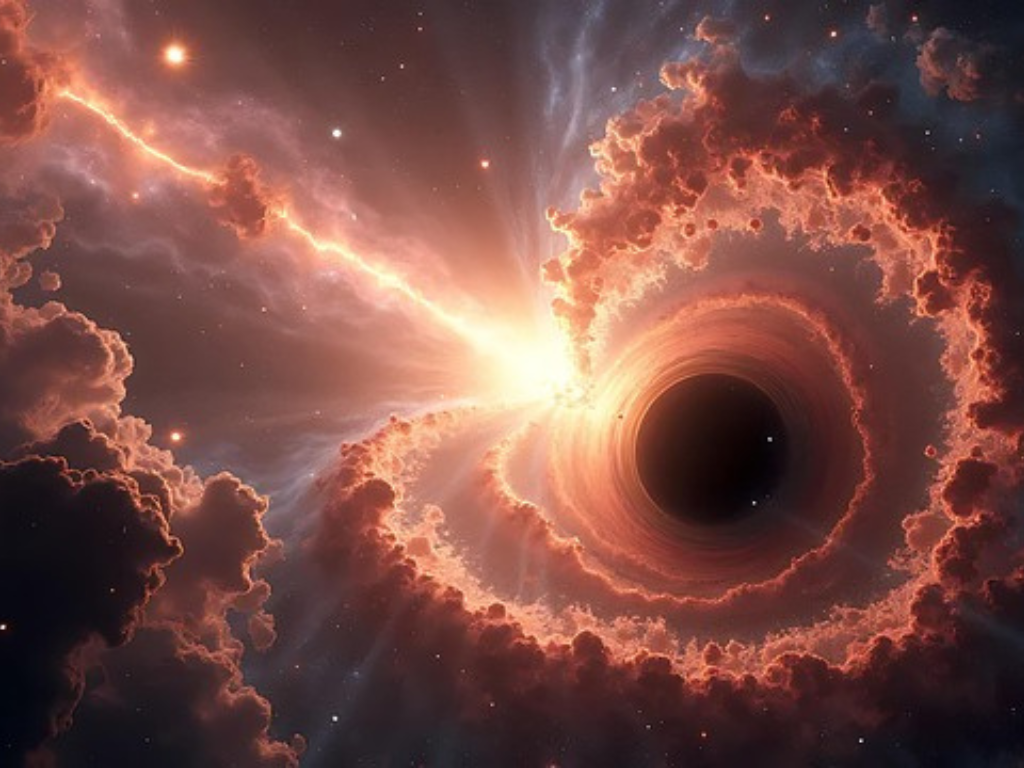
Exploding primordial black holes could be within reach: scientists say there’s a 90% chance one will be detected in the next decade using instruments we already have. Such a discovery would be a landmark moment in physics, offering direct evidence for primordial black holes—miniature black holes thought to have formed fractions of a second after the Big Bang, roughly 13.8 billion years ago.
The idea traces back to Stephen Hawking’s groundbreaking prediction that black holes aren’t completely black. Through a process now called Hawking radiation, they slowly leak energy and lose mass. The smaller the black hole, the faster it evaporates—ending, in theory, with a powerful final burst. That last gasp is exactly what astronomers hope to catch.
A new theoretical model gives the hunt a major boost. It proposes that if primordial black holes carry a tiny “dark” electric charge, their explosive finales could be far more frequent—roughly once every ten years instead of once every 100,000 years. That shift transforms a near-impossible event into something current observatories stand a real chance of seeing.
What would an exploding primordial black hole look like to our instruments? Researchers expect a brief, intense outpouring of energy and particles. The blast could spray familiar building blocks of matter—electrons, quarks, even Higgs bosons—alongside more exotic possibilities that lie beyond the standard model of particle physics, including candidates for dark matter. Spotting such a signal wouldn’t just tick a box on a theory checklist; it would open a rare window into physics at energies and conditions that haven’t been accessible since the universe’s first moments.
Crucially, the team behind the study argues that existing space- and ground-based telescopes are already sensitive enough to catch these events. A confirmed detection would deepen our understanding of Hawking radiation, help test how gravity and quantum mechanics intersect, and clarify the unseen makeup of the cosmos.
The findings were published on September 10 in Physical Review Letters. If the model is right, the next decade could deliver the first direct proof that primordial black holes exist—and with it, clues to the nature of dark matter and the fundamental laws that shaped the early universe.