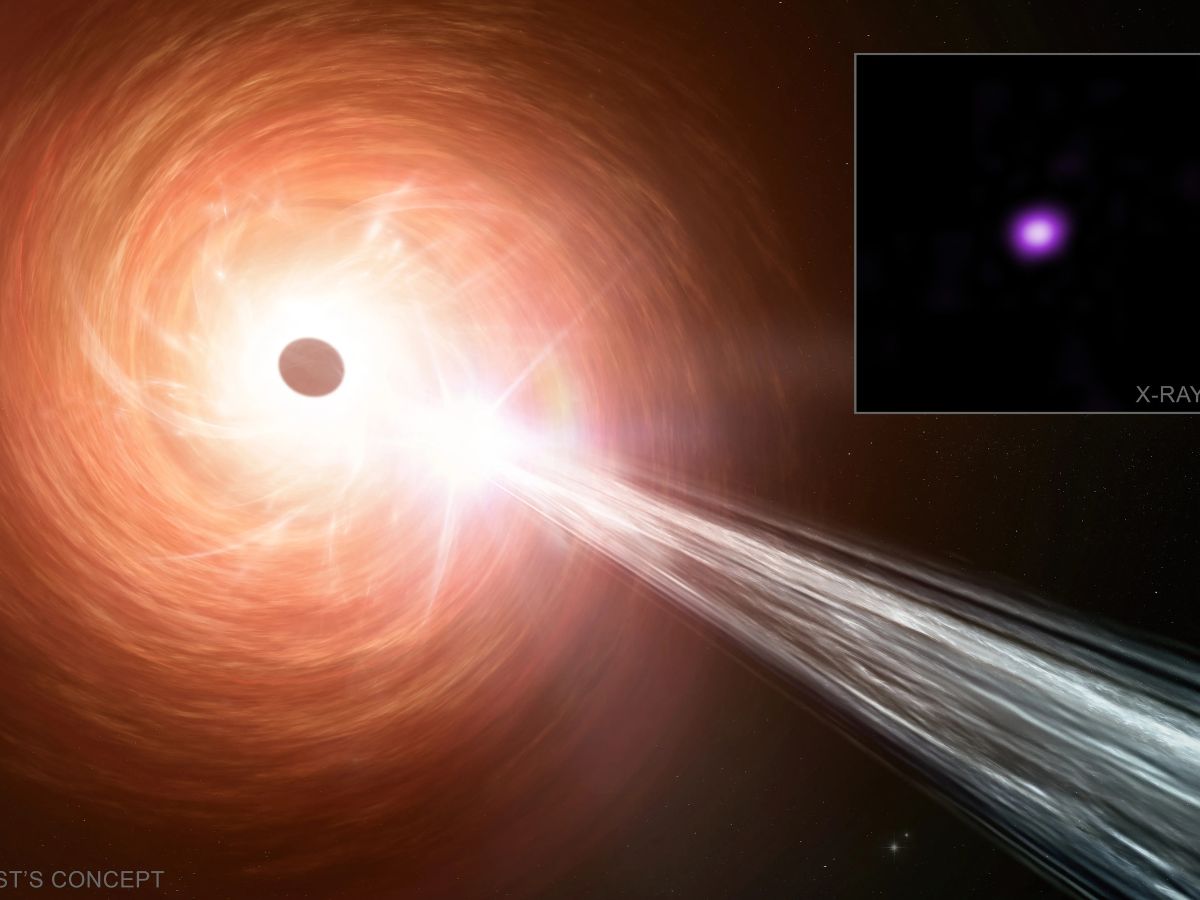
Astronomers have spotted a cosmic heavyweight in overdrive: a supermassive black hole growing faster than any ever recorded. Using data from NASA’s Chandra X-ray Observatory, researchers identified a quasar known as RACS J0320-35 whose central black hole is blazing through matter at an extraordinary pace, offering rare clues to how the universe’s first giants took shape.
Here’s what makes this discovery remarkable:
– Distance and time: The quasar sits about 12.8 billion light-years away, so we’re seeing it as it was just 920 million years after the Big Bang—at the dawn of cosmic history.
– Sheer scale: The black hole weighs in at roughly a billion times the mass of the Sun, yet it’s still rapidly bulking up.
– Dazzling power: As gas spirals inward through an accretion disk, it heats to extreme temperatures and emits intense radiation. In quasars, that glow can outshine the host galaxy itself.
The growth rate is the real shock. Black holes typically follow the Eddington limit, a balance point where the inward pull of gravity and the outward push of radiation keep accretion in check. For RACS J0320-35, researchers find two possibilities: either the black hole is devouring matter at around 2.4 times the Eddington limit—an extreme, so-called super-Eddington phase—or it started life as an unusually massive “seed” with more than 10,000 solar masses. That second scenario is far larger than the commonly accepted birth masses for black holes, which are generally under a hundred Suns.
When scientists compared the observations with theoretical models, the evidence leaned toward super-Eddington growth. Compellingly, the quasar also launches powerful jets of particles, a rare feature that may be linked to its furious accretion. These jets, combined with the unprecedented growth rate, make RACS J0320-35 a standout laboratory for studying black hole physics.
The results, reported in the Astrophysical Journal, help address one of astronomy’s biggest puzzles: how supermassive black holes formed so quickly in the early universe. If brief episodes of super-Eddington feeding were common, they could explain how billion-solar-mass black holes appeared less than a billion years after the universe began.
Why it matters:
– Illuminates how the first generation of black holes emerged and evolved.
– Tests models of extreme accretion, feedback, and jet formation.
– Refines our understanding of quasars as engines shaping young galaxies.
As more high-redshift quasars are uncovered and examined in X-rays and other wavelengths, astronomers expect to learn whether this record-breaking black hole is a rare outlier—or the tip of an early-universe iceberg.


