Astronomers have spotted a cosmic explosion so extreme that it’s rewriting what scientists expect from one of the universe’s most violent events. On July 2, researchers detected a powerful gamma-ray burst (GRB) now named GRB 250702B, and it refused to fade the way these bursts normally do. Instead of flashing for seconds or minutes, it kept going for at least seven hours, making it the longest-lasting GRB ever recorded.
Gamma-ray bursts are not new to astronomy. Since the first detection in 1973, scientists have logged roughly 15,000 GRBs. In most cases, they’re linked to catastrophic, fast-moving events such as two neutron stars colliding or a massive star collapsing into a black hole. These typical bursts are short-lived, intense, and over quickly.
GRB 250702B was different. Its marathon duration is the main reason it stands out, but it’s also what’s pushing astronomers toward an unusual explanation: a black hole consuming a star. In other words, rather than a rapid one-and-done collision, this may have been a drawn-out feeding event that kept generating enormous amounts of energy for hours.
Right now, scientists are weighing two main scenarios for what could have powered such a record-breaking gamma-ray burst.
One leading idea suggests an encounter with a rare kind of black hole known as an intermediate-mass black hole. These objects are thought to be a few thousand times the mass of the Sun—bigger than the stellar-mass black holes formed from dying stars, but smaller than the supermassive black holes found in the centers of galaxies. In this scenario, a star passed too close, gravity tore it apart, and the black hole rapidly devoured the stellar material, producing an unusually long, bright burst.
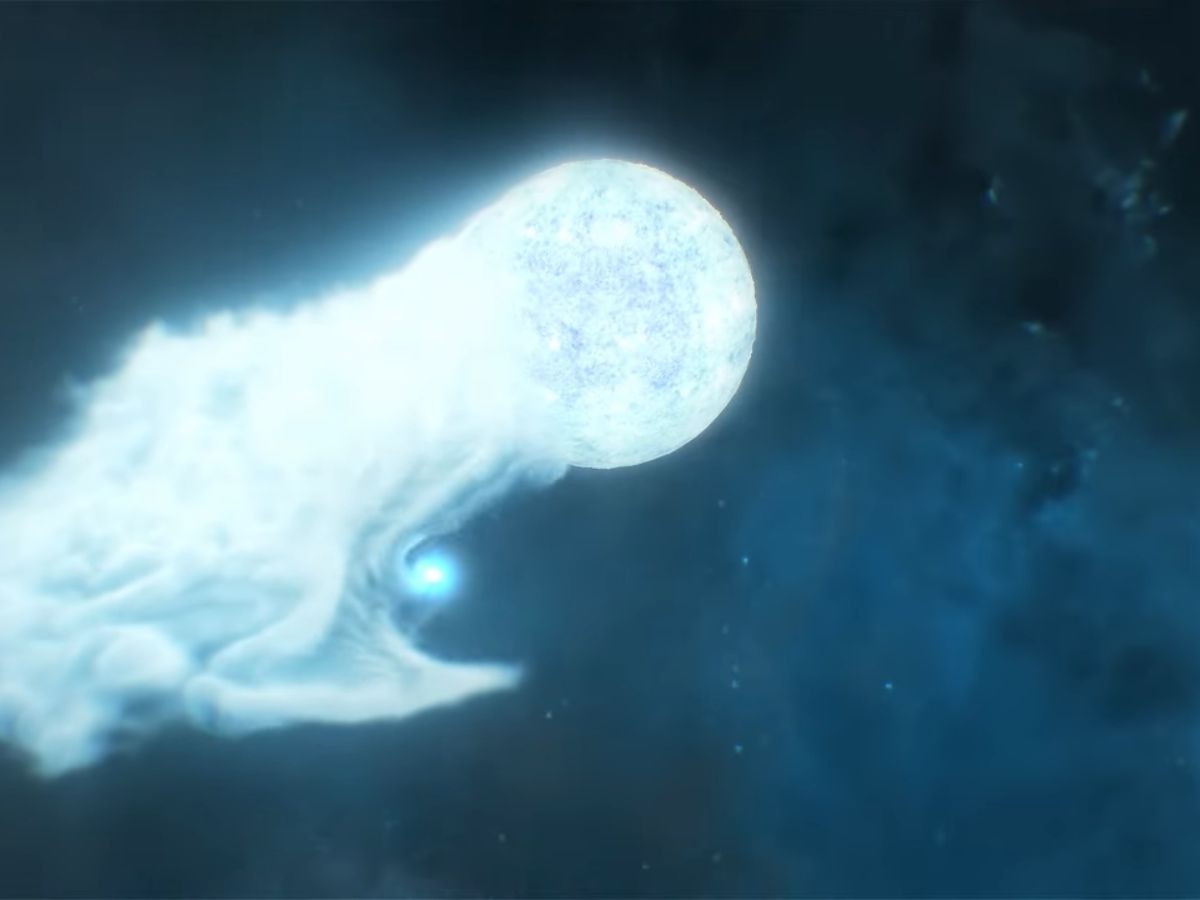
A second explanation points to a much smaller black hole, roughly three times the Sun’s mass, locked in an orbit with a helium star. A helium star is essentially a star that has lost its hydrogen outer layers. Researchers suggest the black hole may have been siphoning gas from the star over time. Eventually, the black hole could have plunged into the star itself, triggering a prolonged, violent feeding process that stretched the GRB across hours rather than minutes.
Adding to the mystery, astronomers report confusing and sometimes conflicting evidence in the data. One standout detail is the host galaxy: it appears to be unusually large compared with the galaxies that typically host gamma-ray bursts. That inconsistency makes it harder to settle on a single clean explanation and suggests GRB 250702B may not fit neatly into existing categories.
What isn’t in doubt is the staggering scale of the event. The energy released is described as equivalent to a thousand Suns shining for 10 billion years—an almost unimaginable output packed into a short slice of cosmic time.
Researchers will continue digging into the observations to understand how this GRB lasted so long, what kind of black hole was involved, and what the event reveals about extreme black hole–star interactions. For now, GRB 250702B stands as a record-setter and a reminder that the universe still has plenty of surprises left to deliver.


