Intel Arc G3 Extreme aims to redefine gaming handheld performance with major gains over AMD’s Z2 Extreme
Intel is making a serious push into the gaming handheld market with its new Arc G3 Extreme chip, a processor designed specifically for portable gaming devices rather than adapted from traditional laptop hardware. Built with the same architectural foundation as Intel’s upcoming Core Ultra Series 3 “Panther Lake” platform, the Arc G3 lineup is focused on delivering high frame rates, strong efficiency, and longer battery life in handheld gaming PCs.
That focus matters. Gaming handhelds are very different from laptops. They need strong graphics performance, tight power control, efficient thermals, and smooth gameplay at lower wattages. Intel says Arc G3 was engineered with those priorities from the start, and the early performance figures suggest a major step forward.
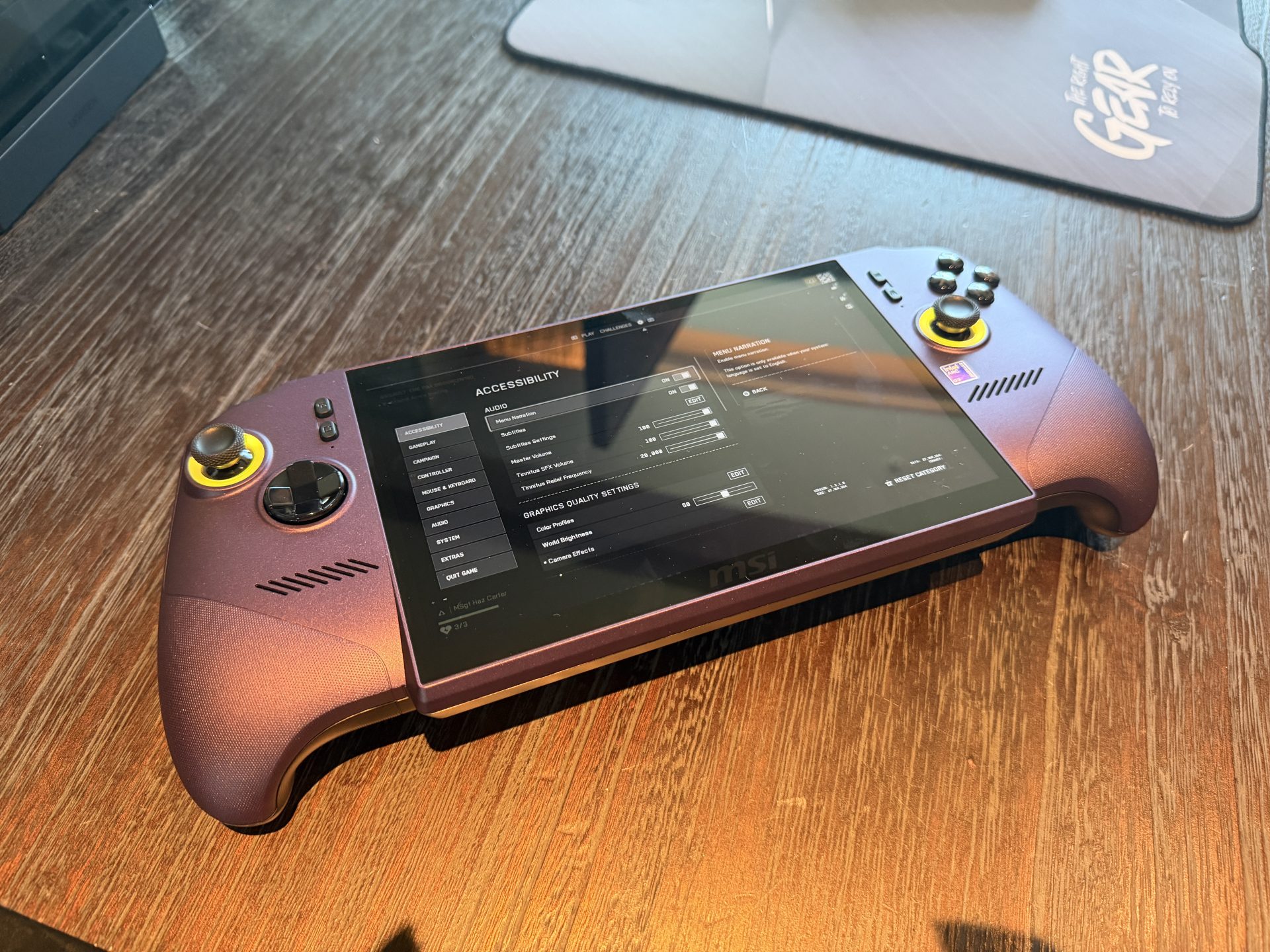
Several upcoming devices are already set to use the top-end Arc G3 Extreme chip, including the MSI Claw 8 EX AI+, OneXPlayer 3, and Acer Predator Atlas 8. More models are expected to join the lineup later, including handhelds using lower-cost Arc G3 variants.
The biggest story is performance. Intel compared the Arc G3 Extreme against its previous handheld-focused effort, the Core Ultra 7 258V from the “Lunar Lake” generation. While Lunar Lake was tuned to work well in compact gaming systems, it was not built as a pure handheld gaming chip in the same way Arc G3 is.
At 35W, the Arc G3 Extreme delivered an average performance uplift of 44% over the Core Ultra 7 258V running at 30W. In several games, the improvement exceeded 50%, showing a sizable generational leap. Cyberpunk 2077 saw one of the largest gains, with Intel claiming a 127% improvement. Battlefield V improved by 56%, Resident Evil Requiem by 44%, Red Dead Redemption 2 by 42%, Diablo IV by 38%, Horizon Zero Dawn Remastered by 34%, Death Stranding 2 by 30%, Hogwarts Legacy by 21%, and Hades II by 18%.
Even when both chips were limited to 17W sustained power, Arc G3 Extreme still came out 24% faster on average. That is an important result because handheld gamers often use lower power profiles to reduce heat, improve fan noise, and extend battery life.
Intel also positioned the Arc G3 Extreme directly against AMD’s Ryzen Z2 Extreme, one of the key chips currently targeting premium handheld gaming systems. At 35W sustained power, Intel says Arc G3 Extreme is 42% faster on average across a selection of games. In some titles, the gap was even larger, with several games running more than 50% faster on Intel’s new chip.
In Intel’s 35W testing, Crimson Desert ran 42% faster on Arc G3 Extreme, Assassin’s Creed Shadows was 43% faster, Cyberpunk 2077 improved by 42%, Call of Duty: Modern Warfare II increased by 42%, Diablo IV gained 41%, Rocket League improved by 41%, and Hollow Knight: Silksong also showed a 41% uplift.
At 17W, the advantage continued, with Arc G3 Extreme averaging 24% faster performance than the Ryzen Z2 Extreme. The comparison used the MSI Claw 8 EX AI+ for Intel’s chip and a Ryzen Z2 Extreme-based handheld for AMD’s platform.
The low-power numbers may be even more important for everyday handheld gaming. At 12W sustained power, Intel claims the Arc G3 Extreme is 37% faster on average than the Ryzen Z2 Extreme. According to Intel’s figures, Arc G3 Extreme was able to maintain playable frame rates above 30 FPS across multiple demanding titles, while the competing chip dropped below that threshold in several cases.
In Intel’s 12W testing, Arc G3 Extreme delivered around 37% to 39% higher performance across a wide range of games. Battlefield 6, Horizon Zero Dawn Remastered, Clair Obscur: Expedition 33, Death Stranding 2, Dying Light: The Beast, Returnal, Red Dead Redemption 2, The Last of Us Part II, Forza Horizon 6, Marvel Rivals, Black Myth: Wukong, Cyberpunk 2077, Hogwarts Legacy, Shadow of the Tomb Raider, Naraka: Bladepoint, F1 25, and GTA V Enhanced all showed strong gains.
This is where Intel’s handheld strategy becomes clearer. The company is not only chasing peak frame rates at higher wattages; it is trying to make demanding games playable at lower power levels. That could translate into cooler devices, quieter fans, and longer gaming sessions away from a charger.
Another major advantage Intel is highlighting is its XeSS 3 upscaling and frame-generation technology. Arc G3 Extreme supports Intel’s latest XeSS features, including multi-frame generation up to 4x modes. That gives Intel a strong software feature set for increasing perceived smoothness and boosting frame rates in supported games.
In Cyberpunk 2077 at 1080p High settings, Intel showed Arc G3 Extreme outperforming the Ryzen Z2 Extreme when upscaling and frame generation were enabled. With super resolution, Arc G3 Extreme reached 73 FPS compared to 52 FPS on the competing chip, a 40% uplift. With frame generation enabled, Intel’s chip reached 121 FPS compared to 89 FPS, a 36% improvement. With multi-frame generation, Arc G3 Extreme climbed to 199 FPS in Intel’s test.
Frame generation is not just about higher numbers on a chart. For handheld players, smoother motion and better frame pacing can make a compact gaming device feel much more responsive, especially on high-refresh displays. If Intel’s implementation performs well in real-world devices, XeSS 3 could become a major selling point for Arc-powered handhelds.
Efficiency is another area where Intel is making bold claims. In one test, Intel compared Arc G3 Extreme running at 17W against AMD’s Z2 Extreme running at 35W. The result was nearly identical performance across a long list of games, but at roughly half the power. Intel’s message is simple: similar gaming performance, lower power draw, and potentially longer battery life.
For handheld gaming PCs, that could be a major advantage. Battery life remains one of the biggest pain points for portable gaming systems, especially when playing modern AAA games. A chip that can maintain smooth performance at 12W or 17W instead of needing 30W or 35W could make a meaningful difference in daily use.
Intel also explained some of the design decisions behind Arc G3. The chip uses two performance cores instead of four, reduces the number of display engines from three to two, and cuts Thunderbolt support from four ports to two. These changes are meant to keep the chip within a practical power envelope for handheld devices.
At the same time, Intel kept the 12 Xe3 graphics cores intact. That makes sense because gaming handhelds are heavily GPU-focused. In many games, especially at 1080p or lower with upscaling, graphics performance and memory efficiency matter more than having a large number of high-power CPU cores.
A key part of Arc G3’s power strategy is Intelligent Bias Control v3.5. This technology helps balance power between the CPU and GPU depending on the workload. In gaming, the GPU often needs sustained power for long periods, while the CPU works in bursts. Intel found that on earlier platforms, the CPU and GPU could compete for power headroom, reducing overall gaming efficiency.
With Intelligent Bias Control, Intel prioritizes GPU frequency while stabilizing how power shifts between CPU and GPU resources. At very low wattages, this becomes even more important. Arc G3 introduces P-core parking, which can fully turn off the performance cores when the chip is running at 12W or lower. That allows the more efficient cores to handle lighter CPU tasks while freeing more power for the GPU.
Intel claims that enabling Intelligent Bias Control can improve Arc G3 performance by up to 31% at 12W. For handheld gaming, that is a significant boost because many users prefer low-power modes for travel, commuting, or extended play sessions.
Intel is also adding an Endurance Gaming feature aimed at improving battery life. This mode is designed to let players choose a custom frame-rate target, such as 30 FPS or 40 FPS, so the handheld can avoid wasting power rendering unnecessary extra frames. For portable gaming, a stable 40 FPS can often feel better than an unstable higher frame rate, especially when paired with a variable refresh rate display.
Overall, the Arc G3 Extreme appears to be Intel’s most serious attempt yet to compete in the gaming handheld space. The chip is not just a repurposed laptop processor; it has been tuned around the needs of portable gaming PCs, with stronger graphics performance, aggressive low-power optimization, XeSS 3 support, and improved efficiency.
If Intel’s performance claims hold up in retail devices, Arc G3 Extreme could become a major competitor to AMD-powered handhelds. More importantly, it could give buyers more choice in a fast-growing category where performance, battery life, and software features all matter.
The next wave of gaming handhelds could be much more competitive, and Intel clearly wants Arc G3 Extreme to be at the center of that shift.Intel Arc G-Series SoCs Aim to Boost Handheld Gaming With Longer Battery Life and Faster Load Times
Intel’s Arc graphics platform continues to gain momentum, and the company is now putting more focus on improving the real-world gaming experience, especially on portable devices powered by Arc G-Series SoCs. Instead of chasing extremely high frame rates at all times, Intel is introducing smarter performance features designed to balance smooth gameplay, power efficiency, and faster game loading.
One of the most interesting additions is Endurance Gaming, a feature built to extend battery life during gameplay. The idea is simple but highly practical: not every player needs a game running at 100 FPS or 200 FPS, especially on handheld gaming devices where battery life matters just as much as performance.
With Endurance Gaming enabled, the system can target a more efficient frame rate, such as 60 FPS, while using hardware-level frame pacing and SoC power controls to reduce unnecessary power draw. This allows games to remain smooth and playable while helping the device last much longer on a single charge.
Intel’s own testing shows a major improvement in battery life. In Forza Horizon 6, the company claims nearly 6 hours of gameplay with Endurance Gaming enabled, compared to roughly 3 hours when the feature is turned off. That kind of increase could make a big difference for gamers using portable PCs or handheld gaming systems, where power efficiency is often one of the biggest concerns.
Intel is also working to reduce one of the most frustrating parts of PC gaming: long shader compilation times. The company already supports Precompiled Shaders through its latest Arc Game-On drivers, and this feature is also planned for Arc G-Series SoCs.
Precompiled Shader Distribution allows the driver to automatically download shader data locally before it is needed in-game. This can help reduce stutter, improve loading behavior, and significantly cut down wait times when launching or entering games.
According to Intel, users may see up to a 3x improvement in game load times on average. For players, that means less waiting and more time actually playing. This is especially important for handheld gaming devices, where quick resume, fast startup, and smooth performance are key parts of the overall experience.
Beyond hardware, Intel is continuing to invest heavily in software support for its Arc GPU ecosystem. The company has been working closely with game developers to improve compatibility, optimize drivers, and support new graphics technologies across a growing number of titles.
Intel says it has received and evaluated more than 3,000 early access game builds under NDA. It has also worked with developers on over 1,000 games that are already available. This level of collaboration is important because strong driver support can make or break a GPU platform, especially in the competitive gaming market.
XeSS Super Resolution has also grown steadily, with more than 400 games now supporting Intel’s AI-powered upscaling technology. XeSS helps improve performance by rendering games at a lower internal resolution and then upscaling the image to deliver sharper visuals with higher frame rates.
Intel has also shipped more than 500 Arc GPUs to developers to help improve game optimization. Since the first Arc graphics launch, the company has provided Day-0 driver support for more than 200 games, helping players get better performance and stability as soon as major titles are released.
Another major part of Intel’s graphics push is XeSS Multi-Frame Generation, which is now supported in more than 100 games. This feature is designed to boost perceived smoothness by generating additional frames, helping supported games feel more fluid when paired with compatible Arc hardware.
Intel’s Arc journey did not have the smoothest start, but the platform has improved significantly over time. With Xe2, Intel began showing stronger hardware and software progress, and with Xe3, the company appears to be in its strongest position yet.
The upcoming Arc G3 series is expected to build on that progress later this year. With features like Endurance Gaming, Precompiled Shader Distribution, XeSS Super Resolution, and XeSS Multi-Frame Generation, Intel is clearly trying to make Arc more competitive not just in raw performance, but in overall gaming experience.
For PC gamers and handheld gaming fans, these updates could be very promising. Longer battery life, faster game loading, smoother frame pacing, and wider developer support are exactly the kinds of improvements that matter in everyday use.
Intel still has work to do in the GPU market, but its continued investment in Arc hardware, drivers, and developer tools shows that the company is serious about building a long-term graphics platform. If the Arc G-Series SoCs and future Arc G3 products deliver on these promises, Intel could become an even stronger player in gaming laptops, handheld PCs, and compact gaming systems.