Intel Arc G3 Extreme could be the handheld gaming chip to watch
Intel is making a serious push into the gaming handheld market with its new Arc G3 series, and the flagship Arc G3 Extreme is shaping up to be one of the most interesting chips for portable gaming PCs. Unlike earlier handheld solutions that often adapted laptop-focused processors for smaller devices, Intel says Arc G3 was designed specifically around the needs of handheld gaming: low power draw, strong integrated graphics, smarter thermal behavior, and longer play sessions.
The Arc G3 series is based on the same technology family as Intel’s upcoming Core Ultra Series 3 “Panther Lake” platform, but the goal here is different. Instead of chasing traditional laptop performance, Intel is targeting the sweet spot for handhelds: efficient gaming at 12W to 35W, where every watt matters.
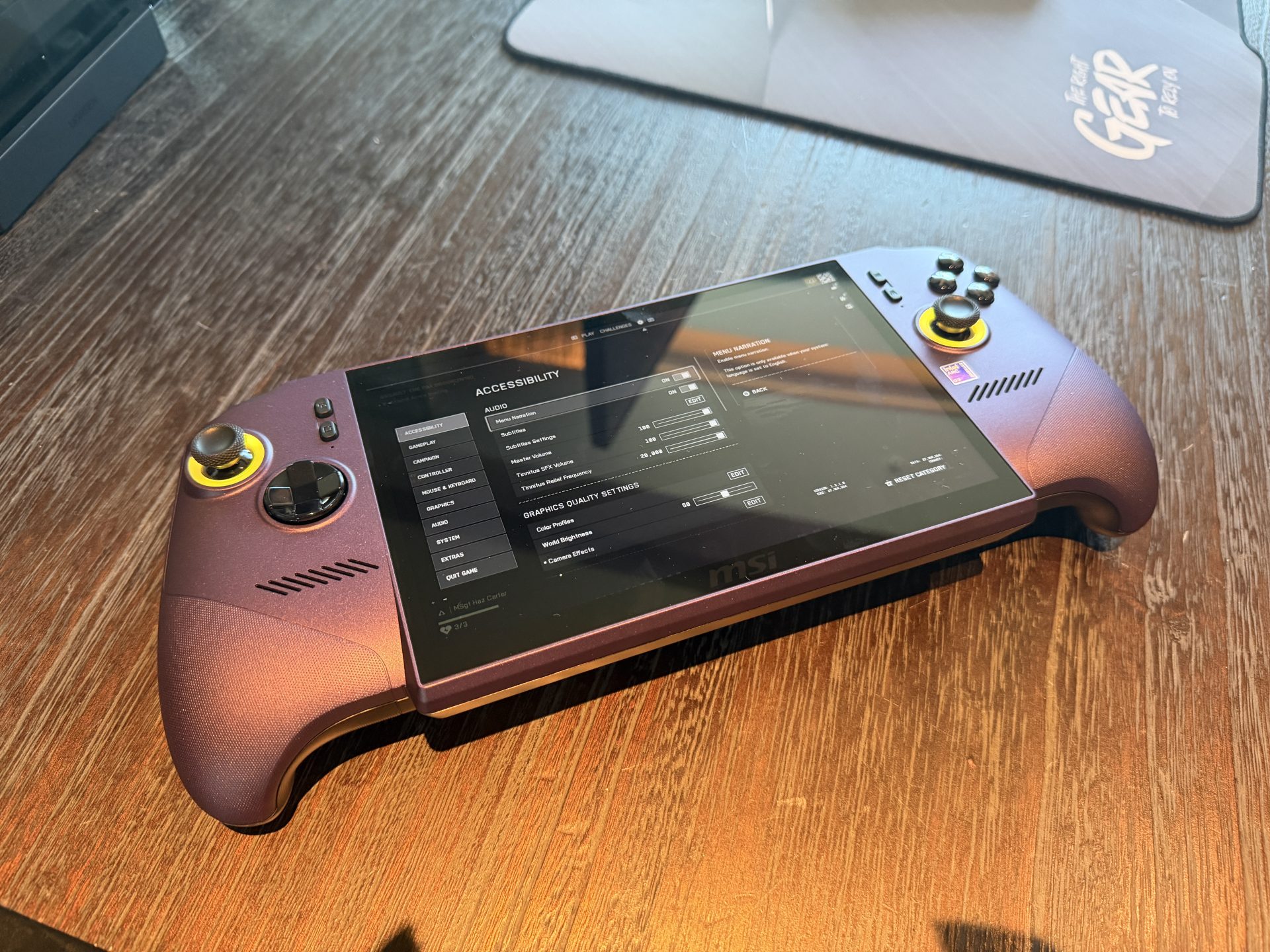
At a handheld showcase in Taipei, several Arc G3 Extreme-powered devices were shown, including the MSI Claw 8 EX AI+, OneXPlayer 3, and Acer Predator Atlas 8. More handhelds using lower-cost Arc G3 chips are also expected, which could make Intel’s new platform a major player across different price ranges.
Intel Arc G3 Extreme vs previous Intel handheld chips
Intel’s last major handheld-focused effort came from the Core Ultra Series 2 “Lunar Lake” family. Those chips were made more suitable for handhelds through power tuning, but they were not built from the ground up as dedicated gaming handheld processors.
Arc G3 changes that approach.
According to Intel’s own benchmark data, the Arc G3 Extreme running at 35W delivers an average performance uplift of around 44% over the Core Ultra 7 258V running at 30W. In several games, the gains go beyond 50%, while one title showed performance more than doubling thanks to optimizations for Intel’s newer Xe3 graphics architecture.
Examples from Intel’s testing include strong gains in games such as Cyberpunk 2077, Red Dead Redemption 2, Battlefield V, Diablo IV, Hogwarts Legacy, Hades II, and Horizon Zero Dawn Remastered. Even when both chips are limited to a 17W sustained power target, Arc G3 Extreme remains around 24% faster on average.
That is an important result because handheld gaming performance is not only about peak speed. Most players care more about stable frame rates, battery life, fan noise, and comfort. If Intel can deliver higher performance at the same or lower power levels, Arc G3 could become a much more practical solution for real-world portable gaming.
Intel Arc G3 Extreme vs AMD Ryzen Z2 Extreme
The bigger comparison is against AMD’s Ryzen Z2 Extreme, one of the most powerful handheld gaming chips currently positioned for premium portable gaming PCs.
Intel claims that when both chips run at 35W, the Arc G3 Extreme is around 42% faster on average across a broad selection of games. In tested titles such as Assassin’s Creed Shadows, Cyberpunk 2077, Call of Duty: Modern Warfare II, Diablo IV, Rocket League, Hollow Knight: Silksong, and Crimson Desert, Intel’s chip showed gains generally sitting around the low-40% range.
The advantage remains when power is reduced. At 17W, Intel says Arc G3 Extreme is still 24% faster on average than the Ryzen Z2 Extreme. At an even lower 12W power limit, the gap reportedly grows to around 37% on average.
That 12W figure may be the most important one for handheld gamers. Lower wattage usually means longer battery life, less heat, and quieter operation. Intel says Arc G3 Extreme can maintain more than 30 FPS across multiple demanding games at 12W, while the competing chip can fall below that threshold in the same tests.
Intel’s 12W test list included games such as Battlefield 6, Horizon Zero Dawn Remastered, Clair Obscur: Expedition 33, Death Stranding 2: On The Beach, Returnal, Red Dead Redemption 2, The Last of Us Part II, Forza Horizon 6, Marvel Rivals, Black Myth: Wukong, Cyberpunk 2077, Hogwarts Legacy, Shadow of the Tomb Raider, F1 25, and GTA V Enhanced.
For handheld players, this is exactly the kind of performance profile that matters. A chip that can stay playable at 12W could make a noticeable difference during travel, commuting, or long couch gaming sessions away from a charger.
XeSS 3 and frame generation could be a major advantage
Raw graphics performance is only part of the story. Intel is also leaning heavily on XeSS, its AI-powered upscaling and frame generation technology.
The Arc G3 Extreme supports Intel’s latest XeSS 3 features, including multi-frame generation with support for up to 4x modes. This gives Intel a potential advantage in handheld gaming, where upscaling and frame generation can help games feel smoother without requiring the chip to render every frame natively.
In Intel’s Cyberpunk 2077 test at 1080p High settings, Arc G3 Extreme reached 73 FPS with super resolution compared to 52 FPS on the competing handheld chip using its upscaling option. With frame generation enabled, Intel showed 121 FPS versus 89 FPS. With multi-frame generation, Intel reported up to 199 FPS, while the competing platform did not offer an equivalent result in that test.
Of course, frame generation is not the same as pure native performance, and latency still matters, especially in fast-paced games. But for handheld gaming, where users often target 30 FPS, 40 FPS, or 60 FPS, strong upscaling and frame generation support can make demanding games much more playable.
Efficiency may be Arc G3 Extreme’s biggest selling point
One of Intel’s most interesting claims is not that Arc G3 Extreme is faster at the same power, but that it can offer similar performance at much lower power.
Intel compared Arc G3 Extreme running at 17W against Ryzen Z2 Extreme running at 35W. In that scenario, Arc G3 Extreme reportedly delivered similar or slightly better performance while using roughly half the power. Tested games included Call of Duty: Modern Warfare II, Crimson Desert, Battlefield, Forza Horizon 6, Assassin’s Creed Shadows, The Last of Us Part II, Cyberpunk 2077, Hogwarts Legacy, Diablo IV, Returnal, Red Dead Redemption 2, Fortnite, and more.
If these numbers hold up in retail devices, the benefit could be huge. Better performance per watt can translate directly into longer battery life, lower temperatures, and a more comfortable handheld experience. That is especially important because many powerful handhelds today can drain their batteries quickly when running demanding games at high wattage.
Why Arc G3 is different from a laptop chip
Intel also revealed some of the design choices behind Arc G3. The chip has been tuned specifically for handheld systems with optimized I/O, new power management strategies, configurable TDP options, and deeper platform-level engineering.
One major design change is the CPU core layout. Intel is using two performance cores instead of four, reducing the display engines from three to two, and cutting Thunderbolt support from four ports to two. These changes help keep the chip inside the thermal and power limits needed for a gaming handheld.
The important part is that Intel kept the 12 Xe3 graphics cores intact. That makes sense because handheld gaming systems are usually limited more by GPU performance than CPU performance. By shifting more of the power budget toward graphics, Intel is trying to deliver better gaming results where they matter most.
Intelligent Bias Control v3.5 improves power sharing
Arc G3 also introduces an updated version of Intel’s Intelligent Bias Control technology. This system is designed to manage power more intelligently between the CPU and GPU.
In handheld gaming, the GPU usually needs sustained power for long periods, while the CPU often works in shorter bursts. If the CPU and GPU compete too aggressively for the same limited power budget, game performance can suffer. Intel’s solution prioritizes GPU frequency while stabilizing how power shifts between the CPU and graphics cores.
With Intelligent Bias Control v3.5, Intel adds a feature called P-Core parking. When the system is running at 12W or lower, the performance cores can be turned off entirely, allowing the more efficient cores to handle lighter CPU work while freeing more power for the GPU.
Intel says this can improve Arc G3 performance by up to 31% at 12W. That could be a key reason why the chip performs so well in low-power gaming scenarios.
Endurance Gaming Mode aims for longer play sessions
Intel is also adding an Endurance Gaming Mode for handheld devices. This feature is designed to let users choose a custom frame rate target, such as 30 FPS or 40 FPS, depending on the device and game.
For handheld gaming, this kind of mode is extremely useful. Not every player needs the highest possible frame rate all the time. Locking a game to a stable lower FPS target can reduce power consumption, improve battery life, lower heat, and create a smoother overall experience.
A stable 40 FPS at lower wattage can often feel better on a handheld than an unlocked frame rate that jumps around while draining the battery quickly.
Arc G3 Extreme could reshape the handheld gaming market
Intel’s Arc G3 Extreme appears to be a major step forward for handheld gaming PCs. Based on Intel’s performance claims, the chip offers large gains over the previous Intel handheld platform, strong advantages over the Ryzen Z2 Extreme in many gaming scenarios, and impressive efficiency at lower power limits.
Its biggest strengths appear to be low-wattage gaming, XeSS 3 support, multi-frame generation, and power management features designed specifically for handheld systems. If device makers can pair Arc G3 with good cooling, high-quality displays, and well-optimized software, the next generation of Intel-powered handhelds could become very competitive.
The real test will come when retail devices launch and independent testing can measure performance, battery life, thermals, and game compatibility in everyday use. But on paper, Intel Arc G3 Extreme looks like one of the most promising handheld gaming chips yet, especially for players who want strong performance without sacrificing portability or battery life.Intel Arc Gaming Updates Aim to Boost Battery Life, Load Times, and Game Support
Intel is continuing to sharpen its Arc graphics platform with a growing mix of hardware-level features, driver improvements, and developer-focused tools. The company’s latest updates show a clear goal: make Arc-powered systems run games more smoothly, load faster, and last longer on battery without forcing players to sacrifice the experience they actually want.
One of the most interesting additions is Endurance Gaming, a feature designed for players who prefer longer play sessions over extremely high frame rates. Not every game needs to run at 100 FPS, 144 FPS, or 200 FPS, especially on portable systems where battery life matters. For many players, a stable 60 FPS can deliver a smooth, responsive, and enjoyable gaming experience.
Endurance Gaming works by handling frame pacing at the hardware level while also using SoC power controls to reduce power consumption. Instead of letting the system push unnecessary frames, the feature helps games run at a more efficient pace. The result is lower power draw, better thermal behavior, and significantly longer playtime.
Intel’s own testing highlights the potential impact. With Endurance Gaming enabled, Forza Horizon 6 reportedly ran for nearly six hours, compared to around three hours with the feature disabled. That kind of improvement could be a major advantage for gaming handhelds, thin-and-light laptops, and other battery-powered devices using Intel Arc graphics.
Intel is also improving the game-loading experience through Precompiled Shader Distribution. This feature is already available through the latest Arc Game-On drivers and is planned for Arc G-Series SoCs as well.
Shader compilation has long been a source of stutter, delays, and long loading screens in PC gaming. With precompiled shaders, Intel’s driver can automatically download the required shader data locally. This allows supported games to load faster and reduces the need for the system to compile everything on the fly.
According to Intel, users may see load times improve by up to three times on average in many games. For gamers, that means less waiting, quicker access to gameplay, and a smoother first-run experience after installing or updating a title.
Beyond individual features, Intel is putting serious effort into building a stronger software ecosystem around Arc. The company says it has received and evaluated more than 3,000 early-access game builds under NDA. It has also worked with developers on more than 1,000 released games, showing a broader push to improve compatibility and performance across the PC gaming market.
XeSS Super Resolution continues to grow as well, with support now available in more than 400 games. Intel has also been providing developers with Arc graphics hardware, with more than 500 GPUs shipped to help studios test, optimize, and implement Arc-focused features.
Driver support has improved notably since the first Arc launch. Intel says it has delivered day-zero driver support for more than 200 games, helping new titles run better as soon as they arrive. The company is also expanding support for XeSS Multi-Frame Generation, which is now available in more than 100 games.
These updates show how far Intel Arc has come since its early days. The platform faced a challenging start, but Intel has continued to invest in drivers, developer relations, AI-powered upscaling, frame generation, shader optimization, and power-saving technology.
With Xe2 already bringing stronger momentum and Xe3 expected to push the platform further, Intel appears committed to making Arc a more competitive option in the graphics market. The upcoming Arc G3 series will be an important test for the company’s long-term GPU strategy, but the software foundation is clearly becoming stronger.
For PC gamers, the most important takeaway is simple: Intel Arc is no longer just about raw hardware. The platform is becoming a full gaming ecosystem built around performance, efficiency, faster loading, and broader game support. If Intel continues at this pace, Arc could become an increasingly attractive choice for players who want smoother gameplay, better battery life, and modern graphics features in future gaming systems.