A mysterious particle from deep space is giving astronomers a fresh cosmic puzzle to solve. Known as Amaterasu, this ultra-high-energy cosmic ray was detected in 2021 by the Telescope Array Project in the United States, and it instantly stood out for one reason: its staggering energy. In fact, it ranks as the second most powerful cosmic ray ever recorded, placing it among the rarest and most extreme particles to ever hit Earth’s atmosphere.
Despite its blockbuster detection, one big question remains unanswered: where did it come from?
Cosmic rays like Amaterasu are not ordinary bursts of radiation. They’re individual particles accelerated to near-light speed by some of the most violent environments in the universe. That usually means powerful astrophysical engines such as black holes, exploding stars (supernovae), or other high-energy structures capable of hurling particles across millions of light-years.
One early idea suggested that Amaterasu may have arrived from the Local Void, a nearby region of space with relatively few galaxies. While intriguing, that possibility raised eyebrows—because an emptier patch of the universe sounds like an unlikely place to find the kind of extreme cosmic “slingshot” needed to accelerate a particle to Amaterasu’s immense energy.
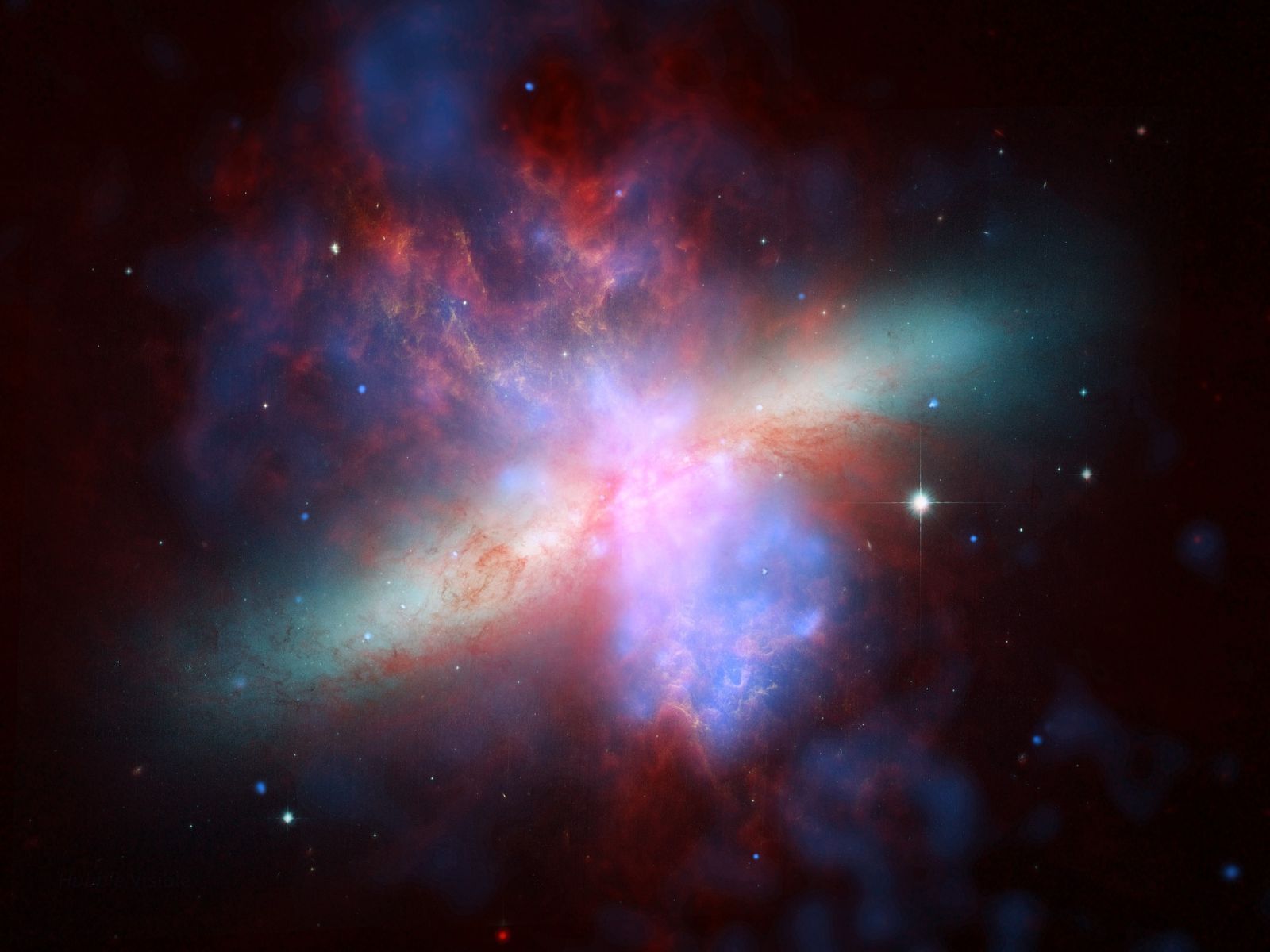
Now, a newer study published in The Astrophysical Journal points to a different and far more energetic suspect: the galaxy M82.
M82, often described as an exceptionally active spiral galaxy, sits roughly 12 million light-years from Earth. It’s the kind of place where high-energy events don’t happen once in a while—they’re part of the galaxy’s personality. Researchers note that M82 features intense galactic winds, hosts black holes, and has shown evidence of supernova activity. Put together, that’s exactly the kind of astrophysical environment that could, in theory, accelerate a cosmic ray to extreme energies and send it racing toward our corner of the cosmos.
Still, the researchers are careful not to lock in a single answer too soon. The study also mentions other possible source galaxies, including NGC 6946 and NGC 2403. These galaxies are considered less active than M82, which may make them less likely candidates—but they remain on the list of possibilities while scientists continue narrowing down the origin.
For now, the mystery isn’t solved, but the path forward is clear: better observations and more data. Ongoing work with the Telescope Array Project, along with the Pierre Auger Observatory in Argentina, is expected to strengthen the search. Planned upgrades and improved detection capabilities could help scientists trace future ultra-high-energy cosmic rays more precisely, building the evidence needed to pinpoint whether Amaterasu truly came from M82—or from somewhere even more surprising.
Until those new observations arrive, Amaterasu remains one of the most fascinating cosmic visitors ever detected: a single particle carrying a message from some of the universe’s most extreme regions, with its exact birthplace still hidden in the dark.


