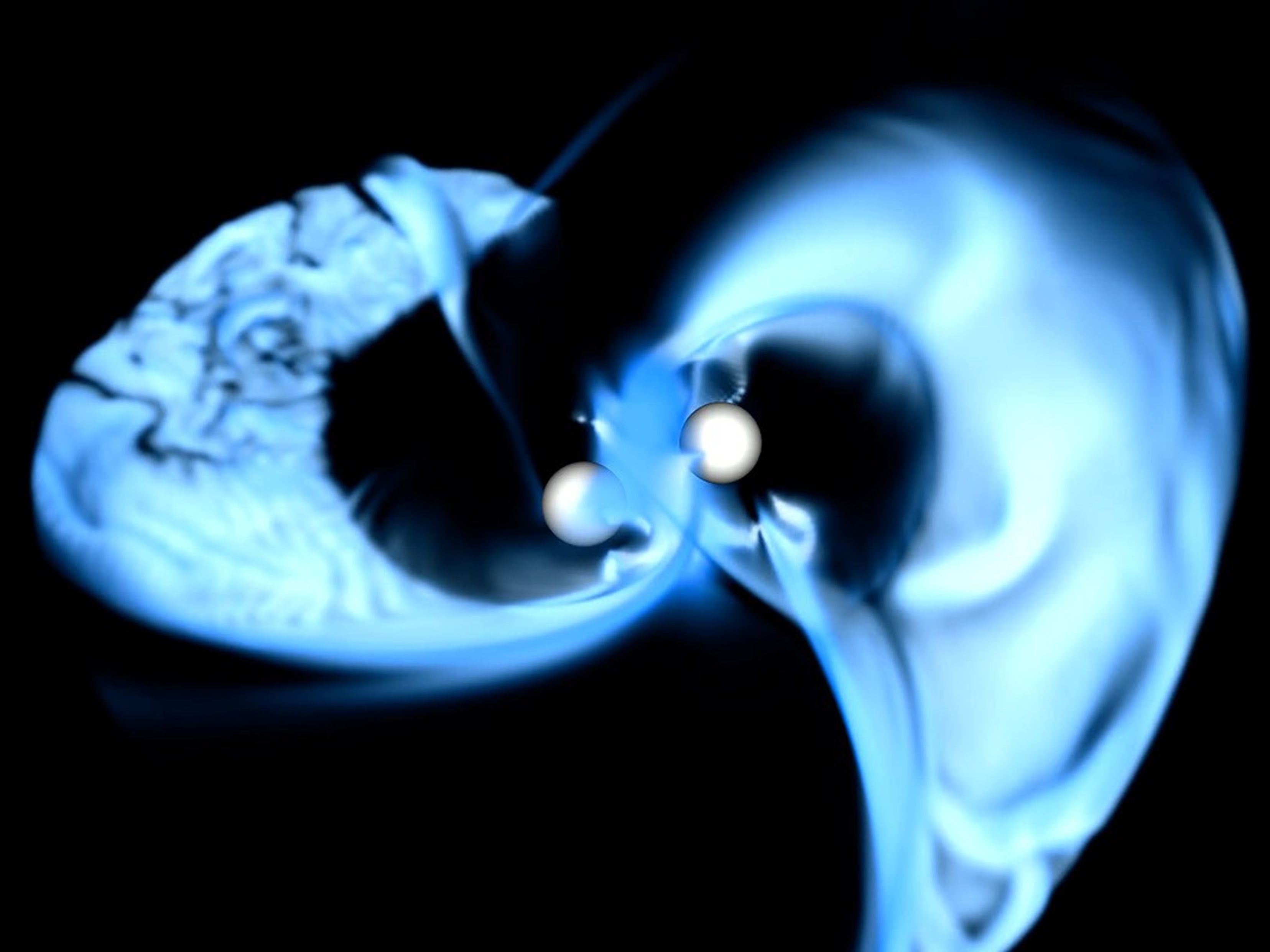
Neutron star mergers are among the most extreme events in the cosmos, unleashing colossal blasts known as gamma-ray bursts. But new simulation work suggests the real action may begin in the final eye-blink before impact—just milliseconds ahead of the collision—when magnetic forces surge and tangle in ways that can shape what we eventually detect from Earth.
As two neutron stars spiral toward one another, they can spin dozens of times every second. That rapid motion helps generate magnetic fields so intense they rank among the strongest known in the universe—up to about 10 trillion times stronger than a typical refrigerator magnet. In environments that powerful, magnetism doesn’t just steer charged particles. It can directly influence how radiation and matter behave, even converting gamma-rays into electrons and positrons, then whipping those particles to extraordinary energies.
To understand how this brief pre-merger phase unfolds, scientists used NASA’s Pleiades supercomputer to run more than 100 simulations. The goal was to test how different magnetic field setups change the way electromagnetic waves travel and escape from a system of two orbiting neutron stars, each about 1.4 times the mass of the Sun. Most simulations zoomed in on the last 7.7 milliseconds before the merger—a tiny slice of time that may hold crucial clues for early warning signals.
What the simulations showed is dramatic: in those final milliseconds, magnetic field lines don’t remain orderly. They twist together, connect, snap apart, and reconnect in rapid succession. This magnetic reconnection drives a furious exchange where particles turn into radiation and radiation turns back into particles, creating a chaotic but powerful engine for high-energy emission right before the stars crash.
The models also pinpointed where the most energetic gamma-rays are likely generated. Paradoxically, the highest-energy gamma-rays may never escape at all. In such intense magnetic fields, they are quickly transformed into particles, effectively trapping that portion of the signal within the system. Lower-energy gamma-rays, however, have a better chance of breaking free. And once they do, they may later produce X-rays—an important detail for astronomers hoping to catch the “before” picture of a neutron star merger rather than only the aftermath.
This is where future space observatories could make a major leap. By targeting these lower-energy gamma-rays and potential X-ray signatures, upcoming instruments may be able to detect radiation that leaks out just before the merger, giving scientists a rare glimpse into the final milliseconds leading up to one of the universe’s most violent collisions. Such observations could deepen our understanding of gamma-ray bursts, extreme magnetic physics, and how neutron star mergers broadcast their presence across space.