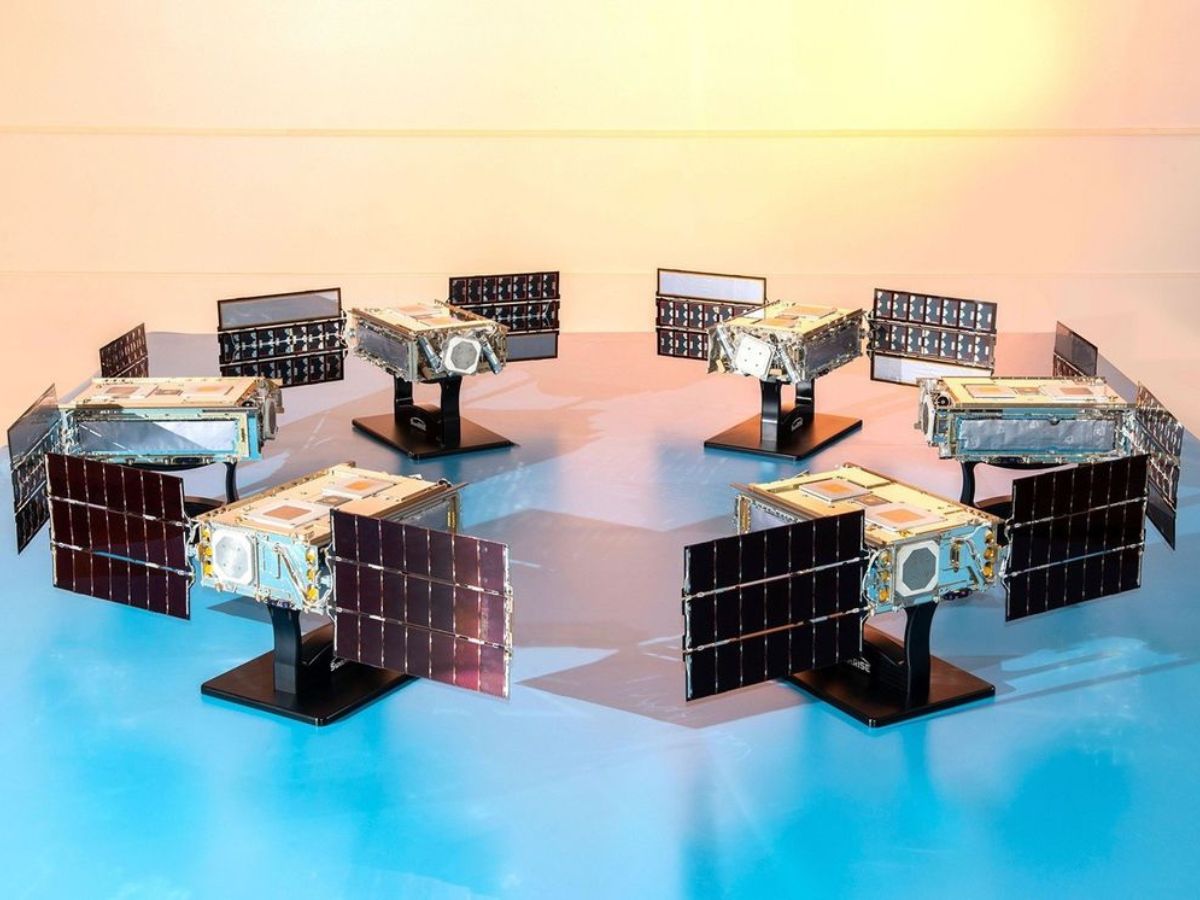
NASA is preparing to launch SunRISE, a heliophysics mission slated for summer 2026 that will give scientists a powerful new way to track dangerous solar activity. The mission will use six small satellites flying in formation to pinpoint where solar radio bursts originate and determine which direction energetic particles are streaming from the Sun. The goal is to improve space weather forecasts and better protect astronauts and satellites operating beyond Earth’s magnetic shield.
When the Sun unleashes solar flares or coronal mass ejections, it accelerates particles to high speeds and produces intense solar radio bursts. Those radio signals arrive first, while the energetic particles follow behind through the solar system. These particles can endanger crewed missions and disrupt satellites, communications, and navigation systems. Understanding where the bursts form and how they evolve is key to predicting the path and impact of these radiation events.
SunRISE, short for Sun Radio Interferometer Space Experiment, tackles this challenge by flying six small satellites about 6 miles (10 kilometers) apart in Earth orbit. By combining their signals through interferometry, the satellites act together like one large radio telescope. This approach allows the mission to localize the origin of solar radio bursts and infer the direction of the associated particle streams with far greater precision than a single spacecraft could provide.
What SunRISE aims to deliver:
– Earlier, more accurate warnings about the direction and intensity of radiation events
– Better protection strategies for astronauts traveling beyond low Earth orbit
– Improved risk assessments for satellites and critical space-based infrastructure
SunRISE will launch as a rideshare aboard a United Launch Alliance Vulcan Centaur rocket. Once operational, it will complement other major heliophysics missions, including STEREO, Parker Solar Probe, and Solar Orbiter. Together, these missions will offer a more complete picture of how solar storms begin, how they evolve, and how they affect the space environment around Earth.
With SunRISE, NASA is taking a significant step toward sharper, faster space weather forecasting—critical for the safety of human spaceflight and the resilience of the satellite systems modern life depends on.


