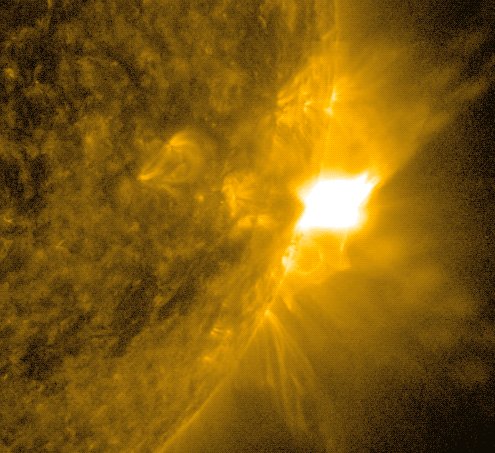
Early yesterday morning, a significant solar event was captured by NASA’s Solar Dynamics Observatory—a strong solar flare peaking at X1.5. This solar flare, occurring at 7:08 a.m. ET, is part of a series of intense solar activities observed over the past weeks. Earlier this month, two notable flares with peak intensities of X1.4 were also detected by NASA’s vigilant solar research satellites.
Solar flares, powerful bursts of radiation emanating from the sun, have far-reaching effects, especially on electronic systems and communication networks both on Earth and in space. They can cause disruptions in satellite operations, navigation, and communications systems. However, it is reassuring to note that none of the top 10 most powerful solar flares recorded in history have occurred in the last five years.
This recent solar flare, classified as X1.5, stands out but does not come close to the intensity of the strongest on record, which was observed on November 4, 2003, and reached beyond the X40 level with a duration of 37 minutes. Comparatively, an M-class solar flare, which hit on June 8th causing a sizable radiation storm, led to a major radio blackout in the northern polar region. This event was rated at M9.7, indicating it was nearly an order of magnitude less intense than the X-class flares.
For those interested in understanding more about the phenomenon of solar flares and their potential impacts, insights can be found in readily available literature, such as the informative guide, “Solar Flares: What You Need to Know” by Whitley Strieber, which provides an accessible explanation suited for a general audience.
As humanity’s reliance on technology grows, understanding and monitoring solar activity have become crucial to safeguarding infrastructure and communications. The work of agencies like NASA and the NOAA Space Weather Prediction Center remains invaluable for predicting and mitigating the effects of space weather events.
By staying informed about solar activity and the research surrounding it, individuals and organizations can better prepare for and respond to the potential disruptions caused by these powerful natural phenomena. It is always beneficial to follow updates from credible space agencies and weather prediction centers for the latest information and protective measures against solar flare implications on our modern world.


