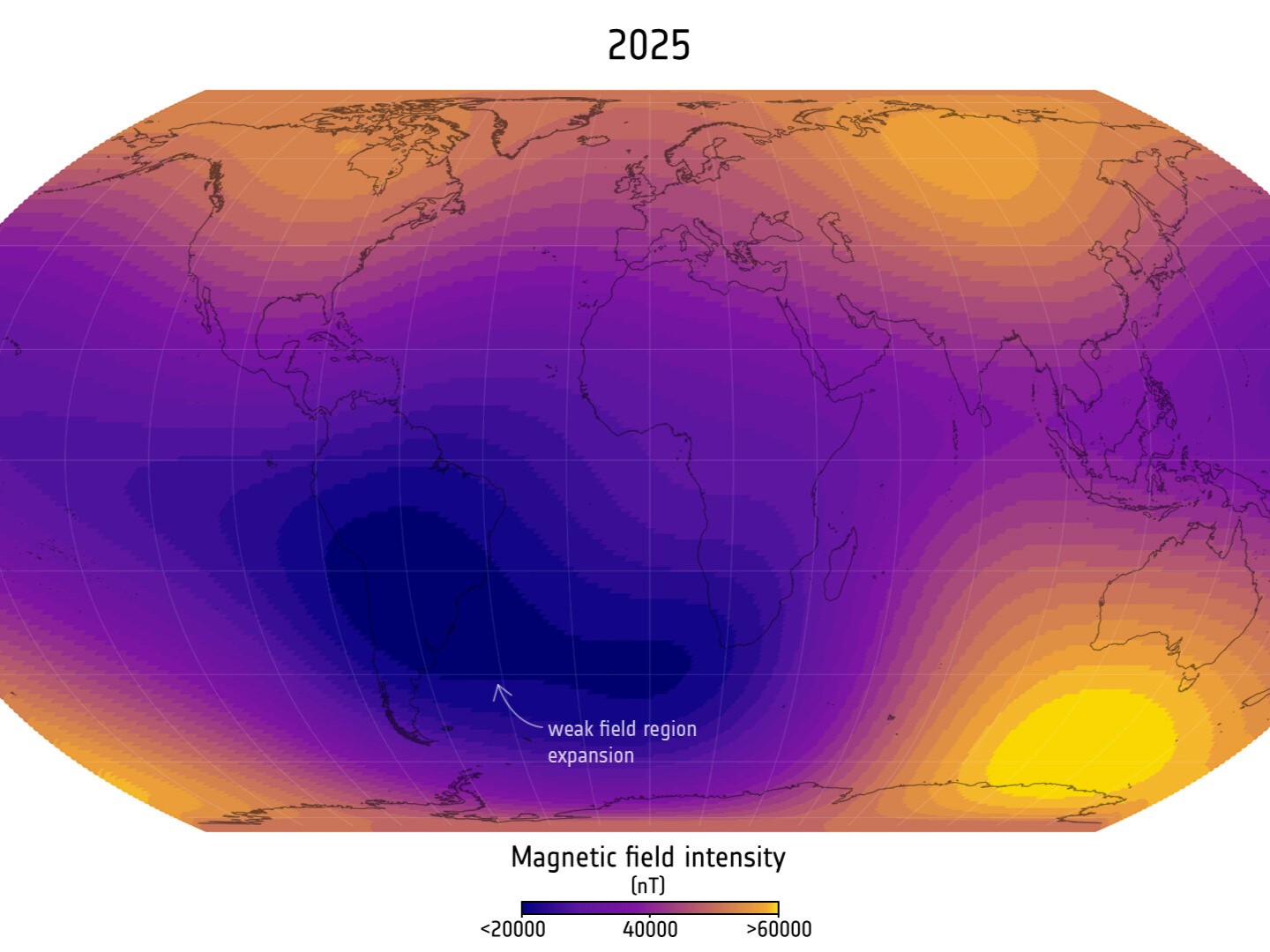
Earth’s protective magnetic shield has a growing weak spot, and it’s expanding faster than expected. Using a decade of measurements from the European Space Agency’s Swarm satellite constellation, researchers have mapped a steady decline in magnetic strength over the South Atlantic, confirming a larger and more complex South Atlantic Anomaly than previously recorded.
Launched in November 2013, the trio of identical Swarm satellites has now delivered the longest continuous record of Earth’s magnetic field ever collected from space. That uninterrupted view is revealing how the field changes over time and where those changes are accelerating.
Between 2014 and 2025, the South Atlantic Anomaly expanded by an area comparable in size to continental Europe. Within that broader weak zone, Swarm data highlight a second, more alarming trend: a pocket of especially rapid magnetic weakening southwest of Africa that has been intensifying since 2020. This concentrated decline is drawing increased attention because localized changes can have outsized effects on satellites and spacecraft that pass through the region.
The new maps do not only show where the field is weakening; they also trace where it remains stronger. Swarm found one prominent high-strength area in the southern hemisphere and two in the north—one centered around Canada and another over Siberia. Over recent years, the Siberian high-strength region has grown stronger, while the Canadian one has weakened, underscoring the magnetic field’s dynamic and uneven behavior.
Why this matters is straightforward: Earth’s magnetic field is a vital shield against charged particles from the Sun and cosmic radiation. Variations in its strength can influence the radiation environment in near-Earth space, with implications for satellite operations, spacecraft electronics, navigation systems, and mission planning. By pinpointing where and how quickly the field changes, scientists can better assess risks, refine models of space weather, and investigate the processes in Earth’s core that drive these shifts.
The latest findings, published in the journal Physics of the Earth and Planetary Interiors, are a direct result of Swarm’s long-term, high-precision measurements. With its unique global vantage point and continuous coverage, the mission is giving researchers the data needed to track the South Atlantic Anomaly’s evolution, monitor the rapidly weakening patch southwest of Africa, and compare northern high-strength regions over Canada and Siberia.
Swarm’s ongoing observations will be crucial for understanding the mechanisms behind these changes and for improving forecasts that help protect satellites, astronauts, and critical technologies on and above Earth. As the magnetic field continues to evolve, the constellation’s record-setting dataset will remain a cornerstone for decoding our planet’s invisible yet essential shield.