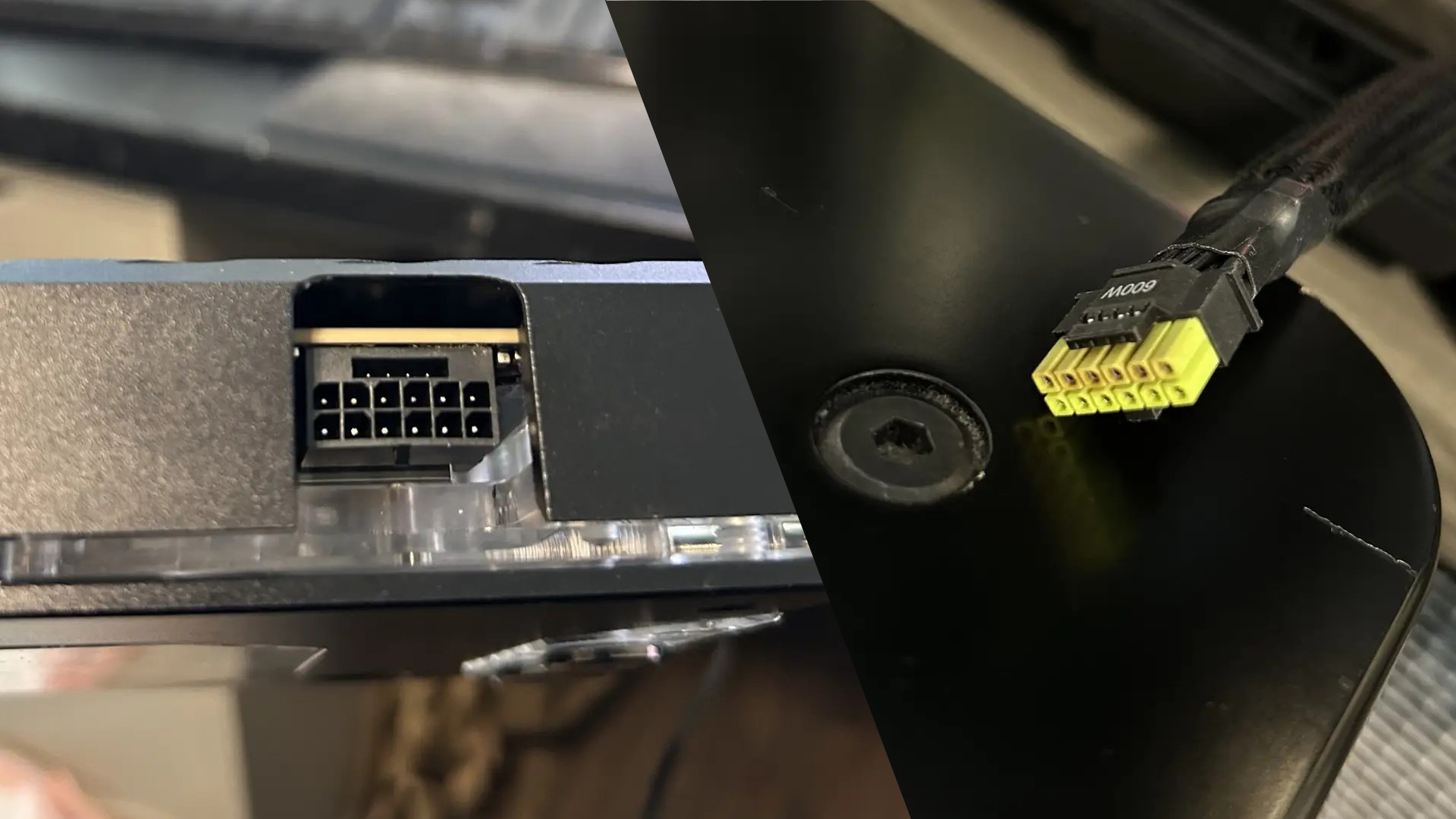
A $40 connector cable might be the simplest way to prevent a high-end GPU from suffering the dreaded 16‑pin power connector meltdown. But there’s an important catch: no cable can make it “safe” to force a graphics card to pull far more power than it was designed to handle. Pushing extreme wattage can still accelerate wear, cause long-term degradation, or lead to failure over time.
In a recent user report shared on overclocking forums, an RTX 5090 owner described a scary moment that ended far better than many similar stories. Instead of a melted connector or a dead graphics card, the system shut itself down before permanent damage could set in—and the shutdown appears to have been triggered by ASRock’s new 12V‑2×6 connector cable.
The user had shunt-modded an MSI RTX 5090 Ventus and paired it with liquid cooling in order to raise the card’s power draw and chase higher benchmark performance. After close to 20 intense benchmark runs, the GPU suddenly powered off. With many recent 16‑pin incidents, that’s often where the worst happens: high load, extreme current, heat buildup, and then a partially melted connector or damaged socket.
This time, though, the shutdown wasn’t caused by the connector physically failing. Instead, the ASRock cable reportedly did what it was designed to do. The cable includes an NTC temperature sensor located at the connector. It monitors heat at the connection point and, if temperatures climb past a preset ceiling, it signals the power supply to stop operating.
According to the user, the shutdown occurred when the connector temperature exceeded 105°C, which is said to be the limit configured by ASRock. A photo shared in the forum thread showed visible discoloration on the GPU-side plug, suggesting the connector area got extremely hot—even if it didn’t melt. After the shutdown, the system wouldn’t allow the GPU to power back on until the cable cooled down, acting like a forced “cooldown period” to prevent repeated overheating.
The good news: the graphics card still works. The user reported the RTX 5090 remained operational after the incident. The bad news: the user believes the GPU’s connector may now be “irreversibly compromised,” and is considering replacing the connector hardware on the card due to the heat stress and discoloration.
Other forum members reacted by suggesting ASRock should consider a lower shutdown threshold than 105°C—something like 85°C—to build in a larger safety buffer. That idea reflects a broader concern in the PC enthusiast world: once you’re seeing triple-digit connector temperatures, you’re already in a zone where plastics, pin contact quality, and socket integrity can degrade quickly.
It’s also worth noting that ASRock wouldn’t be responsible for damage in a situation like this. Shunt-modding is an extreme modification that can void warranties and dramatically increase the risk of hardware failure. No protective cable can fully counteract the stress created when a GPU is pushed to draw drastically more power than intended.
ASRock has also highlighted confidence in its power supply performance, but compatibility matters here. The 16‑pin cable in question is only compatible with specific ASRock power supply lines, including the Taichi and Phantom Gaming series. So while this setup may look like an appealing safety upgrade for RTX 5090 owners, it isn’t a universal solution you can pair with any PSU.
The bigger takeaway for anyone running an RTX 5090 (or any high-wattage GPU using the newer 16‑pin standard) is that monitoring and protection at the connector level is becoming increasingly important. A cable that can detect dangerous heat and force a shutdown may be the difference between a temporary scare and an expensive, permanent failure.
Still, even with better cables and smarter protection features, the safest path remains the simplest: avoid mods that raise the GPU power limit dramatically. Extreme power draw doesn’t just increase performance—it increases current, heat, and long-term risk in the very spot that’s been most vulnerable for modern high-end GPUs: the 16‑pin connector.