ASRock arrived at CES 2026 with a clear message for PC builders and gamers: the company isn’t just maintaining momentum in components like motherboards and graphics cards—it’s expanding aggressively into new categories while refreshing its display lineup with some of the fastest gaming monitors shown at the event.
One of the biggest headlines from ASRock’s booth was its first serious entry into the all-in-one liquid cooler market. Instead of launching a single model and calling it a day, ASRock is rolling out an entire AIO cooler family across multiple product lines, covering premium enthusiasts, gamers, mainstream builders, and value-focused setups. That broad approach makes it obvious the company wants to become a one-stop brand for a full DIY build, not just the motherboard you start with.
ASRock’s new AIO coolers span Taichi, Phantom Gaming, Steel Legend, Challenger, and Pro series designs, each with distinct styling and feature priorities.
The Taichi lineup sits at the top as ASRock’s flagship cooling offering, highlighted by the Taichi Aqua 360 LCD. It targets high-end CPUs and heavy workloads with a dual-pump design rated to handle over 500W TDP. ASRock pairs that high cooling capacity with a premium visual identity: a 3.4-inch front-mounted LCD, a transparent flow chamber, and a precision flow indicator. It also uses a thicker 38mm radiator and an all-metal water block to reinforce the “flagship build quality” theme. Cooling and acoustics get attention too, with LCP fans rated IP54 and an industrial-style dual-ball bearing setup intended to deliver strong airflow while keeping noise under control.
ASRock also showed Taichi cooler concepts that lean even harder into visual flair, including a design featuring a Taichi gear element with a spinning fan that creates a holographic-like effect, plus another concept with a large magnetic display that can be mounted to the water block for a more immersive look inside a case. These are still concept pieces, but they hint at where ASRock may take premium cooling aesthetics next.
For gamers, the Phantom Gaming 360 LCD is positioned as the high-performance “gaming flagship” AIO. It keeps the same 3.4-inch LCD approach, adds vivid ARGB styling, and is rated for up to 360W TDP. The magnetic water block is detachable and rotatable, giving builders more flexibility for orientation and customization. ASRock’s 360mm radiator uses a single-frame fan design for easier installation while maintaining a 32mm thickness. The setup uses FDB fans, and the pump employs a dual-side inlet layout designed to boost cooling efficiency.
Steel Legend is aimed at the mainstream segment, offering both black and white options while still bringing premium-style features down to more affordable builds. These models are rated up to 350W TDP and include a 3.4-inch full-coverage LCD with a magnetic water block, plus integration with ASRock’s PolyChrome RGB Sync ecosystem. They also use triple aerospace-grade LCP fans and a dual-inlet design. A standout feature here is a built-in VRM fan on the water block, intended to improve airflow not just over the CPU area but also across nearby VRMs and potentially even an M.2 SSD zone—an attention-to-detail move that can help stability in compact or airflow-limited builds.
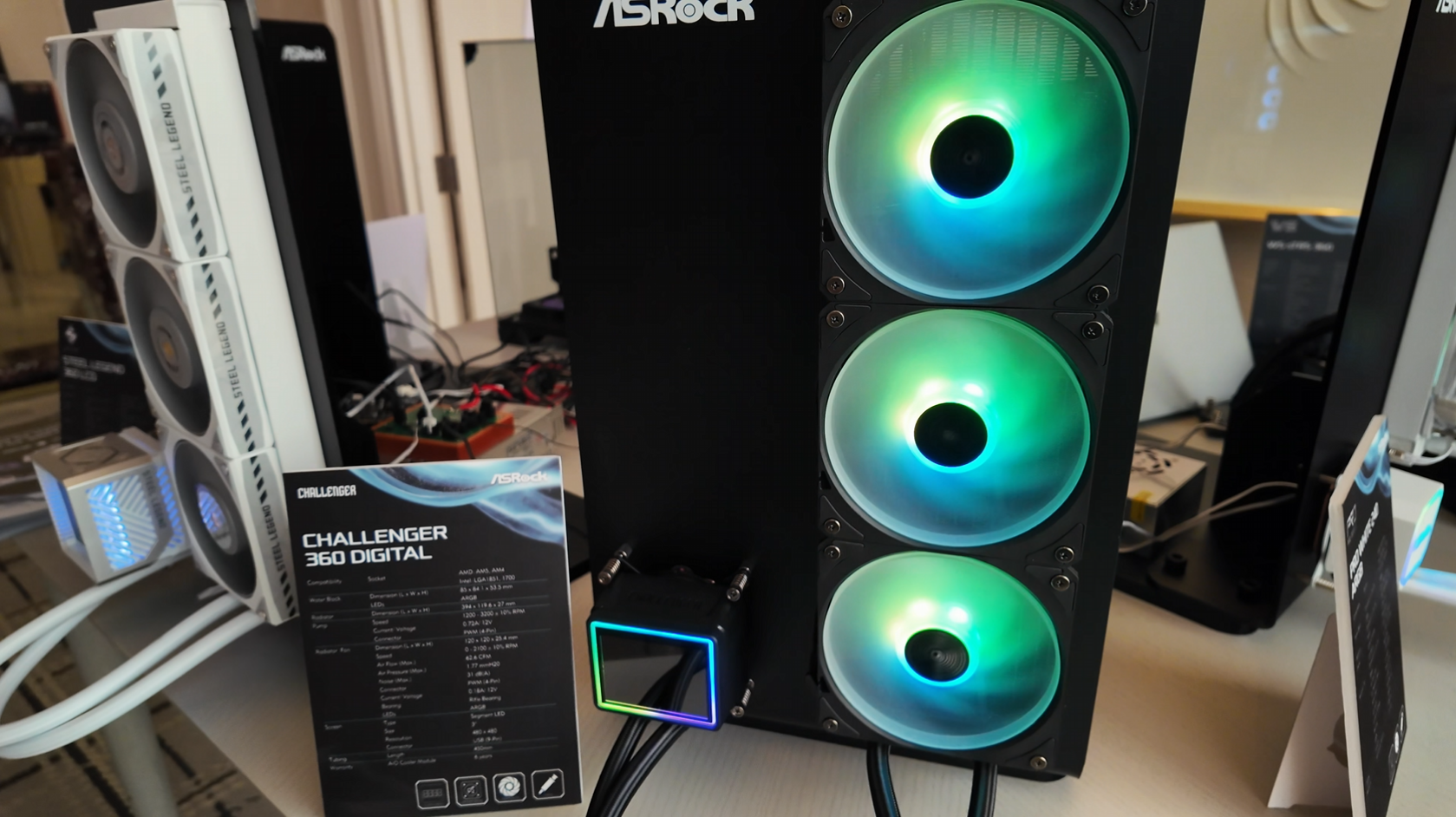
Challenger is designed as the entry point for users who want liquid cooling without jumping into the highest price tiers. ASRock is bringing 360mm and 240mm “Digital” models in both black and white. The 360mm version is rated up to 330W TDP, while the 240mm model is rated up to 300W. They feature a 3-inch smart digital display and a new motor design described as a 3-phase, 6-slot, 4-pole setup for stronger flow. ASRock also emphasizes ring-frame blade fans and hidden cable routing for cleaner-looking builds.
At the value end, the Pro ARGB series targets affordability while still offering ARGB lighting and practical performance. These models include a dynamic ARGB water block and come with pre-installed fans in 360mm and 240mm variants, again offering both white and black color themes. TDP support is listed up to 320W for the 360mm and up to 280W for the 240mm version.
Across the full AIO lineup, ASRock plans to include current Intel and AMD quick-release mounting brackets, aiming to make installation and platform swaps simpler for DIY builders.
Cooling wasn’t the only major focus. ASRock also showed a wide spread of new gaming monitors in its Taichi and Phantom Gaming lines, ranging from premium OLED options to extremely high refresh-rate displays aimed at competitive players.
In the Taichi OLED family, ASRock introduced multiple 27-inch options built around OLED panel technology. The Taichi TCO27USA uses a 27-inch QD-OLED panel with 4K UHD resolution and up to 240Hz refresh rate. It features Taichi “Lightning” styling on the rear, carries DisplayHDR TrueBlack 400 certification, and supports AMD FreeSync Premium Pro. ASRock also plans a white version for builders who want a clean, matching setup.
For esports and ultra-fast gameplay, the Taichi TCO27QXA steps down to QHD resolution while pushing refresh rate up to 500Hz using QD-OLED technology—an attention-grabbing spec for players who prioritize motion clarity and responsiveness.
ASRock also displayed the Taichi TCO27QX, a 27-inch WOLED model with an unusual dual-mode approach: 540Hz at 2K, or up to 720Hz at 720p. This kind of dual-mode setup is aimed at users who want flexibility—high resolution for general play and content, then extreme refresh for competitive titles.
Connectivity across the Taichi monitors includes 65W USB Type-C power delivery, plus DisplayPort 1.4 and HDMI 2.1, positioning them as practical options for modern PCs and high-end gaming setups.
On the Phantom Gaming side, ASRock is pushing more affordable OLED choices with the PGO27QSA and a white variant. These 27-inch QD-OLED monitors target QHD/2K gaming at up to 240Hz and include AMD FreeSync Premium support. A redesigned stand adds better ergonomics, including height, swivel, pivot, and tilt adjustments—features buyers often look for when choosing a daily-use gaming monitor.
ASRock also showcased fast IPS options for mainstream gamers who want high refresh rates without OLED pricing. Models like the PG27QFW2A and PG27QFW1B feature 27-inch IPS panels with 400Hz refresh rate and up to QHD (2K) resolution. An interesting extra here is integrated Wi-Fi antennas, and ASRock is signaling aggressive pricing to keep these competitive in the crowded high-refresh monitor market.
For more budget-friendly builds, ASRock’s mainstream Phantom Gaming displays include the PG27FFS2E, PG27FFS2E-W, and PG27FFS1A. These use 27-inch Fast IPS panels, deliver 240Hz at 1080p, and include 360-degree swivel/pivot adjustment to make them easy to fit into multi-monitor or small-desk setups. ASRock expects these to land at particularly accessible prices, aiming at buyers who want speed without paying for premium panel tech.
Rounding out the booth highlights, ASRock introduced a new “ROCK” motherboard family designed to bring a modern feature set and a clean, minimalist look to more affordable Intel and AMD platforms. The lineup includes AMD B850 ROCK and B850M ROCK, plus Intel B860 ROCK and B860M ROCK. Visually, they focus on a simple, builder-friendly aesthetic with silver heatsinks over key areas like VRMs, M.2 slots, and the chipset—an approach that pairs well with a wide range of case and GPU styles.
Despite targeting affordability, ASRock isn’t treating these boards like stripped-down options. They feature 8-layer PCBs and Dr.MOS power delivery, hardware choices often associated with higher-tier boards. On connectivity, the full ATX versions step up to Wi-Fi 7 and 2.5GbE LAN, while the mATX models use Wi-Fi 6E, which remains a strong option for mainstream wireless performance.
Overall, ASRock’s CES 2026 showing highlights a company that’s widening its reach across the DIY PC ecosystem. With a full AIO cooler launch, OLED and ultra-high refresh gaming monitors, and new value-focused motherboards that still aim to feel “premium enough,” ASRock is clearly trying to capture more of the build from start to finish—especially for gamers who care about performance, styling, and price balance.ASRock is leaning hard into next-generation PC building with a wave of new motherboards, graphics cards, and power solutions that focus on higher bandwidth, better cooling, cleaner builds, and safer high-wattage connections.
On the motherboard side, the latest designs target performance builders who want future-ready expansion. You’ll find full Gen5 x16 PCIe slots paired with a Reinforced Steel Slot implementation for added durability, especially useful for today’s heavier graphics cards. Storage is also getting a serious upgrade thanks to Blazing M.2 Gen5x4 slots capable of up to 128GB/s of bandwidth, giving high-end NVMe drives the headroom they need for faster file transfers, game loads, and creative workflows.
Cooling and build convenience get a noticeable boost too. Enlarged VRM heatsinks and dedicated M.2 heatsinks are designed to pull more heat away from core components, supporting more stable performance under load. ASRock also highlights EZ DIY features aimed at making installation and troubleshooting smoother, particularly for builders who want a less stressful setup process.
Across the lineup, several quality-of-life features come standard: pre-installed IO shields to speed up assembly, a Post Status Checker to help quickly identify boot issues, and BIOS flashback support for easier updates. Another notable addition is the large 64MB BIOS, positioned as a compatibility-friendly move to help support future AMD Ryzen CPU updates. For users who care about aesthetics, PolyChrome Sync is included for customizable ARGB/RGB lighting to match the rest of a build.
Alongside these releases, ASRock is also introducing new Challenger series motherboards, expanding options for different budgets and form factors. The newly announced models include the X870 Challenger WiFi White, X870E Challenger WiFi, B860 Challenger WiFi, and B850M Challenger WiFi (White), offering more choices for builders who want Wi-Fi-enabled boards, cleaner white-themed setups, or compact systems.
ASRock is also putting a spotlight on graphics card design with the Radeon RX 9070 XT Taichi OC White, a premium-looking card that combines a white Taichi cooler design with an integrated LCD display. The screen can show useful real-time stats like GPU temperature and fan RPM, along with extras such as the clock, date, weather forecast, photos, and animations. Visual flair continues with ARGB lighting, while the Taichi triple-fan cooling setup and a stylish backplate complete the high-end presentation.
It’s not just about looks, though. The RX 9070 XT Taichi OC White also aims for strong performance with a 16-phase SPS PCB and Phase-Change pads designed to improve thermal handling. ASRock claims this setup can support clock speeds reaching up to 3.1GHz without issue, targeting enthusiasts who want both standout styling and serious headroom.
For fans of themed hardware, ASRock is also offering a specialized Monster Hunter: Wilds edition Radeon RX 9070 XT. This version goes for a distinctive franchise-inspired look while using a dual-slot, triple-fan cooling solution, catering to gamers who want a build that matches their favorite series without sacrificing cooling capacity.
Power delivery is another major focus, particularly around modern 16-pin GPU connections. ASRock is addressing common concerns—like improper seating or unsupported cables—with a new 12V-2×6 L-Type cable implementation designed to add extra safety and clarity during installation. Each L-Type cable supports up to 600W and is compliant with ATX 3.1 and PCIe 5.1 standards, making it suitable for high-end GPUs that can draw significant power.
To reduce user error, these cables feature a dual-color design that helps indicate whether connections are properly seated on both the GPU and PSU ends. ASRock also includes Cable Over-Temperature protection, a safety feature the company notes has already prevented damage in at least one real-world case involving a high-end graphics card. The cable is 700mm long, includes a 2-year warranty, and ships with select power supply lines including Taichi, Phantom Gaming, and Steel Legend Platinum series PSUs.
Finally, ASRock is broadening its power supply lineup with new SFX and higher-wattage options built for modern systems. The new PG-850PSF is an 850W, Platinum-rated SFX power supply, with a 1000W SFX option also planned for builders who need more headroom in compact cases. In addition, new Steel Legend power supplies are arriving in 850W, 1000W, and up to 1200W variants. These PSUs are designed with modular cables, carry Platinum efficiency ratings, and are positioned to deliver stable power for demanding CPUs and GPUs. They also incorporate +5V Boost Mode technology, aimed at voltage compensation to help maintain consistent performance under load.
With faster Gen5 connectivity, feature-rich boards, eye-catching GPU designs, safer 16-pin power cabling, and more compact high-wattage PSU choices, ASRock’s latest announcements are clearly built around what PC builders are prioritizing right now: performance, reliability, and cleaner, smarter builds.