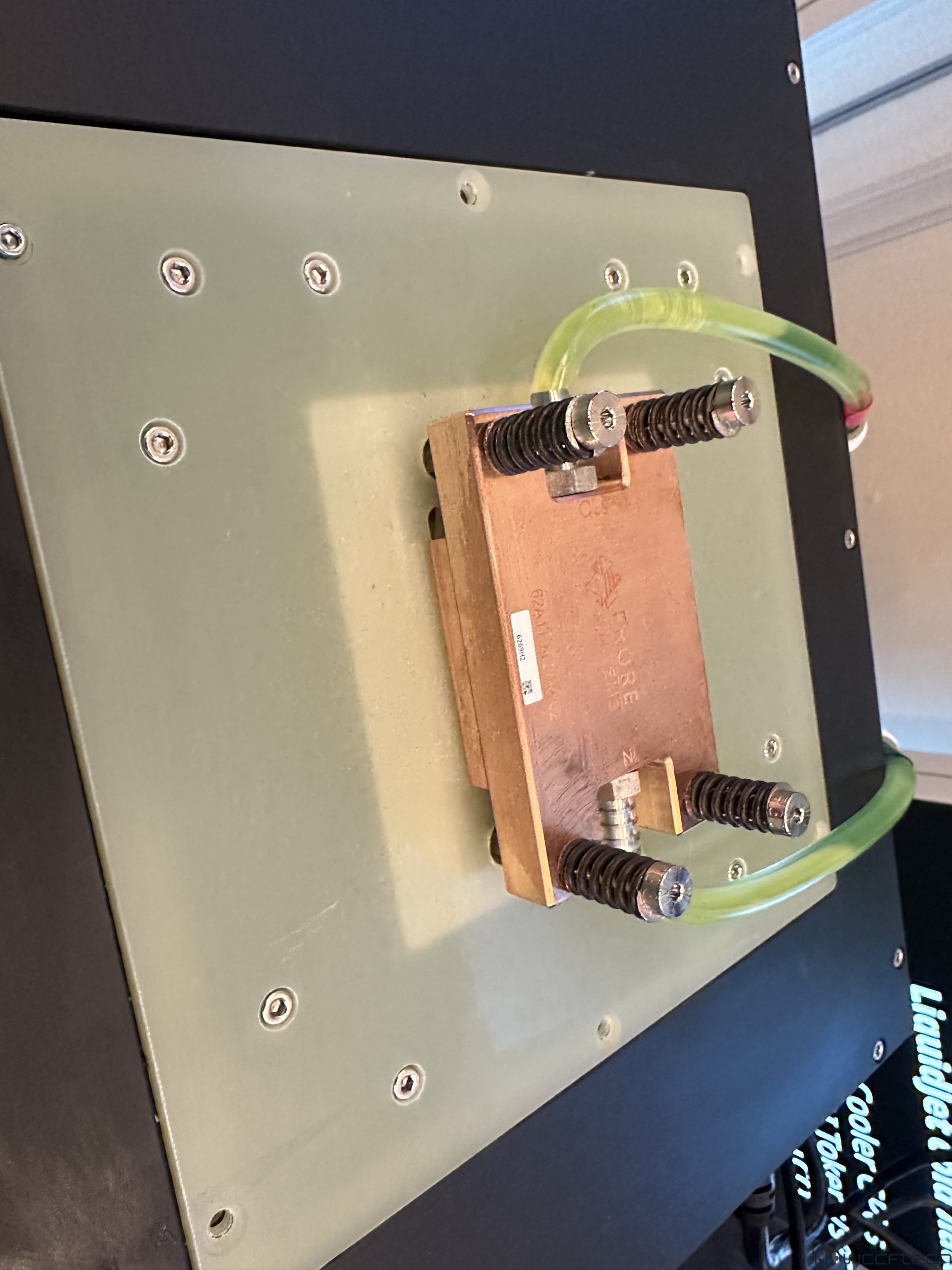
Frore Systems is pushing cooling technology into a new era, showing off major upgrades to both its solid-state AirJet lineup and its high-end LiquidJet coldplate at CES. The big headline: the company demonstrated LiquidJet cooling capable of handling up to 1950W of thermal design power, targeting the next wave of ultra-hot, data-center-class GPUs such as NVIDIA’s upcoming Rubin generation.
LiquidJet is Frore Systems’ answer to a problem that keeps growing every year: modern AI and HPC processors generate so much heat that traditional cooling approaches are becoming a bottleneck. To tackle that, LiquidJet uses a multistage cooling architecture built around a 3D short-loop jet channel design. In practical terms, it’s engineered to pull heat away from the hottest parts of a GPU far more efficiently, and it can be customized to match a chip’s “power map,” meaning it can focus cooling performance where the silicon needs it most.
This isn’t the first time Frore has highlighted the concept. The company previously showed LiquidJet working with a Blackwell Ultra-class GPU, reporting up to 1400W of cooling capability and operating temperatures that were 7.7°C lower than conventional liquid-cooling setups often used in data centers. At CES, however, Frore expanded the demo in a way that made its real-world use cases clearer.
Three LiquidJet demonstrations were shown, each focused on different chip configurations and thermal challenges.
The first setup featured a single-reticle design aimed at extreme hotspot cooling, delivering up to 600W per square centimeter over the GPU hotspot area. Frore used PTM 7950 thermal interface material between the GPU and the coldplate. In this configuration, the system sustained a junction temperature of 94.1°C while the chip’s TJmax was 105°C, showing that the solution can keep temperatures under control even at punishing heat densities.
The second demonstration scaled up to another single-reticle ASIC design paired with 6 stacks of HBM memory and rated at 1200W. This was presented as a higher-power example built around the kind of memory-heavy packaging increasingly common in AI accelerators.
The most attention-grabbing showcase, though, was the demo geared toward NVIDIA Rubin-class hardware. This configuration used two reticle-sized dies, 8 stacks of HBM, and an IO interface, the kind of complex, high-power multi-die package expected to define next-generation accelerators. Frore reported maintaining a TJmax of 80.5°C with an inlet temperature of roughly 40°C, a notable result considering the heat loads these platforms are expected to produce.
Frore Systems says LiquidJet is designed with the future in mind. According to the company, the coldplate platform is intended to scale up to 4400W-class chips, positioning it for even more demanding GPU generations beyond Rubin, including future architectures in the multi-kilowatt range.
Alongside its data-center-focused LiquidJet work, Frore also showed partner systems using its AirJet Mini G2 solid-state active cooling solution, aimed at compact consumer and mobile designs where traditional fans are limiting. Demonstrations included a Snapdragon X2 Elite-based 2-in-1 notebook and a reference mini PC based on the same platform.
AirJet Mini G2 is positioned as a meaningful step up from the first generation, with several specs aimed directly at the thin-and-light market and sealed device designs:
– Heat dissipation of 7.5W, a 50% increase over AirJet Mini G1
– Ultra-compact dimensions of 27mm × 41.5mm × 2.65mm, built for small form-factor devices
– Back pressure rated at 1,750 Pa (about 10 times higher than a fan), supporting dustproof and water-resistant designs
– Low noise output of 21 dBA for near-silent operation
– Solid-state design with no moving mechanical parts for durability and long lifespan
Taken together, Frore’s CES demonstrations show a company aiming to solve cooling at both ends of the computing spectrum: whisper-quiet, compact systems on one side, and next-generation AI accelerators pushing toward 2KW and beyond on the other. If multi-kilowatt GPUs are the next normal for data centers, innovations like LiquidJet may be the kind of thermal leap required to keep performance scaling without hitting a heat wall.