AMD Helios AI Rack: A Full-Stack AI Platform Built for Frontier Computing
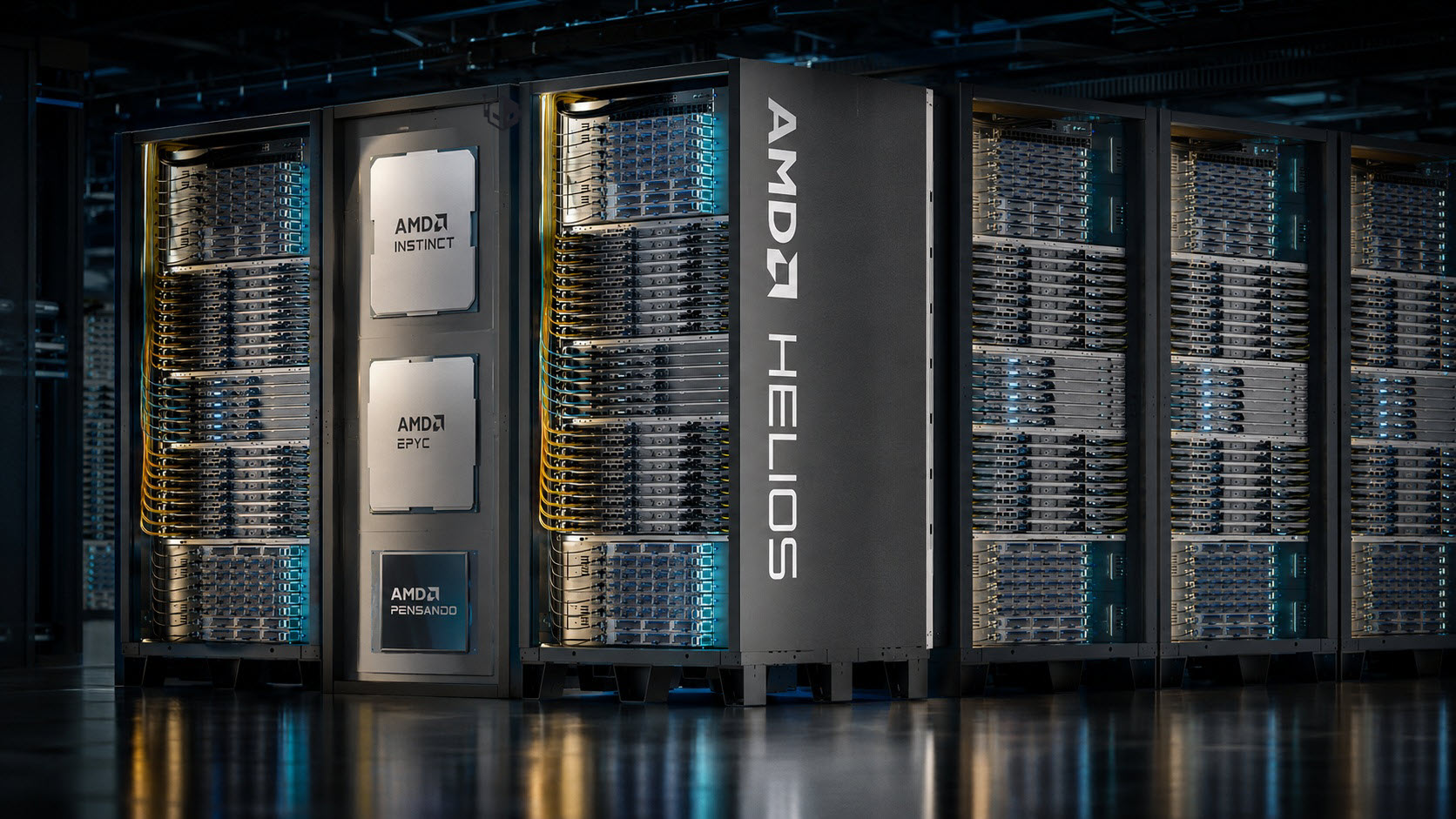
AMD has revealed more details about its next-generation Helios AI Rack, a large-scale AI infrastructure platform designed for frontier AI, sovereign AI, and high-performance inference workloads. Powered by AMD Instinct MI455X GPUs, 6th Gen EPYC “Venice” CPUs, Pensando networking technology, Infinity Fabric, and the ROCm software stack, Helios is AMD’s most ambitious rack-level AI solution yet.
The goal is clear: AMD wants Helios to compete directly in the fast-growing market for complete AI rack systems, where enterprises, cloud providers, research labs, and governments are building massive infrastructure for generative AI, agentic AI, and national AI platforms.
Unlike a traditional server rack filled with separate components, Helios is designed as a full-stack platform. That means AMD is combining compute, networking, memory, software, and interconnect technology into one tightly integrated system. For customers building large AI clusters, this could offer a more open and flexible alternative to closed AI infrastructure ecosystems.
At the heart of Helios are three major hardware pillars: AMD Instinct MI455X GPUs, 6th Gen AMD EPYC Venice CPUs, and AMD Pensando AI networking chips. These are supported by Pensando DPUs, AMD Infinity Fabric, and the ROCm software platform.
AMD Instinct MI455X brings massive AI inference performance
The AMD Instinct MI455X is the main accelerator powering the Helios AI Rack. It belongs to the upcoming Instinct MI400 series, based on AMD’s CDNA 5 architecture. This new GPU generation is aimed at demanding AI training and inference workloads, especially the large-scale models that require huge memory capacity and extremely high bandwidth.
The MI455X is designed to deliver up to 40 PFLOPs of FP4 compute and 20 PFLOPs of FP8 compute. That is a major leap over the MI350 series and positions AMD as a serious challenger in next-generation AI acceleration.
Memory is one of the biggest highlights. The MI455X is expected to feature 432GB of HBM4 memory, a 50% increase over the 288GB HBM3e capacity found on the previous generation. Bandwidth also sees a major jump, with HBM4 delivering up to 19.6 TB/s. For AI workloads, especially large language models and inference at scale, this amount of memory and bandwidth can be critical.
The MI400 family will include several products. The MI455X and MI450X are aimed at large-scale AI training and inference, while the MI430X is expected to target HPC and sovereign AI deployments with strong FP64 performance and hybrid CPU-plus-GPU compute capabilities.
AMD is also emphasizing open standards for rack-scale networking, including UALoE, UAL, and UEC. This matters because the AI infrastructure market is increasingly moving toward massive clusters where communication between GPUs, CPUs, and networking devices is just as important as raw compute power.
6th Gen EPYC Venice CPUs power the Helios platform
While GPUs get most of the attention in AI systems, CPUs remain essential for feeding accelerators, managing data, orchestrating workloads, and maintaining sustained throughput. For Helios, AMD is using its 6th Gen EPYC processors, codenamed Venice.
These CPUs are based on AMD’s Zen 6 architecture and are expected to be among the first high-performance computing products built on TSMC’s 2nm process technology. The move to 2nm introduces nanosheet transistor technology, which is designed to improve performance, reduce power consumption, and increase transistor density compared with older manufacturing nodes.
AMD has stated that the Venice EPYC platform is designed to deliver major gains in performance and efficiency. The company has also discussed improvements in thread density, which is especially important for modern AI workloads where CPUs must handle increasingly complex coordination tasks.
Agentic AI is changing the role of the CPU. Instead of simply supporting GPU-heavy model training, CPUs now need to manage agents, data pipelines, memory movement, orchestration, and real-time decision workflows. This makes the choice of host processor more important than ever in AI rack designs.
With Zen 6 EPYC Venice CPUs, AMD is aiming to provide a strong balance of core count, single-thread performance, efficiency, and total cost of ownership. In large AI deployments, even small gains in efficiency can translate into major savings across thousands of nodes.
Pensando networking and DPUs complete the full-stack design
Networking is another key part of Helios. AMD is integrating Pensando AI NICs and DPUs into the platform to help manage data movement, security, virtualization, and network acceleration.
In large-scale AI clusters, the network can become a major bottleneck. Training and inference workloads often require enormous amounts of data to move between GPUs, CPUs, memory, and storage. If the network cannot keep up, expensive accelerators sit idle.
Pensando technology helps AMD address this challenge by providing dedicated infrastructure processing capabilities. These chips can offload networking, security, and data center services from the CPU, freeing more compute resources for AI workloads.
Combined with AMD Infinity Fabric, the Helios platform is designed to deliver high-bandwidth, low-latency communication across the rack. This is essential for scaling AI models across many accelerators while maintaining efficient performance.
ROCm software stack remains central to AMD’s AI strategy
Hardware alone is not enough to win in AI. Developers and enterprises need a mature software ecosystem, and AMD is continuing to build around ROCm, its open software stack for AI and high-performance computing.
ROCm supports machine learning frameworks, GPU acceleration, and developer tools needed to run modern AI workloads. For Helios, ROCm plays a central role in enabling customers to deploy, optimize, and scale AI models across AMD GPUs and CPUs.
AMD’s focus on open standards could be one of Helios’ biggest advantages. Many organizations building sovereign AI infrastructure want more control over their hardware and software stack. An open approach may appeal to governments, cloud providers, and enterprises that want flexibility and long-term platform independence.
Helios targets frontier AI and sovereign AI markets
The timing of Helios is important. Demand for AI infrastructure is exploding as companies move from experimental generative AI projects to production-scale AI systems. At the same time, governments are investing heavily in sovereign AI, where data, models, and compute infrastructure are controlled within national borders.
AMD is positioning Helios as a platform for both markets. Frontier AI labs need extreme compute performance for the largest models, while sovereign AI projects need secure, scalable, and open infrastructure. Helios is designed to serve both by combining powerful accelerators, advanced CPUs, open networking standards, and a full software stack.
The platform also arrives as competition in AI racks becomes more intense. NVIDIA currently dominates much of the AI infrastructure market, but AMD is pushing aggressively with Instinct GPUs, EPYC CPUs, and full-stack rack systems. With Helios, AMD is no longer offering only individual chips; it is offering a complete AI infrastructure platform.
Why AMD Helios matters
The Helios AI Rack represents a major shift in AMD’s data center strategy. Instead of competing only at the GPU or CPU level, AMD is now competing at the full rack level. That is where the future of AI infrastructure is heading.
Key advantages of the Helios platform include high-capacity HBM4 memory, strong FP4 and FP8 AI compute performance, Zen 6 EPYC host CPUs, Pensando networking acceleration, Infinity Fabric connectivity, ROCm software support, and open rack-scale networking standards.
For AI inference, the MI455X’s memory capacity and bandwidth could be especially valuable. As AI models become larger and more complex, inference is becoming one of the biggest infrastructure challenges. Businesses need systems that can serve models quickly, efficiently, and at scale. Helios is built with that future in mind.
AMD is expected to officially launch the Helios AI Rack at its Advancing AI 2026 event. However, the company has already shared enough details to make one thing clear: Helios is designed to be one of AMD’s most important AI platforms.
If AMD can deliver the performance, efficiency, software maturity, and supply needed by large customers, Helios could become a serious force in the next generation of AI data centers. For enterprises, cloud providers, research institutions, and governments planning future AI infrastructure, AMD Helios is a platform to watch closely.AMD Helios AI Rack: AMD’s open, liquid-cooled push for next-generation AI infrastructure
AMD is preparing one of its most ambitious AI infrastructure platforms yet with Helios, a rack-scale system designed for the era of massive AI training, agentic AI workloads, and large-scale inference. Instead of focusing on a single chip, Helios combines AMD Instinct MI455X GPUs, 6th Gen EPYC “Venice” CPUs, advanced Pensando networking, high-bandwidth HBM4 memory, and the ROCm software platform into one tightly integrated AI rack.
The result is a full-stack platform built to challenge the most powerful AI systems on the market, while emphasizing open standards, high memory capacity, strong scale-out bandwidth, and reduced vendor lock-in.
At the center of Helios is AMD’s latest rack-scale design, built around Meta’s Open Rack Wide standard submitted to the Open Compute Project. The rack uses a fully liquid-cooled architecture and includes 18 compute trays, with each tray carrying four AMD Instinct MI455X GPUs and one AMD EPYC Venice processor. In total, each Helios rack supports 72 GPUs.
Each GPU is cooled by a copper liquid cold plate, helping the system handle the enormous thermal demands of modern AI compute. The full rack is expected to weigh around 5,000 pounds and consume approximately 225 kW to 245 kW of power. Estimated pricing is said to fall in the range of $5 million to $5.5 million per rack, placing Helios firmly in the category of hyperscale AI infrastructure.
The performance numbers are equally aggressive. A single AMD Helios AI Rack is designed to scale up to 2.9 exaflops of FP4 compute and 1.4 exaflops of FP8 compute. It also delivers 31 TB of HBM4 memory, 1.4 PB/s of aggregate memory bandwidth, 43 TB/s of scale-out bandwidth, and 260 TB/s of scale-up interconnect bandwidth. AMD is positioning this platform for trillion-parameter model training, massive inference deployments, and next-generation agentic AI systems that require extremely fast communication between GPUs.
A major part of the Helios design is AMD’s Pensando networking technology. The rack uses the Pensando “Vulcano” 800 AI NIC and the Pensando “Salina” DPU to handle high-speed networking, security, storage offload, and GPU-to-GPU communication.
The Vulcano 800 AI NIC is designed for 800 Gbps Ethernet throughput and supports up to 2.4 Tbps of scale-out bandwidth per GPU. AMD claims this gives each GPU access to up to eight times more scale-out bandwidth, helping reduce bottlenecks in large AI clusters. The NIC is also built with hardware and software programmability, giving data center operators more control over how networking resources are managed.
Vulcano is UEC-ready and uses RDMA over Ethernet optimized for large AI clusters. With a UAL and PCIe Gen 6 host interface, the platform is designed to provide very low-latency communication across GPUs. This is critical for training large AI models, where even small delays in GPU communication can affect efficiency and overall training time.
For scale-up connectivity, AMD is using an open networking approach based on UALink over Ethernet, also known as UALoE. This fabric connects up to 72 GPUs inside a single Helios rack and provides 260 TB/s of scale-up interconnect bandwidth. AMD’s focus on open standards is one of the biggest differentiators of the Helios platform, especially for companies that want flexibility instead of being locked into one closed ecosystem.
The Salina DPU handles another key part of the system. It bridges AI servers with enterprise networks while accelerating network, security, and storage tasks. The DPU features 16 Arm N1 cores and is designed to offload work that would otherwise consume valuable CPU resources. AMD says Salina can deliver a 40% speed-up compared with CPU-only processing and offers twice the capability of the company’s previous-generation DPUs.
Helios also brings serious CPU power through AMD’s 6th Gen EPYC Venice processors. These chips are based on the Zen 6 architecture, with configurations expected to reach up to 256 cores using Zen 6C cores. In a full Helios rack, AMD is combining 72 EPYC CPUs with 72 Instinct MI455X GPUs, creating a powerful CPU and GPU domain for AI workloads that require both compute density and fast data movement.
The Instinct MI455X GPUs are built on AMD’s next-generation AI architecture and include HBM4 memory. Each GPU features 432 GB of HBM4, giving the full rack 31 TB of GPU memory. That high memory capacity is one of AMD’s biggest advantages for AI workloads, especially large language models with long context windows, complex multimodal models, and massive inference pipelines.
Compared with NVIDIA’s Vera Rubin NVL72 platform, Helios appears to prioritize memory capacity, open standards, and scale-out bandwidth. AMD’s rack offers 72 Instinct MI455X GPUs with 432 GB of HBM4 per GPU, while the competing Rubin-based system is expected to offer 288 GB of HBM4 per GPU. That gives Helios 31 TB of total HBM4 memory versus around 20.7 TB in the rival rack configuration.
On peak low-precision AI performance, NVIDIA’s upcoming system is expected to hold an advantage, with figures reaching up to 3.6 exaflops in NVFP4 inference and 2.52 exaflops in NVFP4 training. AMD’s Helios reaches up to 2.9 exaflops of FP4 and 1.4 exaflops of FP8 compute. However, AMD’s higher memory capacity and stronger scale-out bandwidth could make Helios especially attractive for workloads where memory footprint and interconnect flexibility matter as much as raw peak compute.
Scale-out networking is another major differentiator. AMD lists 43 TB/s of scale-out bandwidth for Helios, enabled by Pensando Vulcano 800G AI NICs and Salina DPUs. The competing rack-scale platform is expected to offer 28.8 TB/s of scale-out networking through its own Ethernet and DPU stack. Both systems support liquid cooling and are designed for 2026-era AI deployments, but AMD is clearly leaning into openness as a key selling point.
Software will be just as important as hardware. AMD’s ROCm platform has become central to the company’s AI strategy, serving as its open software stack for AI and high-performance computing. With Helios, AMD is emphasizing broad support for major AI frameworks and tools, including PyTorch, TensorFlow, JAX, Hugging Face, vLLM, SGL, DeepSpeed, ONNX, OpenXLA, Llama Stack, and more.
AMD says the goal is day-one support for modern AI models and frameworks, making it easier for enterprises and cloud providers to deploy workloads without heavy customization. ROCm has steadily improved over recent years, and Helios gives AMD a chance to show that its software ecosystem can support large-scale AI infrastructure at the highest level.
The customer list is also significant. Microsoft is expected to deploy AMD Helios rack-scale solutions to support Azure AI services and customer workloads. New Azure instances are planned around AMD’s upcoming CPU and GPU platforms, including CPU-focused Azure HDv2 instances with nearly 500 6th Gen EPYC CPU cores, 4 TB of RAM, 32 TB of NVMe storage, and 400 Gb Azure Boost networking.
Microsoft is also preparing Azure HXv2 instances aimed at agentic AI workloads. These are expected to include 176 6th Gen EPYC CPU cores per virtual machine, 3D V-Cache, clock speeds above 5 GHz, up to 50% more cache, 2 TB to 4 TB of RAM, and 800 Gb InfiniBand networking. For GPU-heavy AI workloads, the ND MI455X v7 offering will use the full Helios rack configuration with 72 MI455X GPUs and 6th Gen EPYC CPUs.
Beyond Microsoft, AMD has named several major organizations connected to its Helios rack-scale systems, 6th Gen EPYC CPUs, and MI455X GPUs, including OpenAI, Meta, Oracle, HPE, TCS, Celestica, Nutanix, and the U.S. Department of Energy. That level of early interest suggests AMD is no longer simply trying to compete in AI hardware; it is positioning itself as a serious infrastructure provider for the largest AI deployments in the world.
AMD Helios represents a major step forward for the company’s AI ambitions. It combines high-capacity HBM4 GPUs, powerful Zen 6 EPYC CPUs, advanced Pensando networking, liquid cooling, and an open software stack into a single rack-scale platform. Its strengths are clear: more total GPU memory, strong scale-out bandwidth, open networking standards, broad framework support, and an architecture built for massive AI clusters.
The battle for AI infrastructure leadership will not be decided by peak FLOPS alone. Memory capacity, networking efficiency, software maturity, power consumption, deployment flexibility, and total cost of ownership all matter. With Helios, AMD is making the case that open, high-bandwidth, memory-rich AI infrastructure can become a powerful alternative for cloud providers, research labs, and enterprises building the next generation of artificial intelligence systems.
As demand for agentic AI, large language models, and trillion-parameter training continues to grow, AMD Helios could become one of the most important rack-scale AI platforms of 2026.