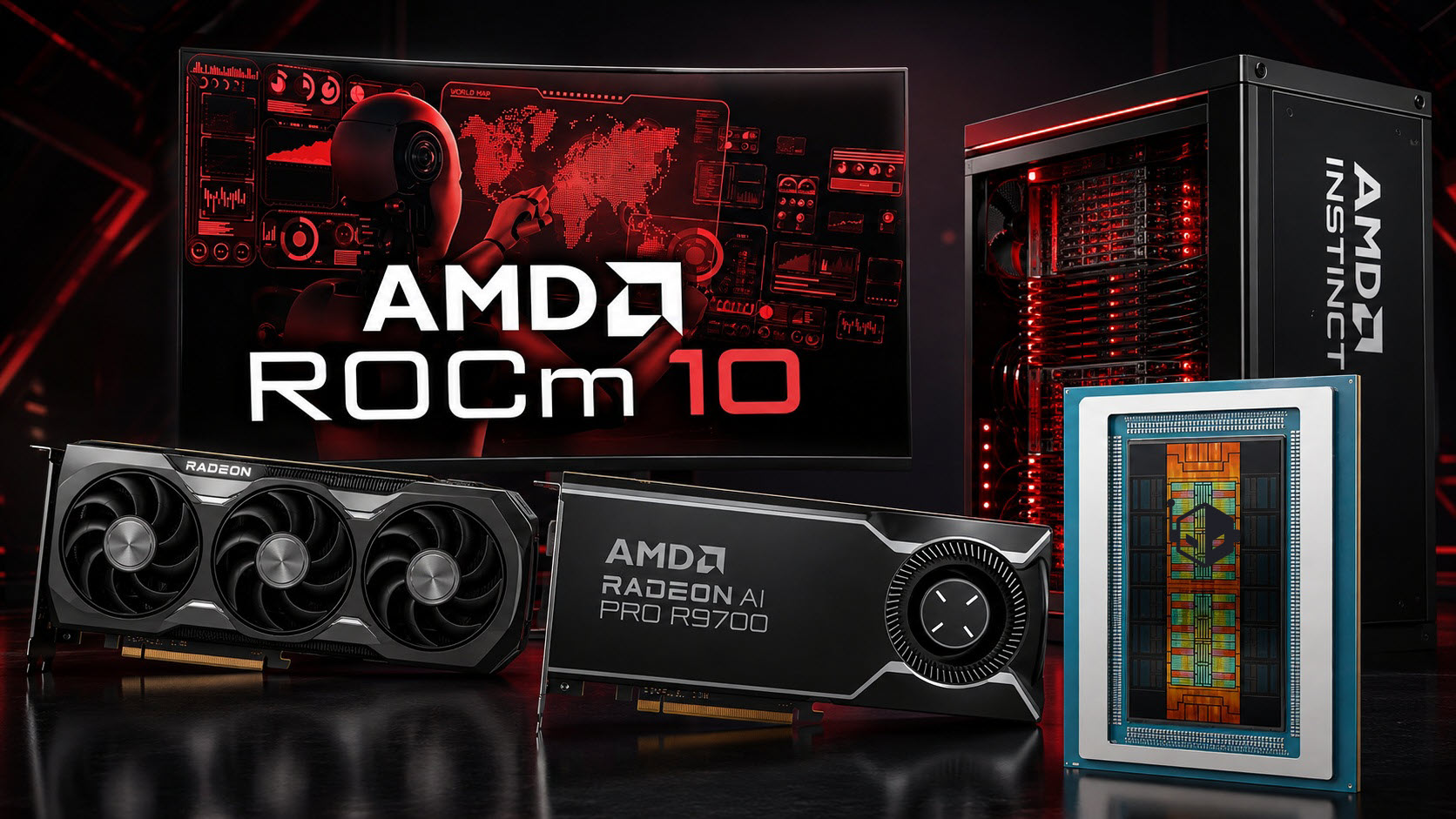
AMD ROCm 10 arrives with major AI upgrades, faster performance, and a new developer workflow
AMD is marking a major milestone for its open-source compute and AI platform with the release of ROCm 10. The first ROCm 1.0 version arrived in April 2016, and a decade later, AMD is positioning ROCm 10 as one of the most important updates in the platform’s history.
ROCm 10 is not just a routine software refresh. It introduces a broader AI-focused development experience built around ROCm.AI, a new environment designed to help developers install, validate, serve, troubleshoot, and optimize AI workloads on AMD hardware with less manual effort.
The release also includes ROCm Core SDK 10.0 and supports AMD’s full GPU portfolio, including AMD Instinct accelerators, Radeon graphics cards, and Ryzen integrated graphics. Support extends across both Windows and Linux, making ROCm 10 a more flexible platform for developers working across different systems and deployment environments.
A major focus of ROCm 10 is performance. According to AMD’s internal testing, systems configured with ROCm.AI delivered an average 3.3x boost in inference performance and a 2.4x increase in training performance compared with ROCm 7. These results were measured on an AMD Instinct MI355X 8-GPU platform using AI models such as GLM-5, Kimi-K2.5, and DeepSeek-R1-0528.
ROCm.AI is the centerpiece of the new release. Instead of only improving the underlying libraries and compute tools, AMD is now focusing on the full developer workflow. The goal is to make AMD hardware easier to set up, easier to test, and easier to tune for modern artificial intelligence workloads.
ROCm.AI is built around three key components: ROCm CLI, AMD Skills, and Hyperloom.
The ROCm CLI is a unified command-line tool that brings several important tasks into one place. Developers can use it to install software, validate system configuration, serve AI models, update components, and diagnose problems. In previous ROCm environments, these tasks often required separate tools, scripts, or manual troubleshooting steps.
In ROCm 10, the ROCm CLI is launching as a tech preview, meaning it is available for early use while AMD continues to refine its interface and capabilities. One of its notable features is model serving through commands such as rocm serve, which can spin up inference workloads on top of PyTorch. Another command, rocm examine, helps detect driver, environment, and configuration issues.
The CLI also supports air-gapped environments, which is important for enterprise, government, and research deployments where systems may not have direct internet access. Dependencies can be packaged into a self-contained bundle alongside the ROCm binary, simplifying installation in controlled environments.
AMD Skills is another major addition in ROCm 10. This feature brings AMD-validated ROCm guidance directly into popular AI coding assistants, including Claude, Cursor, and Codex. Instead of forcing developers to search through documentation or manually troubleshoot complex setup questions, AMD Skills allows AI assistants to provide ROCm-specific help using validated knowledge.
These skills are distributed through AMD’s official skills catalog and are designed to work with standard skill directories already used by supported development tools. AMD is also offering a companion marketplace for one-command installation of skills created by its own engineering teams.
Hyperloom may be the most ambitious part of ROCm.AI. It is an open-source, agentic optimization system designed to automate the process of improving inference workloads. Instead of requiring engineers to manually profile workloads, analyze bottlenecks, plan optimizations, apply changes, and verify results, Hyperloom is built to run that loop automatically.
AMD says Hyperloom can reduce optimization work from weeks to hours. It does this by repeatedly profiling, planning, applying, and validating performance improvements, while exploring more possible optimization paths than a human engineer could typically evaluate under deadline pressure.
The broader message behind ROCm 10 is clear: AMD wants to make its AI software stack more complete, more automated, and more accessible. Previous ROCm releases focused heavily on the underlying platform, libraries, and low-level compute capabilities. ROCm 10 shifts attention toward the full AI development lifecycle.
For AI developers, data scientists, and enterprise teams, this could make AMD platforms easier to adopt. Instinct accelerators, Radeon GPUs, and Ryzen integrated graphics now sit under a more unified software experience, with ROCm.AI acting as the central layer for setup, deployment, and optimization.
ROCm 10 also strengthens AMD’s position in the AI hardware and software market. Performance improvements are important, but developer experience is increasingly just as critical. AI teams need tools that reduce setup time, minimize troubleshooting, and accelerate model deployment. With ROCm CLI, AMD Skills, and Hyperloom, AMD is targeting exactly those pain points.
Taken together, ROCm 10 is more than a software version bump. It represents AMD’s push to turn ROCm into a more complete AI development platform, one that can support everything from local development and model serving to large-scale inference optimization on high-performance GPU systems.