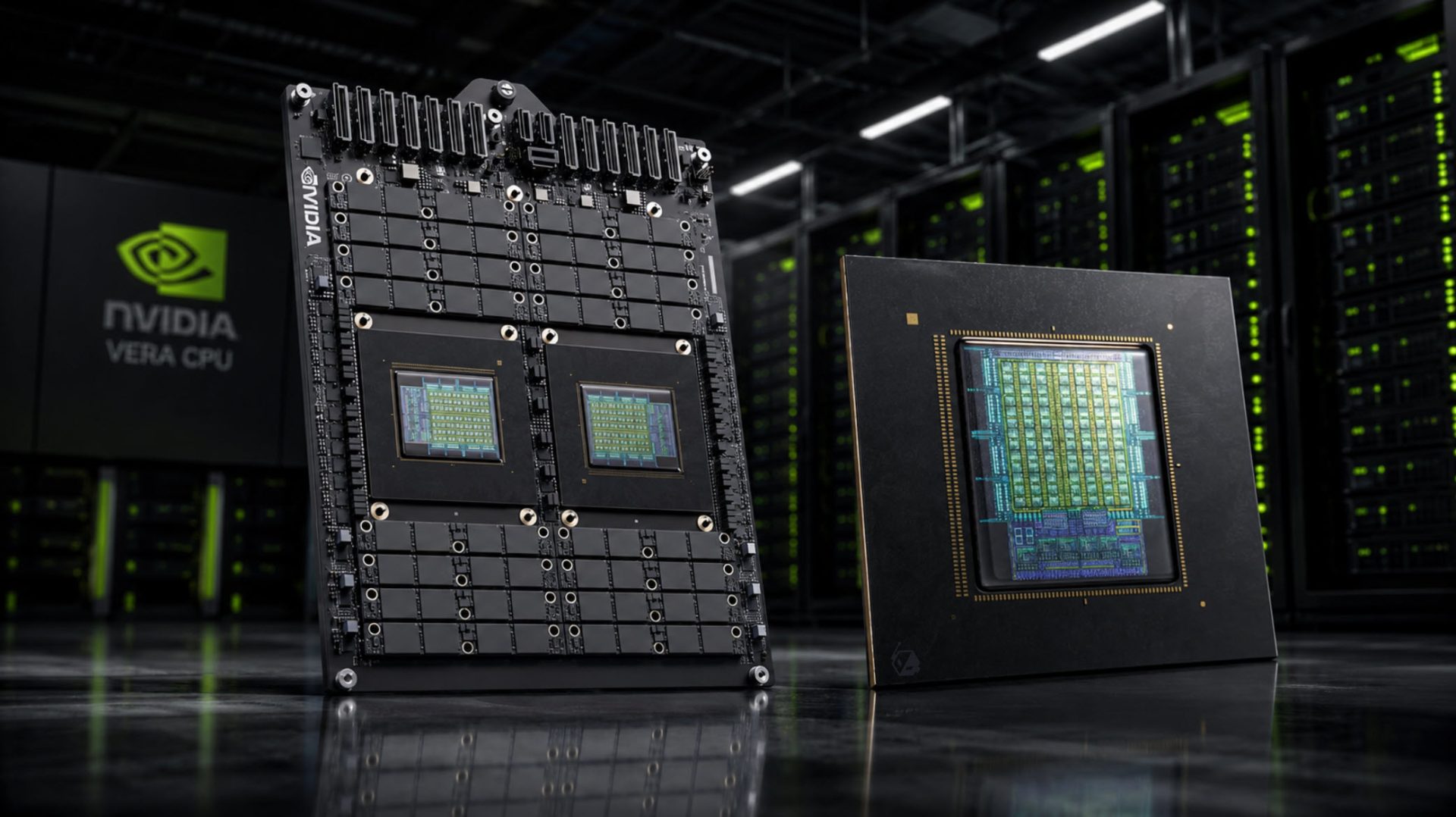
NVIDIA Vera CPU Signals a Major Shift in AI Computing Architecture
NVIDIA’s Vera CPU represents more than another data center processor. It points to a major change in how computing systems are being built for the next era of artificial intelligence. As agentic AI becomes more important, CPUs are no longer just general-purpose multitaskers sitting beside powerful GPUs. They are increasingly becoming orchestration engines designed to manage complex reasoning loops, tool calls, memory access, and rapid handoffs between different parts of an AI system.
For years, the data center industry moved in one clear direction: more cores, more throughput, and better server density. Cloud providers wanted processors that could run as many parallel tasks as possible while maximizing revenue per rack. That approach helped shape the modern cloud era, but it also created a trade-off. In many cases, single-threaded performance and per-core responsiveness were sacrificed in favor of higher core counts.
Agentic AI is now pushing the industry in a different direction.
Unlike traditional cloud workloads, AI agents often operate in fast, repeated loops. A GPU may handle the heavy reasoning step, but the CPU must quickly manage sequential work, tool calls, scheduling, and other tasks before sending the process back to the GPU. If the CPU is slow, the GPU waits. And in an AI data center, idle GPUs are expensive wasted capacity.
That is the problem NVIDIA is trying to solve with Vera.
Why single-threaded CPU performance matters again
In the early 2010s, data center CPUs were often judged by the strength of their individual cores. Fewer cores running at higher speeds were common, and single-threaded performance played a central role in overall system responsiveness.
Then the cloud boom changed the equation. Hyperscale operators needed to pack more compute into each server. CPU designs evolved toward more cores, more chiplets, and greater throughput. This helped cloud companies handle huge volumes of parallel workloads, but it also made per-core performance less of a priority.
The rise of agentic AI is bringing single-threaded performance back into focus.
AI agents do not simply process one request and stop. They plan, reason, call tools, retrieve data, evaluate outputs, and repeat the process. Many of these tasks include sequential steps that cannot always be parallelized efficiently. That means the speed of individual CPU cores matters again, especially when the CPU is responsible for keeping the GPU continuously fed with work.
Vera is designed for this new reality. NVIDIA is positioning it as a CPU that combines strong single-threaded performance with high total throughput, aiming to avoid the traditional compromise between fast individual cores and large-scale parallel processing.
How Vera is built for agentic AI workloads
NVIDIA’s Vera CPU is designed around three major priorities: speed, memory bandwidth, and low latency.
The first priority is high per-core performance. In agentic AI systems, the CPU must finish its portion of the workflow quickly so the AI agent can return to GPU-based reasoning without delay. This is especially important in environments where GPU utilization directly affects infrastructure cost and performance.
The second priority is memory bandwidth. Vera uses a custom LPDDR5X memory subsystem intended to move large amounts of data quickly. Agentic AI workloads can involve frequent memory access, tool calls, and data movement, so memory performance becomes critical.
The third priority is latency reduction. Vera uses a single monolithic compute die, allowing all CPU cores to communicate without crossing chiplet or I/O boundaries that could introduce extra delays. NVIDIA also uses its second-generation Scalable Coherent Fabric to improve communication across the processor.
Together, these design choices are meant to place Vera in a new category of CPU architecture: one that delivers both high single-threaded performance and high throughput.
This matters because AI infrastructure is no longer only about raw parallel compute. It is about orchestration. The CPU must coordinate the flow of work across GPUs, memory, networking, storage, and external tools. In an AI factory, every delay can reduce the efficiency of the entire system.
From cloud-era CPUs to AI-era CPUs
The cloud era rewarded CPUs that could handle many independent workloads at once. The AI era, especially the agentic AI era, rewards processors that can rapidly coordinate complex workflows.
That distinction is important.
A cloud CPU may be optimized for serving thousands of separate users, containers, or microservices. An AI-era CPU must often support dynamic chains of reasoning where each step depends on the result of the step before it. This makes responsiveness and low-latency coordination just as important as total compute capacity.
Vera reflects this shift. Rather than simply chasing core count, NVIDIA is focusing on the CPU’s role inside a larger AI system. The goal is not just to compute, but to keep the full AI pipeline moving efficiently.
This is why Vera is closely tied to the future of AI agents. As businesses deploy agents for coding, research, automation, customer support, robotics, data analysis, and enterprise workflows, the demand for fast CPU-GPU interaction will increase. Systems that cannot manage these loops efficiently may struggle to keep up.
Disaggregation is changing AI infrastructure
Another major theme behind Vera is the growing disaggregation of AI infrastructure.
In older server designs, many functions were handled within a single general-purpose node. Today, AI data centers are becoming more specialized. Different hardware may be assigned to different stages of the workload.
Inference is one example. The pre-fill stage, where a model processes the initial prompt or context, can have different hardware requirements from the decode stage, where tokens are generated sequentially. Separating these stages across different infrastructure can improve efficiency.
The same idea applies to CPUs.
NVIDIA’s earlier CPU strategy focused heavily on the processor as a host node for GPU systems. In that role, the CPU’s job was to support and feed GPUs inside a rack. But agentic AI and reinforcement learning have expanded the CPU’s importance. There are now workloads where large numbers of CPUs may be needed independently, especially for tool calls, environment simulation, orchestration, and sequential reasoning tasks.
This has led to a broader view of Vera. It is not only part of a CPU-GPU platform. It can also exist as a standalone CPU resource, including pure CPU racks designed to handle massive volumes of agent-related work.
That is a notable shift. It suggests that future AI factories may use specialized racks for different jobs: GPU-heavy systems for model reasoning and training, CPU-heavy systems for agent orchestration and reinforcement learning, and other specialized components for storage, networking, or memory-intensive tasks.
How Vera fits into the future of AI agents
Agentic AI is expected to place new pressure on data center architecture. Instead of simple request-and-response model usage, AI systems are moving toward multi-step reasoning and autonomous task execution.
A single AI agent may need to search through data, call external tools, run code, compare results, update its plan, and repeat the cycle several times. Each of these steps can involve the CPU, and each delay can slow down the entire process.
Vera is NVIDIA’s answer to that bottleneck. By improving single-threaded performance, boosting memory bandwidth, and minimizing latency, the CPU is designed to help AI agents move faster through their reasoning loops.
This could become increasingly important as enterprises deploy more AI agents at scale. A small delay in one agent may not matter much. But when thousands or millions of agents are operating across a large AI platform, CPU efficiency can become a major factor in cost, responsiveness, and GPU utilization.
The bigger picture
NVIDIA Vera highlights a broader transformation in computing. The CPU is not disappearing in the age of AI. Instead, its role is evolving.
GPUs remain essential for massive parallel computation, model training, and AI inference. But CPUs are becoming the control layer for increasingly complex AI workflows. In the agentic AI economy, the processor that coordinates the work may be just as important as the accelerator that performs the heaviest calculations.
Vera is designed for that new balance. It aims to combine fast individual cores, high throughput, strong memory bandwidth, and low-latency communication in a CPU built specifically for AI-era infrastructure.
The message is clear: as AI agents become more capable, data centers will need CPUs that can keep up with them. NVIDIA’s Vera CPU is a sign that the next phase of AI computing will not be defined by GPUs alone, but by tightly orchestrated systems where every component is optimized to keep intelligence moving.NVIDIA Vera CPU Targets Agentic AI With Faster Performance, Spatial Multithreading, and a Monolithic Data Center Design
NVIDIA’s Vera CPU is being positioned as more than a traditional host processor for GPU-heavy systems. The company is presenting Vera as a purpose-built data center CPU for the next wave of AI workloads, especially agentic AI, reinforcement learning, tool-calling systems, Python-heavy pipelines, code compilation, data analytics, and large-scale sandbox execution.
The key message is clear: Vera is designed for environments where CPUs are becoming increasingly important again. As AI agents perform more sequential tasks, interact with tools, compile code, manage sandboxes, and execute workflows that cannot always be accelerated by GPUs, NVIDIA sees a major opportunity for a high-performance CPU built specifically for modern AI infrastructure.
NVIDIA says Vera delivers around 1.5 times the performance of Grace, its previous-generation data center CPU. Against leading x86 processors, the company claims Vera can reach up to 2 times faster performance in agentic workloads, with an average advantage of around 1.6 times across tested scenarios.
That distinction matters. The 2x figure is not a comparison against Grace, but against top x86 server CPUs in workloads tied to AI agents. These workloads often include Python scripting, LLVM compilation, sequential execution, and other tasks where single-thread performance, memory movement, and efficient scheduling can have a major impact.
While Vera has been described as having a wide front-end design, including a 10-wide decode capability, NVIDIA’s public explanation focused less on branch misprediction recovery latency and more on full workload performance. In other words, rather than highlighting a specific cycle count for misprediction recovery, the company is emphasizing that Vera’s architecture produces large real-world gains in the types of software environments expected to dominate AI data centers.
One of Vera’s most notable features is NVIDIA’s approach to multithreading. Instead of relying only on conventional simultaneous multithreading, NVIDIA uses what it calls spatial multithreading. This CPU-native feature is designed to allocate resources more predictably by separating thread responsibilities.
In practice, one thread can be treated as the primary worker thread, while another can be assigned to I/O or background tasks. The goal is to stop important compute threads from being starved when the system is under heavy load. In large data center environments, where processors are constantly feeding GPUs, managing storage, handling network traffic, and coordinating software stacks, that kind of resource balance can become extremely important.
NVIDIA argues that spatial multithreading is not a performance penalty. Instead, the company says it improves efficiency by helping cores maintain better resource allocation. A third-party Linux hardware analysis also found that NVIDIA’s implementation can provide roughly a 20 percent performance uplift, reinforcing the idea that this is not simply a scheduling trick, but a meaningful architectural advantage.
This is especially relevant for agentic AI. AI agents often need to call external tools, run scripts, process files, launch containers, interact with APIs, compile code, and maintain context across multiple execution steps. These are not always GPU-friendly operations. As a result, the CPU can become a critical part of the AI pipeline rather than just a supporting component.
The bigger industry question is how far the CPU-to-GPU balance may shift as AI agents scale. Some discussions around AI infrastructure have suggested that future environments could require far more CPUs per GPU than traditional AI training systems. Ratios as high as 80:1 have been mentioned in industry conversations, especially when considering massive numbers of isolated sandboxes for autonomous agents.
NVIDIA is not officially committing to a specific CPU-to-GPU ratio. The company has made it clear that it does not want to forecast a precise number, partly because the market is still changing and partly because such a prediction could signal future business direction. However, NVIDIA does believe the ratio is moving toward greater CPU demand.
That shift is a major reason why Vera is being promoted as an “agentic CPU.” NVIDIA wants data center operators, cloud providers, AI labs, and enterprises to think of Vera not only as a companion to GPUs, but also as a standalone CPU platform for agentic AI and reinforcement learning workloads.
The scale of this market could be enormous. Some sandbox providers already support hundreds of thousands of sandboxes for a single customer. If AI agents become widely deployed across software engineering, enterprise automation, research, customer support, data processing, and digital operations, the number of active execution environments could rise dramatically. In that kind of world, CPU performance, memory bandwidth, and scheduling efficiency become central to AI infrastructure design.
Another major design choice behind Vera is NVIDIA’s decision to use a monolithic die rather than a chiplet-based layout. Many modern server processors use chiplets to improve manufacturing flexibility, yields, scalability, and product segmentation. NVIDIA, however, chose a different path for Vera.
The company’s reasoning is tied to its market position. Unlike traditional x86 vendors, NVIDIA does not need one CPU architecture to serve both consumer PCs and data centers. It is not trying to balance laptop, desktop, workstation, and server requirements with the same design foundation. That gives NVIDIA more freedom to build Vera specifically for high-performance AI data centers.
By using a monolithic die, all Vera CPU cores sit on one continuous piece of silicon. This allows cores located in different areas of the chip to communicate without crossing chiplet boundaries or external I/O links. NVIDIA says this helps reduce internal communication overhead and improves data movement, which is vital for agentic AI, analytics, and large-scale processing tasks.
That design choice leads to one of Vera’s headline specifications: 3.4 terabytes per second of bisection bandwidth. NVIDIA says this is around 3 times higher than leading x86 server processors. Bisection bandwidth matters because it reflects how efficiently different parts of the processor can communicate with each other. When cores need to collaborate, share context, or access data across the chip, higher bandwidth can translate into smoother and faster execution.
For workloads that depend on shared state, context passing, and coordination between many CPU cores, that advantage can be significant. Agentic AI systems are a strong example because they often involve multiple processes working together, managing context, triggering tools, and coordinating sequential steps.
Still, NVIDIA is not rejecting chiplets forever. The company describes its design philosophy as pragmatic rather than ideological. Vera uses a monolithic die because that was the right choice for the performance targets and market opportunity NVIDIA wanted to address. If a future product requires chiplets to meet different goals, NVIDIA appears open to that direction.
The broader takeaway is that Vera is not being built as a generic server CPU. It is being shaped around the emerging reality of AI infrastructure, where CPUs must do more than simply host GPU workloads. With agentic AI, reinforcement learning, sandbox execution, data analytics, and code-heavy workflows growing in importance, NVIDIA is betting that data centers will need CPUs optimized for high-throughput coordination, fast core-to-core communication, and predictable resource allocation.
Vera’s claimed advantages include 1.5 times faster performance than Grace, up to 2 times faster performance than leading x86 processors in agentic workloads, spatial multithreading that can improve efficiency instead of adding overhead, and a monolithic die design offering 3.4 terabytes per second of bisection bandwidth.
If AI agents become a dominant computing model, Vera could play an important role in reshaping how data centers balance CPUs and GPUs. Instead of treating the CPU as a background component, NVIDIA is positioning it as a key engine for the next generation of AI workloads.