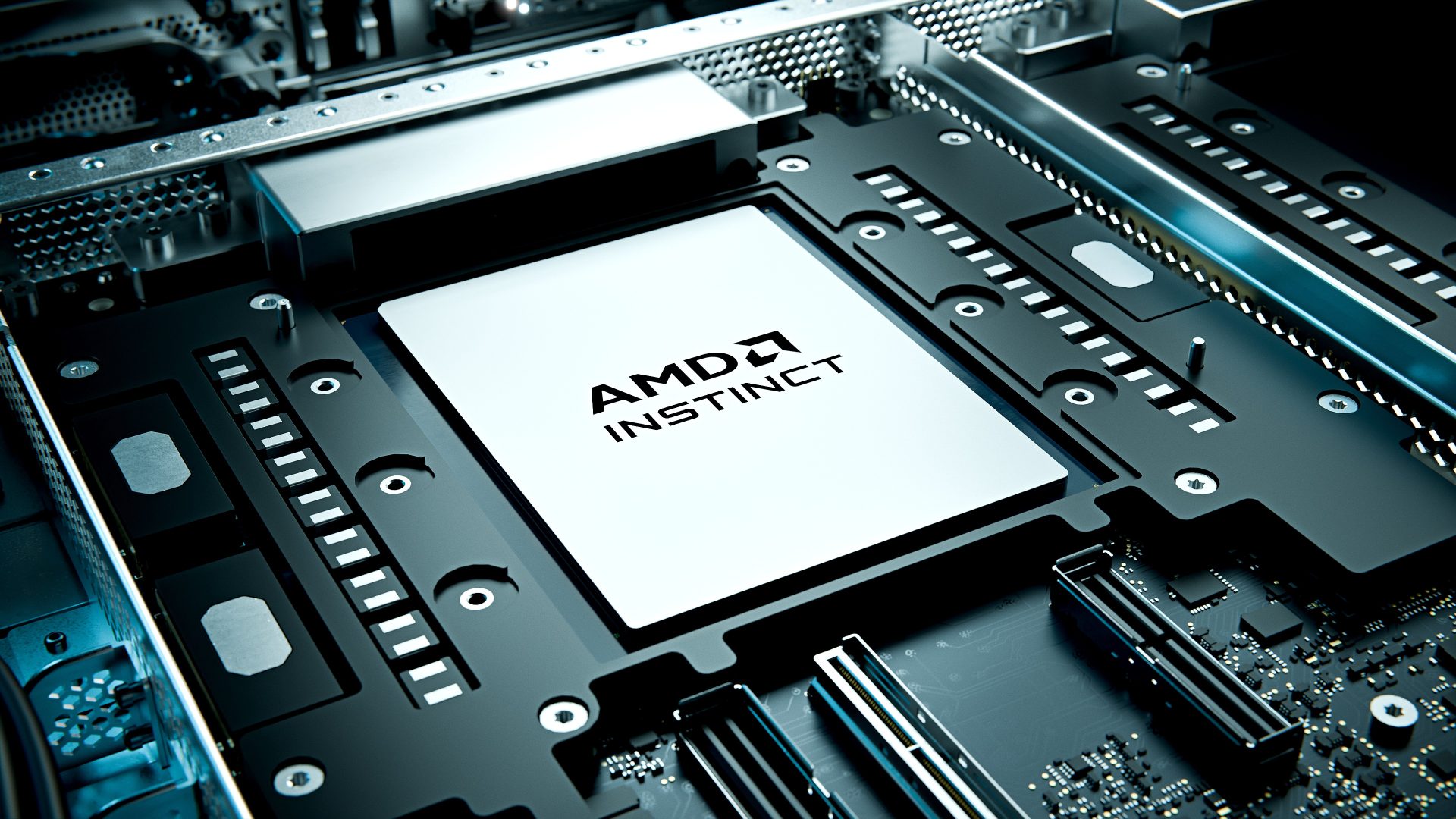
AMD Instinct MI455X pushes AMD’s AI roadmap forward with massive HBM4 memory and over 40 PFLOPs of compute
AMD is preparing a major leap in AI acceleration with the Instinct MI455X, a next-generation GPU designed to power large-scale AI factories, advanced inference systems, frontier model training, and emerging Agentic AI workloads. Built on the CDNA 5 architecture, the Instinct MI455X is positioned as AMD’s direct answer to NVIDIA’s Rubin-class AI accelerator, bringing enormous memory capacity, high compute throughput, and rack-scale deployment capabilities.
At the center of AMD’s new AI strategy is the Instinct MI400 series, led by the MI455X. This accelerator is expected to power AMD’s Helios AI rack solution, a full rack-scale platform aimed at hyperscalers, research institutions, enterprise AI deployments, sovereign AI projects, and high-performance computing environments.
The Instinct MI455X is described as a massive engineering effort, packing around 320 billion transistors. That puts it close to NVIDIA’s Rubin GPU in transistor count, while AMD is emphasizing a different advantage: memory capacity. With up to 432 GB of HBM4 memory, the MI455X is expected to offer far more onboard memory than many competing AI chips, making it highly attractive for large AI models that need more memory to reduce system complexity and improve efficiency.
Compute performance is another major part of the story. The AMD Instinct MI455X is expected to deliver up to 40 PFLOPs of FP4 performance and 20 PFLOPs of FP8 performance. Compared with AMD’s previous MI350 series, that represents a major jump in AI compute capability. These formats are especially important for modern AI workloads, including large language model inference, training, fine-tuning, and high-throughput generative AI services.
AMD’s MI400 lineup is expected to include multiple products. The Instinct MI455X and MI450X are aimed at scaled AI training and inference, while a cost-optimized version with fewer HBM stacks is also planned. The Instinct MI430X, meanwhile, is being tailored for high-performance computing and sovereign AI environments. It is expected to focus on strong FP64 performance, hybrid CPU and GPU computing, and the same HBM4 memory technology used in the MI455X.
Memory is one of the biggest differentiators for the MI455X. AMD is moving from the 288 GB HBM3e configuration used in its MI350 generation to 432 GB of HBM4 on the MI455X, a 50% increase in capacity. Bandwidth also rises dramatically, with HBM4 delivering a major uplift over the 8 TB/s bandwidth of the MI350 series. Depending on the final configuration, AMD’s MI400 platform is expected to reach extremely high memory bandwidth levels, helping AI systems handle larger models and data-heavy workloads more effectively.
Against NVIDIA’s Rubin-class accelerator, AMD is positioning the MI455X as highly competitive in several areas. AMD claims advantages such as 1.5x memory capacity, comparable FP4 and FP8 compute, similar scale-up bandwidth, and stronger scale-out bandwidth. This matters because AI performance is no longer only about raw GPU compute. Modern AI clusters depend heavily on memory capacity, memory bandwidth, interconnect performance, and how efficiently thousands of accelerators can work together.
The Helios AI rack is a major part of AMD’s strategy. Rather than focusing only on individual GPUs, AMD is building a complete rack-scale AI infrastructure platform around the MI455X. This approach is designed for frontier AI deployments where compute, networking, software, memory, and security must work together at massive scale.
Software remains another important pillar. The Instinct MI400 series will run on AMD’s ROCm software stack, which includes programming models, compilers, libraries, runtimes, and deployment tools for AI and HPC workloads. AMD continues to promote ROCm as an open software foundation, aiming to give customers more flexibility and reduce dependence on closed ecosystems. For enterprises and research organizations planning long-term AI infrastructure, software portability and openness can be just as important as hardware performance.
Security is also being built into the platform. AMD says the Instinct MI400 series will include advanced protection features such as secure boot, encrypted GPU-to-GPU links, and hardware-based safeguards for sensitive AI and HPC workloads. These features are especially relevant for government AI systems, national research infrastructure, financial workloads, healthcare AI, and other environments where data protection is critical.
The MI430X adds another angle to the MI400 family. While the MI455X is focused heavily on AI training and inference at scale, the MI430X is designed for workloads that require strong scientific computing performance. With hardware-based FP64 capability and support for hybrid CPU plus GPU computing, it is aimed at HPC centers and sovereign AI projects that need both AI acceleration and traditional simulation performance.
AMD is also setting the stage for a faster product cadence. After the Instinct MI400 series, the company plans to introduce the Instinct MI500 series in 2027. This next-generation family is expected to bring further improvements in compute, memory, and interconnect technology. AMD appears to be moving toward annual AI accelerator updates, similar to the rapid release cycle now shaping the broader AI hardware market.
Based on AMD’s roadmap, the Instinct MI500 series will move to the CDNA 6 architecture and is expected to use next-generation HBM4E memory. While many specifications remain undisclosed, AMD is clearly signaling that it wants to compete aggressively in the AI accelerator market over multiple generations, not just with one flagship chip.
The Instinct MI455X could become one of AMD’s most important data center products yet. Its combination of CDNA 5 architecture, 432 GB HBM4 memory, high FP4 and FP8 throughput, rack-scale deployment, open software support, and advanced security features makes it a serious contender for next-generation AI infrastructure.
As AI models grow larger and more complex, memory capacity and system-level scaling are becoming just as important as raw compute. That is where AMD is trying to make the MI455X stand out. If the final hardware delivers as promised, the Instinct MI400 series could give cloud providers, AI labs, enterprises, and HPC centers a powerful alternative for building large-scale AI systems.