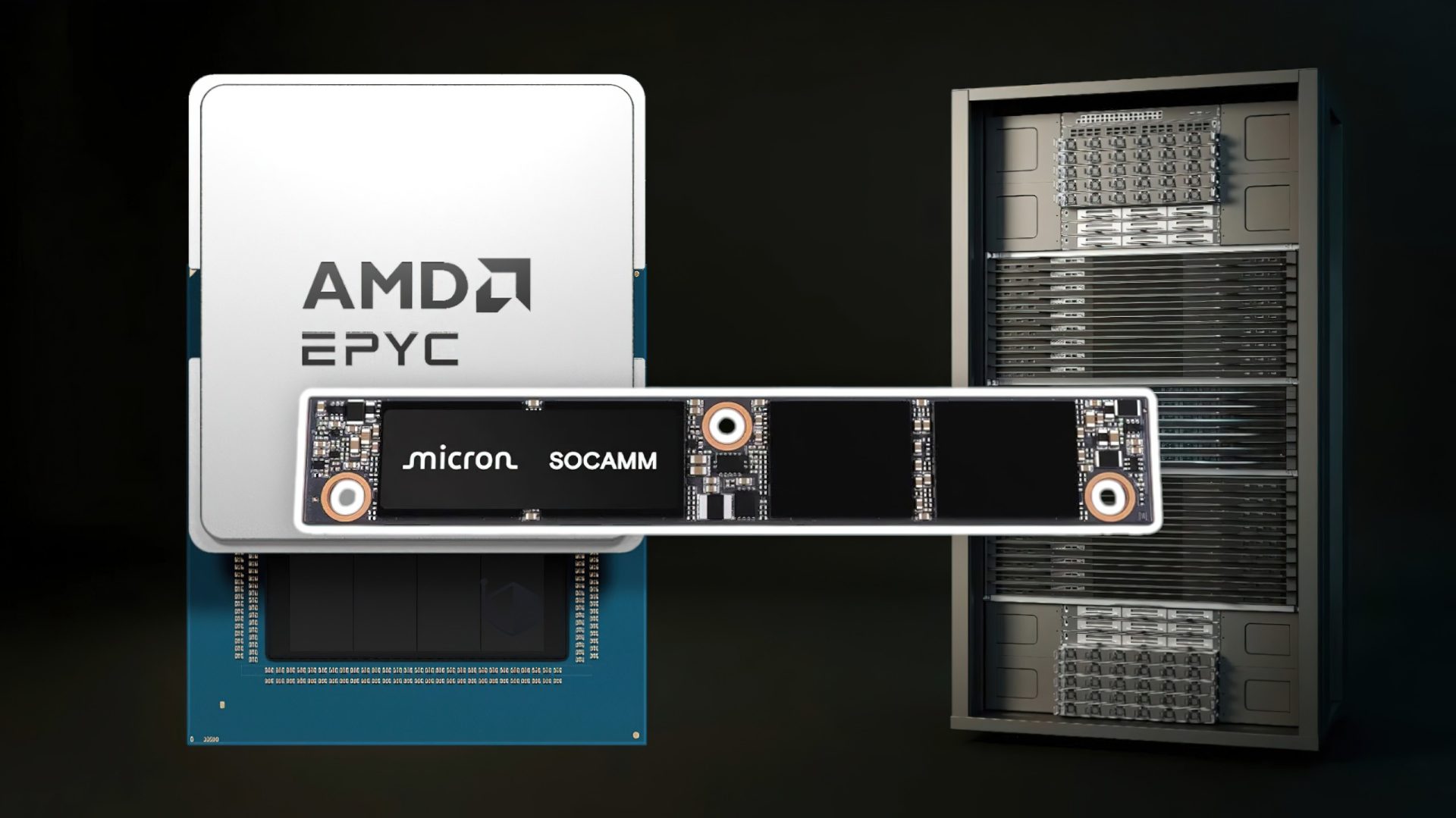
AMD has confirmed a key detail about its next wave of data center hardware: the company’s 6th Gen EPYC “Verano” server CPUs will be the first EPYC chips to support SOCAMM2 memory, a new LPDDR5X-based memory form factor aimed at boosting performance per watt for AI infrastructure.
Verano was previously introduced as AMD’s rack-scale AI-focused EPYC platform designed to pair with next-generation Instinct accelerators, including the MI500 series, and connect through AMD’s Vulcano interconnect. While there was some early speculation that Verano might jump to a newer core generation, AMD has since clarified that Verano remains part of the 6th Gen EPYC family—alongside “Venice,” which is based on Zen 6.
The headline change is memory. Traditional server platforms typically rely on DDR5 RDIMMs, and new high-performance options like MRDIMMs. AMD says the broader 6th Gen EPYC lineup will support those standards, but Verano will also introduce SKUs built around LPDDR5X SOCAMM2. In other words, AMD is adding a power-efficient LPDDR5X path to its server roadmap—without abandoning mainstream DDR5 support.
So what makes SOCAMM2 important? SOCAMM2 (often associated with “small outline” memory modules) is designed to deliver high bandwidth and high capacity in a compact, more power-friendly package than conventional server DIMMs. It’s also designed with serviceability and data center practicality in mind. The modules mount horizontally on the system board, which can improve airflow and simplify cooling designs such as cold plates—an increasingly big deal as AI racks push power and thermal density higher.
Memory makers are already pushing capacity hard on this format. For example, Micron has been shipping 256GB LPDDR5X SOCAMM2 modules to partners building AI infrastructure. High-density deployments are a major part of the appeal: more memory in less space, with lower energy use, is exactly what large-scale AI training and inference systems want.
AMD also put a timeline on this move. EPYC Verano is currently slated for 2027, positioned specifically as the optimized host CPU for future generations of AMD Instinct GPUs in rack-scale AI solutions. The company’s message is clear: pairing Verano with LPDDR5X SOCAMM2 is meant to improve overall performance per system watt, blending bandwidth, efficiency, and maintainability for next-generation data centers.
However, there’s a broader industry ripple here—and it’s not just about AMD. SOCAMM2 and LPDDR5X are gaining traction across the AI hardware landscape. Other upcoming platforms—from multiple vendors—are also leaning into LPDDR-based designs for AI accelerators and inference-optimized solutions. That growing demand matters because the memory supply chain, especially for LPDDR, is already under pressure.
If more of the world’s LPDDR5X production gets pulled into AI racks—where systems can consume enormous amounts of high-density memory—it could tighten availability and pricing elsewhere. LPDDR isn’t only a data center concern; it’s a critical component for smartphones and other compact, power-sensitive devices. A surge in AI-driven LPDDR demand could spill over into consumer tech, affecting everything from mobile hardware planning to broader DRAM market dynamics.
In short, AMD’s confirmation that 6th Gen EPYC Verano will be the first EPYC platform to adopt LPDDR5X SOCAMM2 is more than a spec update. It’s a signal of where server design is headed for AI at scale: denser memory, better efficiency, and data center-friendly packaging—along with a potential new squeeze on an already tight low-power DRAM supply.