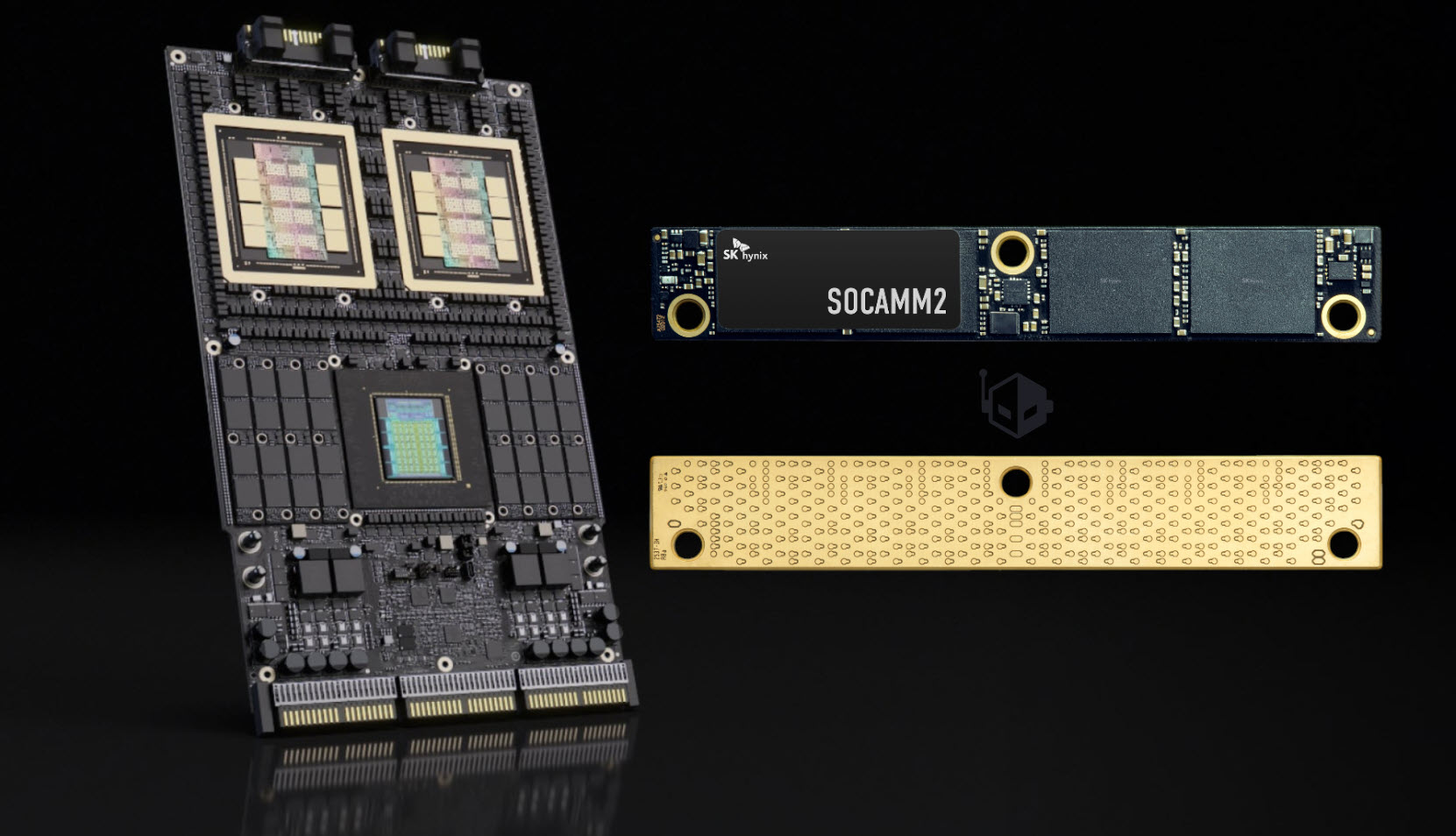
SK Hynix has officially started mass production of its latest AI-focused memory module, SOCAMM2, offering capacities up to 192GB. The company says these next-generation modules are designed to power upcoming NVIDIA AI data center platforms, including systems built around the Vera Rubin era of accelerated computing.
The move comes just a few months after SK Hynix revealed it had already delivered SOCAMM2 as part of its next-gen memory lineup for NVIDIA’s future AI infrastructure. Now, the product is no longer in the early delivery phase—SOCAMM2 is in full-scale production, positioning it to meet the growing demand for high-performance memory in next-generation AI servers.
A key part of this rollout is supply readiness. NVIDIA is expected to source SOCAMM2 from multiple major memory makers, including SK Hynix, Samsung, and Micron, to build a diversified supply chain. That matters as AI data centers scale rapidly and competition intensifies in what many are calling the “agentic AI” phase, where AI systems require more compute and memory resources to train, reason, and act.
According to SK Hynix, the new 192GB SOCAMM2 is built using its 1cnm process, described as the sixth generation of its 10-nanometer-class technology, and it uses LPDDR5X low-power DRAM. The company highlights two headline gains versus conventional RDIMM memory used in many servers today: more than double the bandwidth and over 75% better power efficiency. In practice, this combination targets one of the biggest pain points in modern AI infrastructure—feeding hungry accelerators with enough fast memory bandwidth without blowing up power budgets.
SK Hynix also frames SOCAMM2 as a direct answer to memory bottlenecks that show up during training and inference of massive large language models, including those with hundreds of billions of parameters. When memory can’t keep up, expensive accelerators spend more time waiting than working. By increasing bandwidth and improving efficiency, SOCAMM2 is intended to boost overall system throughput and shorten time-to-train for large-scale models.
Another reason SOCAMM2 is drawing attention is the market shift in AI workloads. While inference has been a major focus, training is increasingly taking center stage again as model sizes grow and new AI capabilities demand deeper learning cycles. SK Hynix believes SOCAMM2 is well-positioned for this shift because it’s built to run large models with lower power consumption—an increasingly critical metric for cloud providers and AI data center operators trying to manage energy costs and rack-level power constraints.
What makes SOCAMM2 different from traditional server memory is its roots in mobile memory technology. SOCAMM2 adapts low-power LPDDR—commonly used in smartphones and other mobile devices—for the server environment. The result is a primary memory solution designed specifically for next-generation AI servers that need both speed and efficiency.
SOCAMM2, short for Small Outline Compression Attached Memory Module 2, is described as an AI server-optimized memory module based on LPDDR. SK Hynix says it offers a slim form factor, high scalability, and a compression-style connector that improves signal integrity while also making module replacement easier—useful in large-scale deployments where serviceability and reliability are essential.
With 192GB modules entering mass production and targeted at upcoming NVIDIA platforms, SOCAMM2 is shaping up to be a major building block for the next wave of AI data centers—especially as providers race to eliminate memory bottlenecks and deliver faster, more power-efficient training at scale.