Uranus has always stood out as one of the solar system’s most mysterious worlds. This massive ice giant isn’t just known for its unusual tilt—its magnetic field is also one of the strangest ever observed. Unlike Earth’s relatively tidy magnetic setup, Uranus’ magnetic field is tilted, off-center, and doesn’t line up cleanly with the planet’s rotation. That odd geometry creates complex effects high above its clouds, and new observations are helping scientists see those effects more clearly than before.
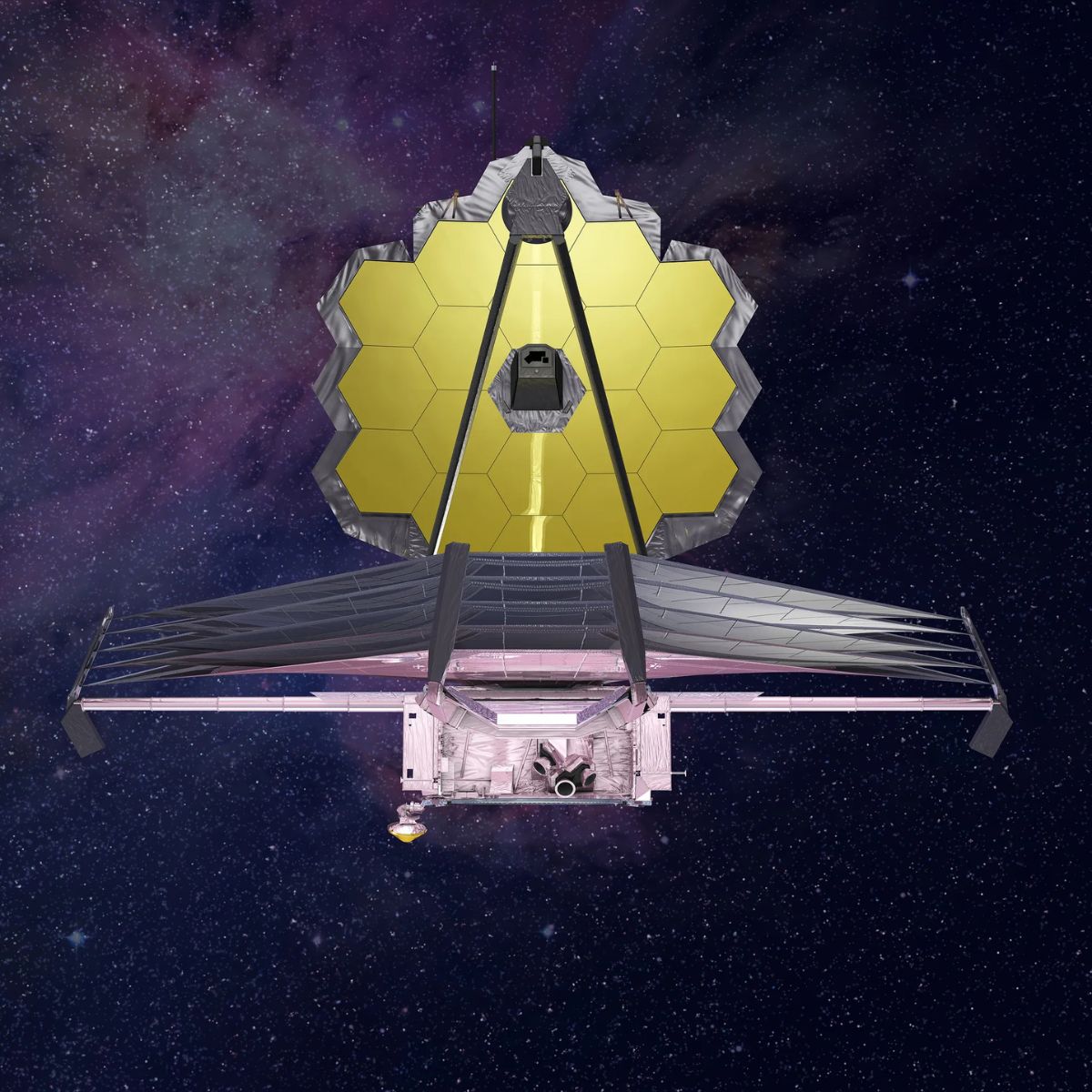
Using the James Webb Space Telescope’s NIRSpec instrument (Near-Infrared Spectrograph), researchers have been able to capture faint infrared glows from Uranus’ upper atmosphere. These emissions come from the ionosphere, a high-altitude region that can extend up to about 5,000 kilometers above the planet’s cloud tops. In this layer, gases become ionized—meaning they carry electric charges—making the ionosphere highly responsive to Uranus’ unusual magnetic field.
One of the most exciting details revealed in the new data is the presence of distinct auroral features. Auroras form when charged particles travel along magnetic field lines and slam into gases in the upper atmosphere, causing them to glow. On Uranus, scientists detected two bright auroral bands near the magnetic poles, along with a darker region where the emission and ion density appeared weaker. Researchers think this dimmer zone may be linked to changes in how charged particles move, possibly where magnetic field lines shift or transition in a way that reduces the energy driving the glow.
Interestingly, similar auroral patterns have been seen on Jupiter, suggesting there may be shared physical processes at work—even across planets with very different environments. By comparing these worlds, scientists can better understand how magnetospheres shape the behavior of upper atmospheres, from particle motion to atmospheric chemistry.
Beyond revealing dramatic space weather on Uranus, the findings are valuable for a much bigger reason: they help explain how magnetic fields influence planetary atmospheres on ice giants. That matters not only for understanding Uranus and Neptune in our own solar system, but also for interpreting distant exoplanets. Many planets discovered around other stars may be similar in size and composition to ice giants, and learning how Uranus works provides an important guide for reading the signals we detect from far-off worlds.


