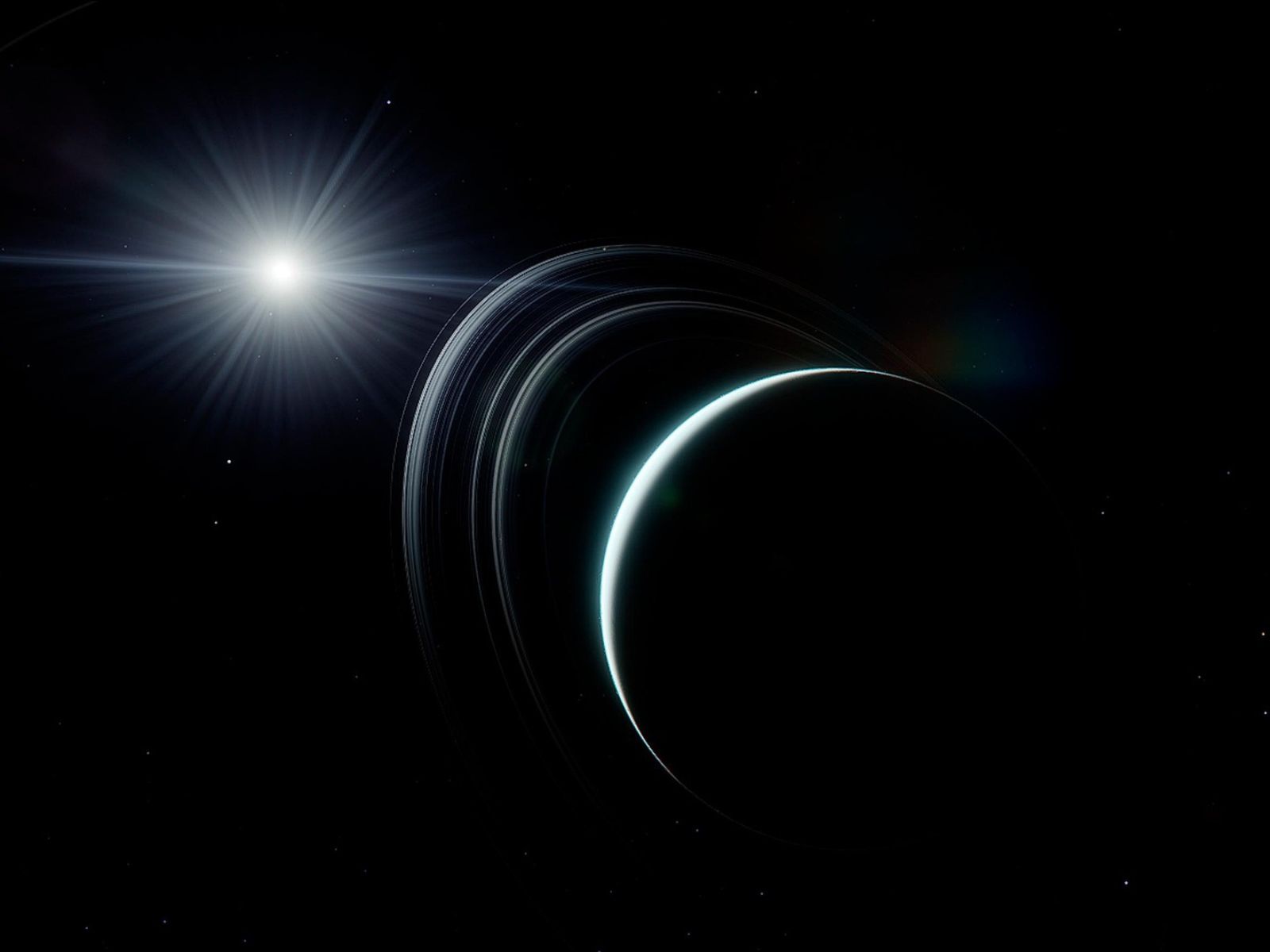
Astronomers are peeling back another layer of mystery around Uranus, thanks to fresh observations from the James Webb Space Telescope and the Hubble Space Telescope, combined with archived data from the Keck Observatory. The new findings suggest something surprisingly complex about the planet’s ring system: Uranus’ two outer rings didn’t form the same way and don’t even appear to be made from the same kind of material.
Uranus has been watched in the night sky for centuries and was officially recognized as a planet in 1781. Yet it continues to puzzle scientists, especially when it comes to its faint and unusual rings, first discovered in 1977. Now, a new study focusing on the outer rings—known as the μ (mu) and ν (nu) rings—argues they have different origins, and their distinct colors are a major clue.
The μ ring appears blue, while the ν ring looks red. That color contrast isn’t just a visual detail; it points to differences in composition. Researchers at the University of California, Berkeley report that the μ ring is dominated by water ice. The ν ring, on the other hand, seems to be largely rocky material containing roughly 10 to 15% carbon—suggesting a more organic-rich mix.
Even more intriguing is what this implies about where the ring material comes from.
Based on the space telescope observations, scientists believe the tiny moon Mab—only about 12 kilometers across—is the primary source of the μ ring. That matters for more than ring science. If Mab is supplying icy particles to the ring, it also strengthens the case that Mab itself is rich in water ice, offering a clearer picture of what this small Uranian moon is made of.
The ν ring tells a different story. Instead of being fed by an obvious moon, the study suggests its material is generated by micrometeorite impacts and collisions involving unseen rocky bodies. These objects are thought to orbit somewhere between some of Uranus’ known moons and may be rich in organic material. One of the biggest questions raised by the research is why the parent bodies feeding these two rings would be so different in composition—icy for the μ ring, but rock-and-carbon heavy for the ν ring.
Taken together, the results highlight how dynamic and varied the Uranus system may be. Rather than being a single, uniform set of rings, Uranus’ outer rings could be shaped by multiple sources, different types of parent bodies, and ongoing collisions that continually refresh the material.
And despite these new insights, Uranus remains one of the least understood planets in our solar system. Each discovery seems to open up new questions—exactly the kind that future observations and dedicated missions could help answer as scientists continue to investigate this distant ice giant and its strange, delicate rings.