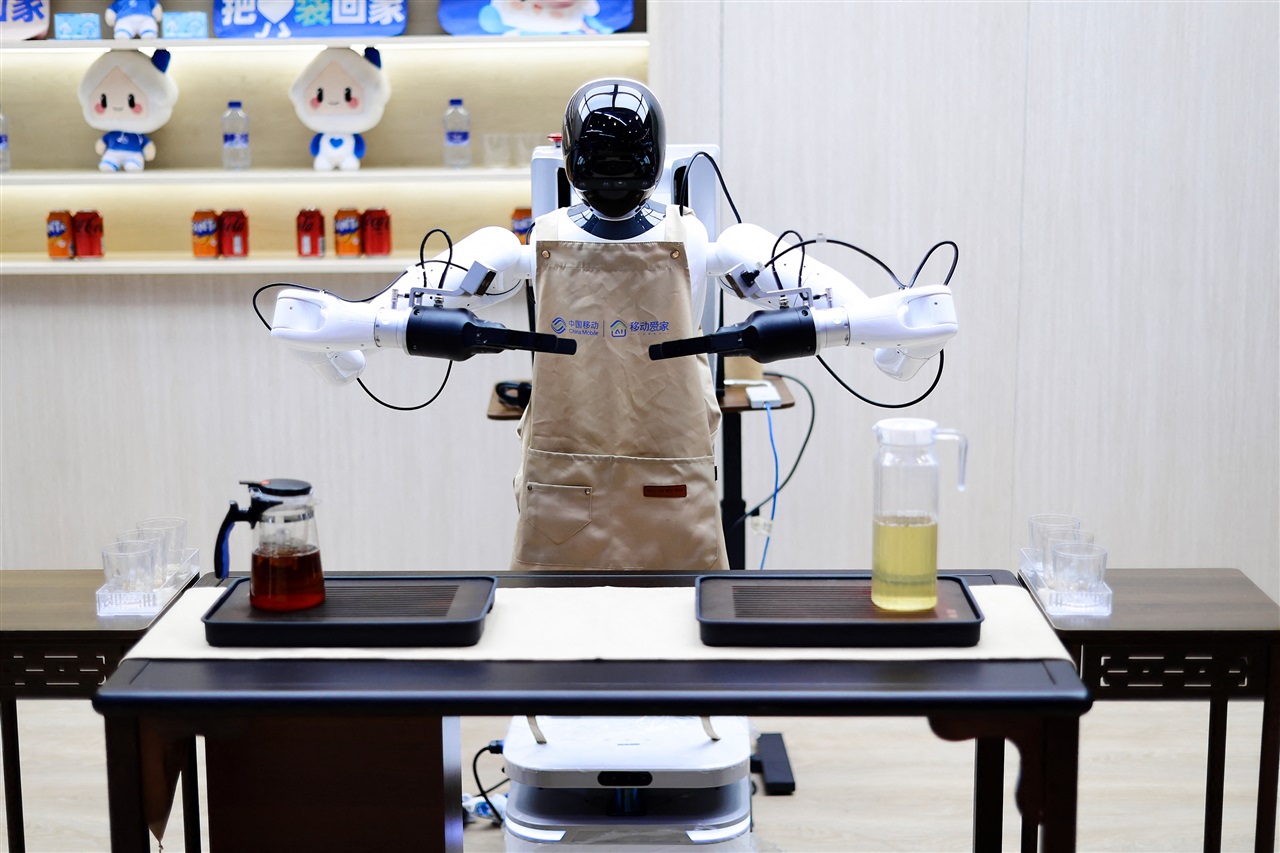
For decades, robots have been masters of repetition and strangers to real reasoning. Put one on an assembly line, and it can perform the same weld, pick, or turn thousands of times with near-perfect accuracy. But change the conditions even slightly—swap an object, shift the layout, introduce an unfamiliar obstacle—and many robots struggle. That weakness isn’t about motors or sensors. It’s about intelligence: the ability to understand what’s happening, make decisions in real time, and adapt to the unexpected.
This limitation has shaped where robots can succeed. They thrive in rigid, tightly controlled environments where every variable is predictable and every task is preplanned. Factories have been the natural home for automation precisely because they can be structured around the robot. The real challenge begins when the environment can’t be controlled—homes, hospitals, warehouses with constantly changing inventory, busy sidewalks, or disaster zones. In these places, the difference between a machine that moves and a machine that thinks becomes impossible to ignore.
That “gap between motion and thought” has been the central problem robotics has wrestled with for years. Engineers have built incredibly capable machines, yet many still rely on painstaking programming and narrowly defined rules. Traditional robots don’t truly understand goals the way humans do; they execute instructions. When reality doesn’t match the script, performance often breaks down.
What’s driving fresh excitement in robotics now is the rise of a new kind of intelligence engine—systems designed not just to repeat actions, but to reason about them. Instead of being locked into a single routine, these smarter models aim to interpret context, evaluate options, and adjust behavior on the fly. It’s an important shift: from robots that simply follow steps to robots that can handle variation, uncertainty, and change.
If this transition continues to accelerate, it could redefine what people expect from robots. The most useful machines won’t be the ones that only excel in perfect conditions—they’ll be the ones that remain reliable when conditions aren’t perfect at all. And that’s exactly where the future of robotics is headed: closing the long-standing gap between a machine’s ability to act and its ability to think.