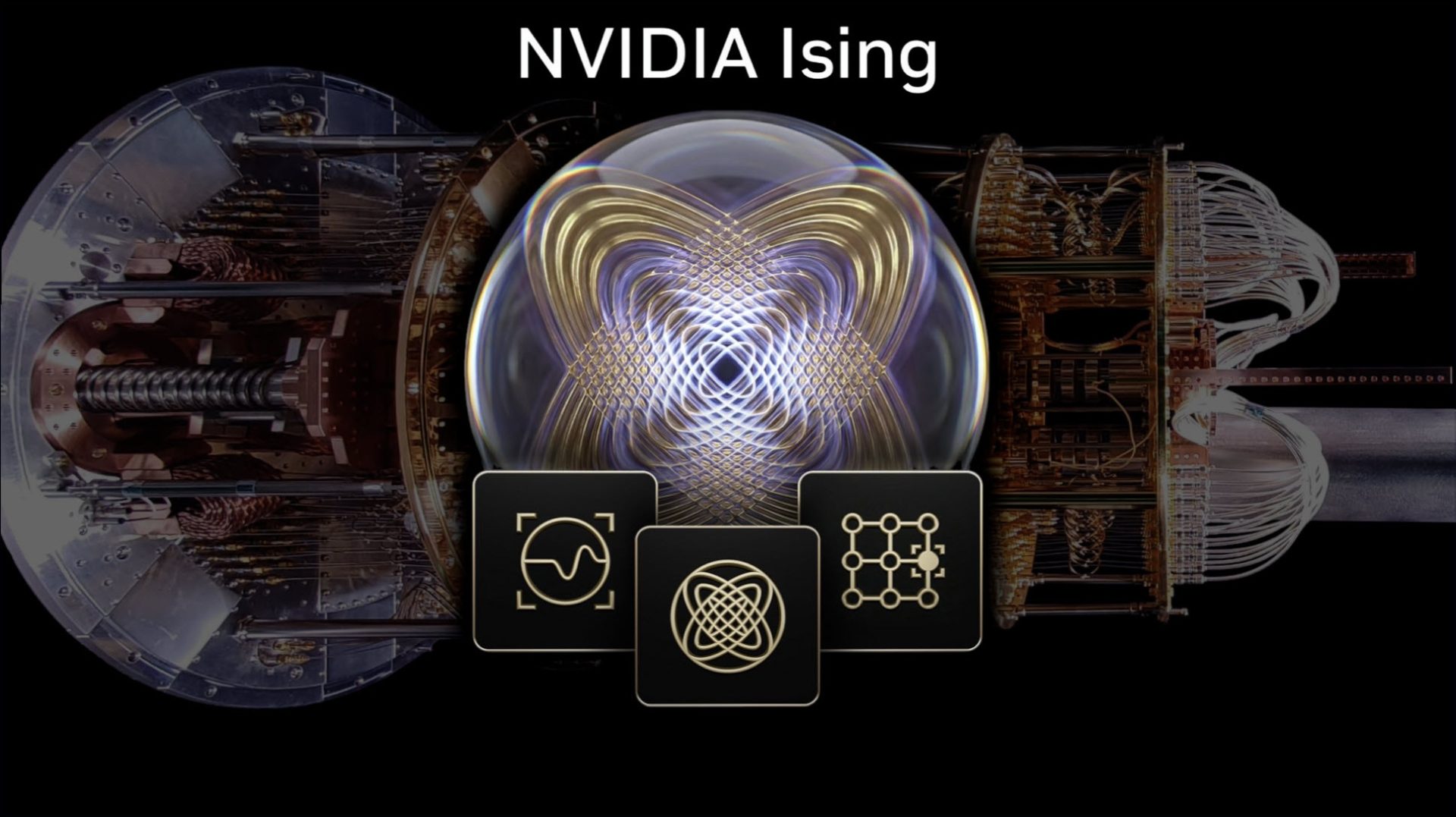
NVIDIA has unveiled Ising, a new family of open-source AI models built to help make quantum computers faster, more reliable, and genuinely useful for real-world workloads. As quantum computing continues to move from theory toward practical adoption, tools that reduce today’s biggest limitations—noise, instability, and constant errors—are becoming as important as the quantum processors themselves.
Quantum computing has long been positioned as the next major leap in computing, and after years of research, the industry is starting to see meaningful breakthroughs. NVIDIA has already been supporting this space with CUDA-Q, its open-source, qubit-agnostic development platform designed to work across different quantum processing units (QPUs) and qubit modalities. Now, with Ising, the company is pushing further by applying AI directly to the toughest problems that hold quantum hardware back.
The core challenge in modern quantum systems is calibration and error correction. Qubits are extremely sensitive, which means quantum processors are “noisy” and prone to frequent mistakes. Right now, errors can appear roughly once every thousand operations. For quantum computers to become broadly practical and capable of large-scale reliable computing, that error rate would need to improve dramatically—down to something closer to one error in a trillion operations. NVIDIA’s stance is clear: AI is essential to closing this gap.
Ising launches with two customizable, state-of-the-art models designed for the two biggest bottlenecks in the quantum pipeline:
Ising Calibration is a vision-language model that can quickly interpret measurement data coming from quantum processors and respond to it. The goal is to enable AI agents that can automate continuous calibration. That matters because calibration has traditionally been slow and labor-intensive; NVIDIA says this approach can cut calibration time from days down to hours.
Ising Decoding targets quantum error correction using two variants of a 3D convolutional neural network, with one tuned for speed and another optimized for accuracy. These models are built for real-time decoding—the step that helps identify and correct errors as computations run. NVIDIA claims Ising Decoding can deliver up to 2.5x faster decoding performance and up to 3x higher accuracy compared to pyMatching, a widely used open-source standard for decoding in quantum error correction workflows.
NVIDIA also highlights efficiency advantages. Ising Calibration is said to be 15x smaller than alternative approaches, while Ising Decoding reportedly needs 10x less training data—two improvements that could make it easier for labs and organizations to deploy these models without needing massive resources or extended training cycles.
According to NVIDIA, Ising is already being used by researchers, academic institutions, and enterprises working at the forefront of quantum computing. While quantum computers still have major hurdles to overcome, Ising signals a growing trend: pairing advanced AI with quantum hardware to accelerate progress toward stable, scalable, and application-ready quantum systems.